

The Current Challenges Facing the Chiropractic and Spine Clinic Market
Across global healthcare systems, Chiropractic and Spine Clinic practices are under increasing operational pressure. While public awareness of spinal health continues to rise, many clinics struggle to convert interest into sustainable growth. The core issues are not a lack of demand, but structural limitations within traditional service models.
First, service homogenization has become widespread. Many Chiropractic and Spine Clinic providers rely on similar manual assessment techniques, similar adjustment protocols, and similar consultation flows. From a patient's perspective, it is increasingly difficult to understand how one clinic differs meaningfully from another.
Second, clinical judgment is highly dependent on individual practitioners. Diagnosis and treatment planning often rely heavily on the experience and subjective interpretation of chiropractors or therapists. When key practitioners leave, clinics face immediate operational risk, service inconsistency, and declining patient trust. This dependence reduces scalability and resilience.
Third, screening efficiency remains low. Traditional posture checks, palpation, and visual observation require time and professional availability. As patient volumes grow, clinics struggle to provide fast, standardized spinal assessments without compromising accuracy or experience.
Finally, monetization remains weak. Many Spine Clinic businesses focus primarily on single-session treatments, with limited upselling into corrective devices, long-term programs, or preventive services. Without objective assessment data, it is difficult to justify extended treatment plans or personalized products in a way patients fully understand and accept.
These challenges define today's Chiropractic and Spine Clinic landscape: high competition, limited differentiation, slow screening, and low conversion efficiency.
Why Visualized Spinal Health Assessment Matters
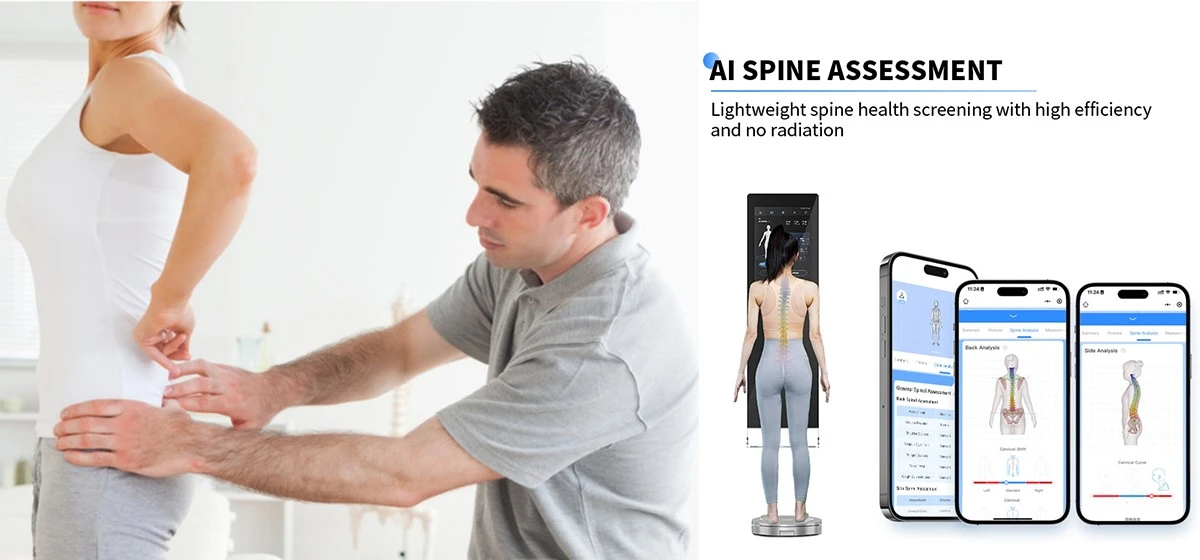
One of the most critical gaps in traditional Chiropractic and Spine Clinic services is the lack of visual feedback.
Patients are often told they have postural imbalance, spinal deviation, pelvic tilt, or functional leg length discrepancy. However, without clear visualization, these explanations remain abstract. Patients must rely on trust rather than understanding.
Visualized spinal health assessment changes this dynamic entirely.
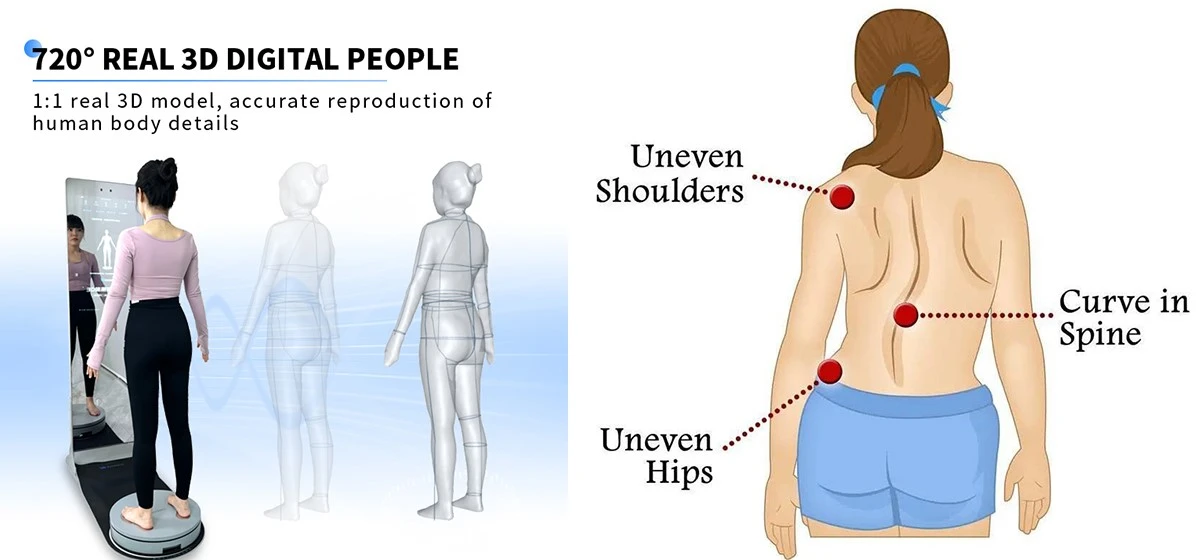
When patients can see their own posture, spinal alignment, and asymmetries through a precise 3D body model, spinal health becomes tangible. Data replaces assumption. Understanding replaces doubt. This visual clarity significantly improves patient engagement, acceptance of recommendations, and long-term compliance.
For Chiropractic and Spine Clinic operators, visualization creates a shared language between practitioner and patient-reducing reliance on persuasion and increasing reliance on evidence.
How Xianku 3D Body Scanner Enables AI-Driven Spinal Health Visualization
Xianku 3D Body Scanner is designed to address the structural pain points of modern Chiropractic and Spine Clinic operations through AI-powered spinal health assessment and visualization.
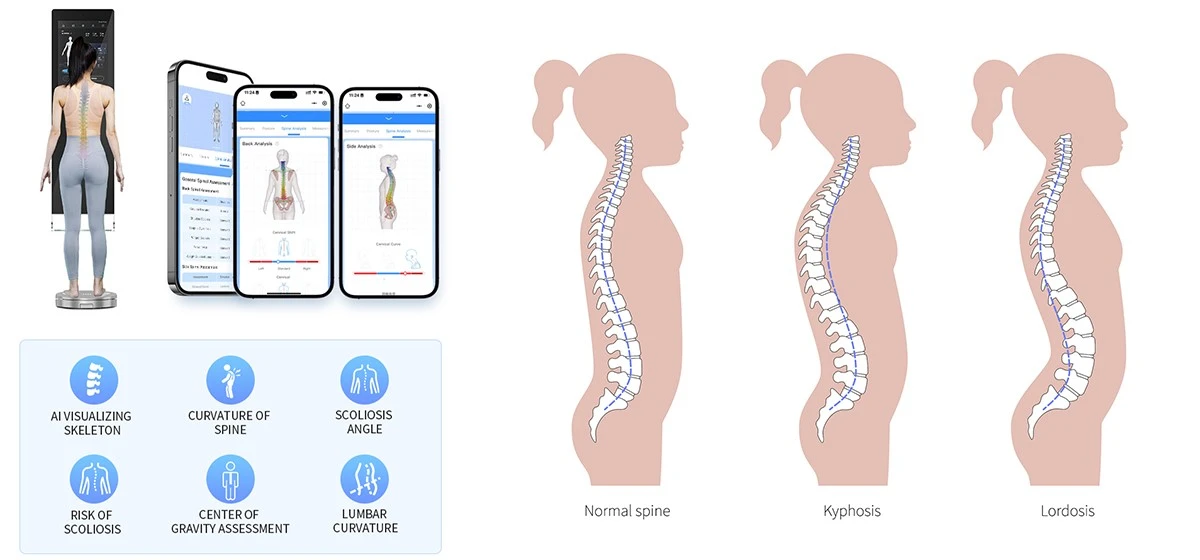
Using high-precision 3D structured-light scanning, the system captures the full body in seconds and evaluates over 128 posture and spinal data points, including spinal curvature, pelvic alignment, shoulder balance, and body symmetry.
Within a short scan, the system generates:
- A realistic 3D human body model
- An AI-analyzed spinal model
- A comprehensive visual report combining posture data, spinal risk indicators, and body metrics
This transforms spinal assessment from a subjective process into a standardized, visualized, and data-driven workflow suitable for any professional Chiropractic or Spine Clinic setting.
From Manual Judgment to Standardized, Visual Assessment
Traditional Chiropractic evaluation relies on practitioner expertise. While valuable, this approach lacks consistency and scalability.
Xianku enables Chiropractic and Spine Clinic teams to:
- Standardize initial spinal screenings
- Reduce variability between practitioners
- Provide objective baselines before treatment begins
Patients no longer depend solely on verbal explanations. Instead, they observe their own spinal deviations and postural imbalances directly, increasing confidence in the assessment process.
Building a Closed-Loop Service and Conversion Flow
Xianku supports a structured service SOP tailored for Chiropractic and Spine Clinic operations:
Body Scan → Data Analysis → Spinal Health Assessment → AI-Based Recommendation → Service or Product Conversion
This closed-loop process integrates health education and business outcomes seamlessly.
Examples of Personalized AI-Driven Recommendations:
- Spinal orthotic supports for scoliosis risk
- Corrective insoles for functional leg length discrepancy
- Cervical support pillows for forward head posture
- Exercise or rehabilitation plans for X/O-shaped leg alignment
Clinics can define recommendation logic based on clinical standards, ensuring consistency while maintaining flexibility
The Importance of Visualization in Increasing Monetization
Visual spinal assessment significantly improves conversion rates in Chiropractic and Spine Clinic environments.
When patients see:
- Their spinal curvature
- Pelvic tilt angles
- Posture deviations
They are more likely to:
- Accept extended treatment plans
- Invest in corrective devices
- Commit to follow-up programs
Visualization transforms services from perceived costs into measurable health investments.
Tracking Change: Making Results Visible Over Time
Another major limitation in traditional Chiropractic care is the inability to clearly demonstrate progress.
Xianku allows patients to:
- Perform repeated scans
- Compare before-and-after 3D body and spinal models
- Visually confirm improvements or remaining risks
For Spine Clinic operators, this feature strengthens retention, reinforces treatment value, and provides clear proof of service effectiveness.
Data Accumulation and Long-Term Clinic Value
As scans accumulate, Chiropractic and Spine Clinic businesses gain access to structured datasets that support:
- Service optimization
- Product selection
- Inventory planning
- Evidence-based innovation
Data transforms clinics from labor-dependent operations into knowledge-driven health service providers.
Patient Acquisition and Trust Building
Xianku's fast, safe, non-invasive scanning enables clinics to offer:
- Free spinal screening campaigns
- Community health events
- Preventive posture checks
These initiatives lower the entry barrier for new patients while establishing trust through professional assessment rather than sales-driven messaging.
CRM Integration and Private Patient Management
Each scan automatically creates a patient profile within the Xianku CRM system. Chiropractic and Spine Clinic operators can:
- Track patient history
- Review past assessments
- Follow up with personalized communication
- Re-engage patients for ongoing care
This transforms spinal health services into a long-term relationship model rather than one-time treatment.
Comparison: Traditional Assessment vs Visualized AI Assessment
| Aspect | Traditional Chiropractic Assessment | Xianku Visualized Assessment |
|---|---|---|
| Objectivity | Practitioner-dependent | Data-driven & standardized |
| Patient Understanding | Limited | High (3D visualization) |
| Conversion Efficiency | Low to medium | Significantly higher |
| Progress Tracking | Subjective | Visual before-after comparison |
| Scalability | Limited | High |
Conclusion: A New Standard for Chiropractic and Spine Clinic Services
The future of Chiropractic and Spine Clinic care lies in visualization, data, and standardization.
Xianku 3D Body Scanner enables clinics to move beyond subjective judgment, slow screening, and low monetization. By integrating AI-driven spinal health assessment and visualized reporting, clinics can build trust, improve patient outcomes, and create sustainable business growth.
In an increasingly competitive Chiropractic and Spine Clinic market, visibility is not just a feature-it is a foundation for credibility, efficiency, and long-term success.
