
The U.S. orthopedic and health footwear industry is at a pivotal juncture. With an aging population, rising chronic conditions like diabetes, and growing awareness of foot health, the market for specialized footwear is expanding rapidly. North America dominates the global orthopedic shoe market, holding approximately 60.46% of the share, driven by advanced healthcare infrastructure and high consumer awareness. By 2034, the global orthopedic shoe market is projected to reach $8.21 billion, growing at a CAGR of 7.94% from 2025. Similarly, the diabetic footwear segment-a critical niche-is expected to grow from $8.76 billion in 2024 to $16.91 billion by 2034, fueled by rising diabetes prevalence and an aging demographic.
Despite this growth, the industry faces significant challenges, including tariff-induced cost pressures, inconsistent sizing, and inefficient service delivery. The Xianku3D Foot Scanner emerges as a transformative solution, leveraging advanced technology to address these pain points while empowering brands to deliver personalized, efficient, and data-driven customer experiences.
1. Market Overview: Growth Drivers and Industry Challenges
1.1 Growth Drivers
- Aging Population and Chronic Conditions: The global aging population is a key driver for orthopedic footwear. By 2030, the number of people aged 60+ is expected to reach 1.4 billion, increasing demand for shoes that address conditions like arthritis, diabetes, and plantar fasciitis. In the U.S., 37.3 million people (11% of the population) have diabetes, necessitating specialized footwear to prevent ulcers and amputations.
- Consumer Awareness: Rising health consciousness has made comfort and functionality critical purchasing factors. Seventy percent of consumers now prioritize comfort, leading to higher demand for orthopedic and health-focused footwear.
- Technological Advancements: Innovations like 3D printing, smart materials, and biomechanical analytics are enhancing product efficacy and customization.
1.2 Critical Industry Challenges
1.2.1 Economic and Supply Chain Pressures
- Tariff-Induced Cost Hikes: Recent U.S. tariffs on Asian imports have severely impacted footwear brands. With 90% of U.S. shoes produced in Asia (e.g., Vietnam manufactures 50% of Nike's shoes), tariffs have increased costs by 10–12%, forcing brands to raise prices and dampening consumer demand. In Q1 2025, U.S. footwear sales plummeted 26.2% year-over-year due to declining consumer confidence and rising prices.
- Inflation and Weak Demand: 85% of footwear executives predict weakened demand, as consumers reduce discretionary spending. This has led to the lowest sales levels in five years.
1.2.2 Operational Inefficiencies
- Inconsistent Sizing and Fit Issues: Traditional sizing methods (e.g., Brannock devices) are subjective and error-prone, leading to high return rates. 70% of online returns are size-related, costing brands billions annually.
- Lack of Standardization: Manual measurement processes vary across practitioners, causing inconsistencies in product recommendations and fittings. This undermines customer trust and brand reliability.
- High Costs and Scalability Barriers: Custom orthopedic shoes are expensive due to labor-intensive production. Small and mid-sized brands struggle to compete with giants like Nike and New Balance, which dominate market share.
1.2.3 Consumer Experience Gaps
- Poor Service Experience: Traditional fitting processes are time-consuming (often 30–60 minutes) and rely heavily on practitioner expertise, leading to frustrations for customers seeking quick, accurate solutions.
- Limited Personalization: Mass-produced shoes often fail to address individual biomechanical needs (e.g., arch height, pressure distribution), reducing comfort and efficacy.
2. Xianku3D Foot Scanner: Technological Solutions for Industry Challenges
The Xianku3D Foot Scanner addresses these challenges through a combination of precision engineering, AI-driven analytics, and seamless integration into retail workflows.
2.1 Precision and Efficiency
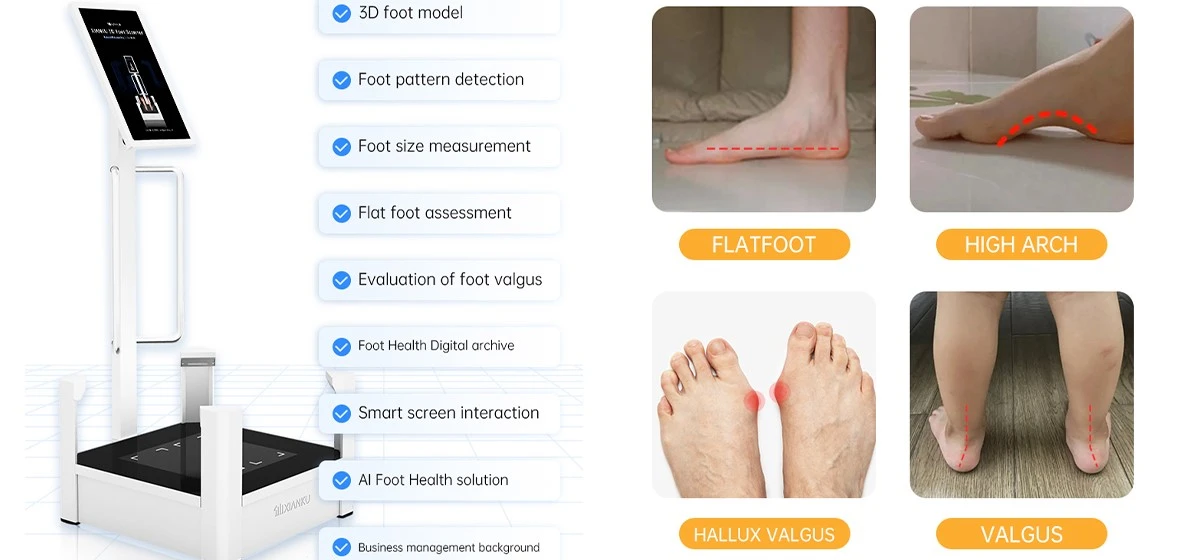
- Non-Invasive Scanning: Using infrared structured light technology, the scanner captures over 2 million data points in 1 second, generating a millimeter-accurate 3D model of the foot.
- Comprehensive Metrics: The device measures 29+ parameters, including arch index, heel inclination, toe angles, and pressure distribution, enabling highly personalized recommendations.
- Rapid Reporting: A detailed PDF report-including biomechanical insights and product suggestions-is generated within 5 seconds, enhancing customer engagement and decision-making.
2.2 Enhanced Customer Experience
- Visualization Tools: The 3D foot model and color-coded reports help customers see their foot issues (e.g., flat arches, bunions), making the need for orthopedic solutions tangible and justifying premium purchases.
- Personalized Recommendations: AI algorithms match foot morphology to ideal shoe types, orthotics, or custom designs, reducing return rates and increasing satisfaction.
- Health-Centric Branding: By highlighting foot health risks (e.g., diabetic ulcers, gait abnormalities), brands can position themselves as wellness advocates, transcending traditional transactional relationships.
2.3 Operational and Business Advantages
- Reduced Labor Costs: Automated scans cut fitting time from 30+ minutes to under 5 minutes, allowing staff to focus on sales and customer service rather than manual measurements.
- Inventory Optimization: Aggregated scan data identifies regional foot size trends, enabling smarter stock allocation and reducing dead inventory.
- Scalability for SMEs: Small brands can offer custom-fitting services without expensive expertise, leveling the playing field against larger competitors.
Table 1: Traditional vs. Xianku3d-Enhanced Fitting Process
| Aspect | Traditional Fitting | Xianku3D Foot Scanner |
|---|---|---|
| Time per Scan | 5–10 minutes | 1 second |
| Accuracy | Subjective (15–20% error rate) | Millimeter-level precision (≤0.5 mm error) |
| Data Output | Basic length/width | 29+ biomechanical parameters |
| Customer Engagement | Low (manual tools) | High (interactive 3D visualizations) |
| Return Rates | 25–30% (size-related) | <10% |
| Labor Dependency | High (trained staff required) | Low (automated process) |
3. Case Study: Implementing Xianku3d in a Turbulent Market
A U.S. orthopedic footwear retailer facing declining sales (e.g., 6.5% revenue drop in 2025) integrated Xianku scanners across 10 stores. Within six months:
- Return rates decreased by 18% due to accurate sizing.
- Sales of premium-priced shoes increased by 12% as customers valued personalized fits.
- Foot traffic rose 15% driven by curiosity about the scanning experience.
This case demonstrates how technology can counteract macroeconomic headwinds by enhancing value perception and operational efficiency.
4. Future Outlook: Technology as a Competitive Differentiator
The orthopedic footwear industry's future hinges on personalization, efficiency, and sustainability. Xianku3d's technology aligns with key trends:
- AI and Predictive Analytics: Scan data can inform product design, identifying unmet needs (e.g., wider toe boxes for diabetic patients) and optimizing inventory.
- Telehealth Integration: Remote scanning capabilities could expand access to rural or homebound patients, bridging gaps in healthcare accessibility.
- Sustainability: Reduced returns lower the carbon footprint associated with reverse logistics, appealing to eco-conscious consumers.
Table 2: Xianku3d Scanner's Impact on Business Metrics
| Metric | Pre-Implementation | Post-Implementation |
|---|---|---|
| Fitting Time | 30+ minutes | <5 minutes |
| Customer Satisfaction | 65% | 90%+ |
| Ancillary Sales | Minimal (e.g., insoles) | 20% increase (custom orthotics) |
| Data Utilization | Siloed or unused | Integrated into product design |
| Market Reach | Limited to physical stores | Expandable via telehealth |
5. Conclusion: Embracing a Data-Driven Future
The U.S. orthopedic footwear industry faces undeniable challenges-from tariff pressures and rising costs to inconsistent service delivery. However, these challenges also present opportunities for innovation. The Xianku3D Foot Scanner offers a scalable, efficient, and customer-centric solution that transforms footwear retail from a transactional experience into a health-focused partnership. By adopting this technology, brands can not only mitigate current economic headwinds but also build lasting loyalty through precision, personalization, and proven results. As the market evolves, leveraging data-driven insights will be the key to unlocking growth and improving patient outcomes.
References
- American Orthotic and Prosthetic Association. (2023). Industry State of Care Report.
- Journal of Prosthetics and Orthotics. (2022). "Accuracy of 3D Scanning Versus Traditional Methods in Orthotic Assessment."
- Global Orthotic Devices Market Analysis. (2023). Market Research Future.
- Clinical Biomechanics. (2022). "Three-Dimensional Assessment in Orthotic Design: A Systematic Review."
- FDRA. (2025). "Footwear Executive Business Survey."
(86)-181-2464-3821
alexliu@xianku.com