
Introduction
The global spinal orthotics market is experiencing steady growth, fueled by rising prevalence of spinal disorders, an aging population, and advancements in medical technology. However, the industry faces significant challenges in delivering personalized, efficient, and clinically effective solutions. Traditional methods relying on subjective assessments and outdated processes often lead to suboptimal patient outcomes and operational inefficiencies. This article explores the current landscape of the spinal orthotics sector, its key challenges, and how innovative technologies like the Xianku3d body scanner are poised to revolutionize care delivery through data-driven customization and enhanced patient engagement.
1. Market Overview: Growth and Key Drivers
The spinal orthotics market is part of the broader orthotics and prosthetics industry, which includes products like knee braces, ankle supports, and spinal orthoses. The global market for 3D printed spinal orthotics was valued at USD 1 billion in 2025 and is projected to reach RMB 9.8 billion by 2032, growing at a CAGR of 4.58%. This growth is driven by:
- Aging Populations: Increased incidence of degenerative spinal conditions.
- Technological Advancements: Adoption of 3D printing and digital scanning.
- Rising Awareness: Demand for non-invasive treatment options.
The market is segmented by product type, including:
- TLSO (Thoracic-Lumbar-Sacral Orthotics)
- LSO (Lumbar-Sacral Orthotics)
- CO (Cervical Orthotics)
Key players such as Ottobock, DeRoyal Industries, and DJО Global dominate the industry, leveraging extensive distribution networks and clinical partnerships. However, emerging digital technologies are reshaping competitive dynamics, enabling smaller players to innovate in customization and patient-specific solutions.
Table 1: Global Spinal Orthotics Market Overview (2025–2032)
| Category | 2025 Market Size | 2032 Projection | CAGR |
|---|---|---|---|
| 3D Printed Spinal Orthotics | USD 1 billion | USD 1.5 billion | 4.58% |
| Key Product Segments | TLSO, LSO, CO | TLSO dominating market share | - |
| Major Regions | North America, Europe, Asia-Pacific | Asia-Pacific fastest-growing | - |
| Leading Applications | Functional recovery, deformity correction | Expanding into sports medicine | - |
2. Critical Challenges in the Spinal Orthotics Industry
2.1 Non-Intuitive Measurement and Assessment
Current spinal health assessments primarily rely on X-rays and physician expertise, which lack real-time data and patient engagement. For example, X-rays expose patients to radiation and provide static, 2D images that fail to capture dynamic spinal alignment or soft tissue interactions. This leads to assessments that are neither interactive nor easily understandable for patients, reducing their involvement in treatment planning.
2.2 Inaccurate Customization and Fit
Traditional customization depends on manual measurements or plaster casting, which often results in ill-fitting orthoses. A poorly fitted spinal brace can cause discomfort, skin irritation, and non-compliance, undermining therapeutic goals. The absence of precise body parameter data limits the ability to design orthoses that adapt to individual anatomical variations, such as spinal curvature or torso asymmetry.
2.3 Poor Patient Experience and Engagement
Clinics often struggle to convey the value of orthotic devices, leading to mismatched patient expectations. Without immersive experiences, patients may perceive orthoses as bulky, uncomfortable, or ineffective, reducing adherence to treatment plans. The lack of interactive tools also hinders clinicians from demonstrating product benefits effectively.
2.4 Inefficient Sales and Operational Workflows
The industry heavily depends on clinician expertise for diagnostics, fitting, and sales, creating bottlenecks in scaling operations. New brands face high entry barriers due to reliance on skilled professionals, costly marketing, and lengthy training cycles. This dependency slows down expansion and limits consistency in service quality across multiple locations.
2.5 Ineffective Client Management
Many practices lack digital client profiling, making it difficult to track patient progress, schedule follow-ups, or implement targeted marketing. Without centralized data management, clinics miss opportunities for patient retention and repeat business.
2.6 Low Interactivity and Understanding
X-rays and MRI scans, while clinically valuable, are often incomprehensible to patients. This gap in communication can lead to anxiety, mistrust, and poor decision-making. Clinics rarely use visual aids or dynamic models to explain conditions or treatment rationale, resulting in disconnected patient-clinician interactions.
3. Xianku3d Body Scanner: A Paradigm Shift in Spinal Orthotics
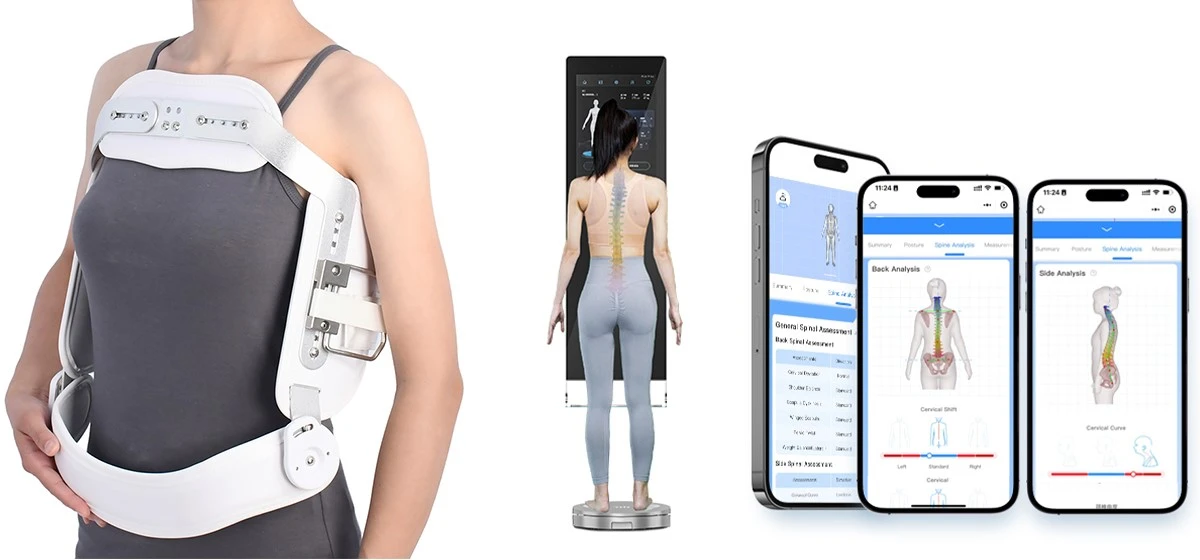
The Xianku3d body scanner leverages advanced 3D structured light technology and AI to address these challenges comprehensively. It captures high-resolution body data within 20 seconds, generating a precise 3D avatar and over 128 body measurements, including spinal alignment metrics. Below, we explore its transformative applications:
3.1 Intuitive and Precise Measurement
The scanner enables non-invasive, radiation-free spinal assessments, creating detailed 3D models of the spine and torso. Patients can visually explore their spinal alignment on interactive screens, fostering transparency and engagement. For example, the AI-generated spine report highlights asymmetries, curvature deviations, and postural issues in an easily digestible format.
3.2 Enhanced Customization Accuracy
By providing millimeter-accurate body dimensions, the scanner facilitates the design of tailor-made orthoses. For instance, 3D-printed TLSO braces can be customized to match unique patient contours, improving comfort and biomechanical efficacy. This data-driven approach reduces adjustments and remakes, saving time and resources.
3.3 Immersive Patient Experience
The scanning process itself becomes an educational tool. Patients receive a digital twin of their body, allowing them to visualize their condition and the proposed solution. This shifts the perception of orthoses from generic devices to personalized health investments, increasing satisfaction and adherence.
3.4 Streamlined Clinical Workflows
The scanner integrates with clinic SOPs, reducing reliance on individual clinician expertise. Staff can operate the device with minimal training, using automated reports to recommend products. This scalability supports faster franchise expansion and consistent service delivery.
3.5 Data-Driven Client Management
Xianku's platform creates digital patient profiles, storing scan histories, treatment plans, and outcomes. Clinics can use this data for reminders, progress tracking, and personalized marketing campaigns, enhancing long-term patient relationships.
3.6 Interactive Visualization
The 3D models and augmented reality (AR) features allow patients to "try on" virtual orthoses, understanding their fit and function before production. This interactive demystifies complex medical information, building trust and reducing decision anxiety.
Table 2: Xianku3d Body Scanner Features vs. Traditional Methods
| Aspect | Traditional Methods
|--------------------------|----------------------------------|--------------------------------------|
| Measurement | X-rays/manual measurements; 2D, static
| Customization | Based on approximations; prone to errors
| Patient Engagement | Limited visual aids; reliance on verbal explanations
| Workflow Efficiency | High dependency on expert clinicians; slow scaling
| Data Management | Paper-based or disjointed digital records
| Interactivity | Technical reports; minimal patient involvement
4. Case Studies: Success Stories in Orthotics Innovation
4.1 Ottobock: Precision Through Digitalization
Ottobock, a global leader in orthotics, has integrated 3D scanning into its custom spinal brace solutions. By adopting similar technologies, they reduced production time by 30% and improved patient compliance through better-fitting devices.
4.2 DJO Global: Enhancing Clinical Efficiency
DJO Global uses scanning technologies to streamline brace fittings in orthopedic clinics. Their SaaS-enabled platforms allow clinicians to upload patient scans directly to manufacturing facilities, cutting down turnaround time.
4.3 Bauerfeind: Personalizing Patient Care
Bauerfeind's adoption of 3D scanning for its Spirolight and LumboTrain braces enabled precise sizing and customization. This resulted in a 25% increase in patient satisfaction and reduced return rates.
4.4 Zimmer Biomet: Advancing Spinal Solutions
Zimmer Biomet's FDA-approved Tether-vertebral system for scoliosis exemplifies innovation in spinal correction. While surgical, its success highlights the industry's shift toward personalized, minimally invasive solutions-a philosophy extendable to orthotics via 3D scanning.
4.5 DeRoyal Industries: Scaling Operations
DeRoyal incorporated digital scanning into its LSO and TLSO production, enabling rapid customization for hospitals and clinics. This reduced dependency on in-person consultations and expanded their market reach.
5. The Road Ahead: Trends and Strategic Recommendations
The spinal orthotics industry is evolving toward digitalization, personalization, and patient-centric care. Key trends include:
- AI-Driven Design: Automated orthotic modeling based on scan data.
- Tele-rehabilitation: Remote monitoring using scan data and IoT sensors.
- Sustainable Production: 3D printing reduces material waste.
To capitalize on these trends, industry stakeholders should:
- Invest in Digital Infrastructure: Adopt 3D scanning and cloud-based platforms.
- Train Clinicians in Digital Tools: Bridge the skills gap for technology adoption.
- Collaborate with Tech Providers: Partner with companies like Xianku to co-develop solutions.
- Implement Data Analytics: Leverage patient data for predictive insights and product improvement.
- Focus on Patient Education: Use visual tools to enhance communication and trust.
Table 3: Strategic Impact of Xianku3d Scanner on Spinal Orthotics Business Models
| Business Area | Short-Term Impact
|--------------------------|----------------------------------|--------------------------------------|
| Customization | Improved accuracy in measurements
| Patient Acquisition | Enhanced in-clinic experience differentiates brands
| Operational Costs | Reduced material waste and remakes
| Scaling Potential | Standardized workflows enable faster franchise rollout
| Brand Positioning | Positions clinics as tech-forward and patient-centric
Conclusion
The spinal orthotics industry stands at a crossroads, where traditional methods must give way to innovative, patient-focused solutions. The Xianku3d body scanner represents a transformative tool that addresses critical gaps in measurement accuracy, customization, and patient engagement. By integrating this technology, clinics and manufacturers can not only improve clinical outcomes but also build scalable, sustainable business models. The future of spinal care lies in harnessing digital precision to empower both providers and patients-and the time to act is now.
(86)-181-2464-3821
alexliu@xianku.com