
The global custom footwear market is experiencing significant transformation, with the custom shoe sector projected to reach $7.4 billion worldwide by 2025, according to recent market analysis. The entire industry is anticipated to grow at a compound annual growth rate (CAGR) of 13.35% through 2032, potentially reaching $17.8 billion globally. Simultaneously, the specific niche of men's leather dress shoes is expected to expand from $60.718 billion in 2025 to $81.255 billion by 2032.
Despite these promising figures, the custom leather shoe industry faces significant challenges that hinder its potential for mass adoption and scalability. Traditional customization methods struggle with differentiation, functionality, transparency, and operational efficiency-creating barriers to growth in an increasingly digital marketplace.
*Table: Global Custom Footwear Market Projection (2025-2032)*
| Year | Global Market Size (USD Billion) | China Market Size (USD Billion) | Growth Rate (%) |
|---|---|---|---|
| 2025 | 75.7 | 19.4 | - |
| 2027 | 97.4 | 25.1 | 13.35 |
| 2029 | 125.4 | 32.2 | 13.35 |
| 2032 | 182 | 46.8 | 13.35 |
Critical Challenges in the Custom Leather Shoe Industry
Lack of Service Differentiation
The custom leather shoe industry remains heavily reliant on traditional manufacturing approaches that haven't evolved significantly in decades. Most providers depend on manual measurements and physical shoe molds to create customized footwear. This contact-based measurement process often proves inconsistent, potentially compromising the precision essential for truly comfortable custom shoes. Without advanced technological integration, many custom shoe makers struggle to distinguish their service offerings beyond material quality and craftsmanship, creating a competitive landscape where price often becomes the primary differentiator rather than innovative service delivery or superior fit.
Limited Functional Value Proposition
Currently, the custom leather shoe market primarily positions itself around two key value propositions: enhanced comfort and premium status. While these aspects appeal to certain consumer segments, they fail to address broader foot health concerns or specific medical needs that customized footwear could potentially solve. The industry has largely overlooked opportunities to integrate orthopedic support and biomechanical alignment features that could transform luxury items into therapeutic solutions. This functional limitation restricts the market's potential reach to beyond affluent consumers seeking status symbols, neglecting customers who might seek custom footwear for medical reasons or specific physical conditions.
Transparency Deficiencies in Customization Process
The traditional bespoke shoe experience often leaves customers uncertain about the final product until completion. Through concealed production stages and limited visual updates during manufacturing, clients struggle to visualize how their measurements will translate into the finished footwear. This opaque customization journey creates a psychological barrier for potential customers wary of investing significant sums without clear expectations of the outcome. The inability to preview or modify designs during production further exacerbates this issue, potentially leading to dissatisfaction upon delivery and complicating the relationship between artisans and clients.
Inefficient Sales and Operational Procedures
Traditional custom shoe retailers face significant scalability challenges due to their dependency on skilled sales personnel and complex service workflows. The conventional process-involving manual measurement, style selection, material choice, and order placement-requires highly trained staff capable of guiding customers through numerous decisions. This labor-intensive approach not only increases operational costs but also limits expansion potential, as finding and training qualified personnel becomes a bottleneck. Additionally, inconsistent service quality across different locations further complicates multi-store management and brand standardization.
Data Management Limitations
Perhaps the most significant constraint facing traditional custom shoe makers is the absence of comprehensive digitization in their operations. Without structured data collection on customer preferences, foot morphology, and purchasing patterns, businesses struggle to optimize inventory management, production planning, and personalized marketing. This data deficit forces companies to maintain either excessive raw material inventories or face production delays when sourcing materials, ultimately impacting both cost efficiency and customer satisfaction. The lack of digitized foot shape information also prevents the industry from achieving true mass customization capabilities.
Innovative Solutions: The Xianku3d Smart Foot Scanner Advantage
Technological Superiority for Service Differentiation
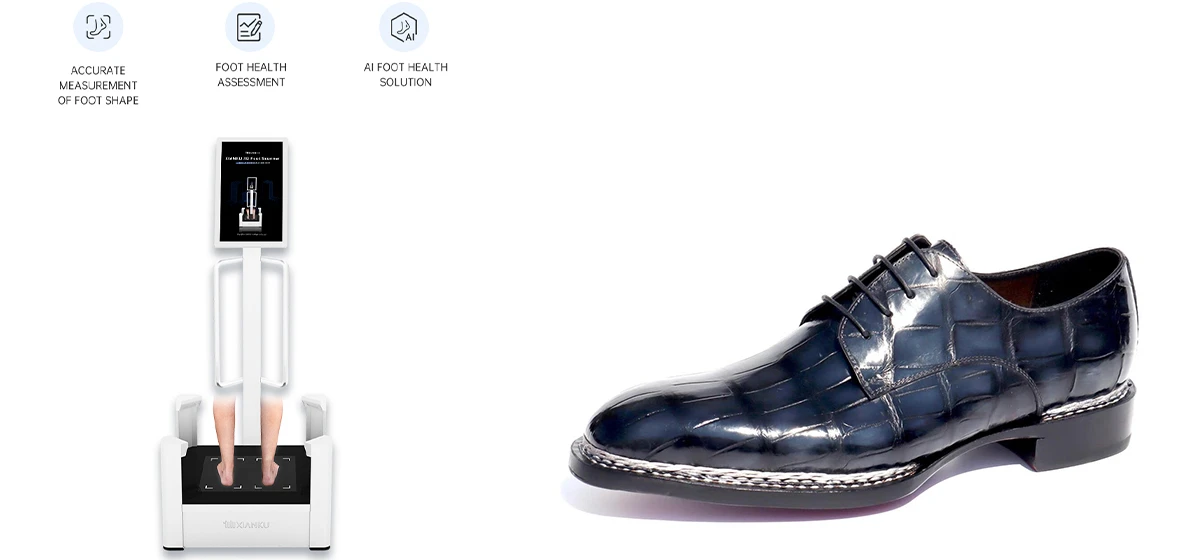
The Xianku3d Smart Foot Scanner represents a groundbreaking approach to footwear customization through its implementation of advanced structured light scanning technology. This system captures precise three-dimensional foot data in under one second, achieving millimeter-level measurement accuracy previously unattainable through manual methods. The non-contact measurement process not only enhances hygiene-an increasingly important consumer consideration-but also eliminates inconsistencies associated with traditional measurement techniques.
By integrating this technology into their service flow, custom shoe retailers can create a distinctly modern and scientifically-backed customer experience that sets them apart from competitors still relying on tape measures and manual tracing. The scanner's sleek, technologically advanced design alone signals innovation, while its ability to generate comprehensive foot analysis reports demonstrates a commitment to precision that justifies premium positioning in the competitive custom footwear marketplace.
Enhancing Functional Value Through Scientific Analysis
Beyond mere size measurement, the Xianku3d Smart Foot Scanner provides comprehensive foot health assessment capabilities, identifying potential issues including flat feet, high arches, foot valgus, and hallux valgus. This detailed analysis enables shoe designers to create footwear that addresses both aesthetic preferences and specific biomechanical needs, effectively elevating custom shoes from luxury items to health-conscious solutions.
The scanner generates a detailed foot assessment report covering toe morphology, plantar analysis, heel inclination angle, and other podiatric metrics. This information allows manufacturers to incorporate targeted support features, pressure distribution optimization, and gait-correcting elements into their designs-transforming the value proposition from simple comfort to active foot health management. This functional enhancement opens new market segments including therapeutic footwear, athletic performance optimization, and ergonomic workplace solutions.
Transparent and Interactive Customer Experience
The integration of 3D foot scanning technology creates an unprecedented level of process transparency throughout the customization journey. Customers receive immediate visual feedback through detailed 3D models of their feet, helping them understand the specific anatomical characteristics that will influence their custom shoe design. This demystifies the bespoke process and builds confidence in the technical expertise of the provider.
Many forward-thinking retailers are combining this scanning technology with augmented reality visualization tools that allow customers to preview their custom designs from multiple angles before production begins. This interactive experience transforms the measurement process from a mundane necessity into an engaging brand moment, strengthening emotional connection to the product and justifying the premium nature of custom footwear through demonstrated technological sophistication.
Streamlined Operational Workflow
The Xianku3d Smart Foot Scanner fundamentally transforms the custom shoe retail operation by standardizing and automating the most variable aspect of the process: foot measurement. By capturing precise digital data at the outset, the technology eliminates measurement inconsistencies between staff members and across locations, ensuring uniform service quality regardless of operational scale.
This technological integration enables a more efficient sales workflow where staff can focus on design consultation and customer service rather than technical measurement tasks. The automated report generation provides objective data that helps customers understand their unique fitting requirements, reducing decision anxiety and simplifying the style selection process. Additionally, the digitization of foot measurements enables remote ordering and reordering without repeat visits, enhancing customer convenience while increasing lifetime value.
Table: Traditional vs. Technology-Enhanced Custom Shoe Service Comparison
| Aspect | Traditional Custom Service | Xianku3d Scanner Enhanced Service |
|---|---|---|
| Measurement Process | Manual, contact-based measurements | Automated, non-contact 3D scanning |
| Measurement Time | 5-10 minutes | 1 second for scan, 5 seconds for report |
| Data Accuracy | Subjective, varies by operator | Millimeter-level precision |
| Health Assessment | Limited to visual observation | Comprehensive analysis of foot conditions |
| Customer Experience | Opaque process | Interactive 3D visualization and reporting |
| Scalability | Limited by staff expertise | Standardized process across locations |
| Data Utilization | Minimal digital retention | Comprehensive digital foot database |
Data-Driven Operations and Manufacturing
The establishment of a structured digital foot morphology database represents one of the most significant long-term advantages of 3D foot scanning integration. This repository of precise customer measurements enables manufacturers to implement predictive inventory management, stocking materials and components based on historical demand patterns rather than speculation. The availability of aggregated foot shape data also facilitates the development of standardized custom last systems that can accommodate the most common morphological variations while minimizing completely one-off production requirements.
For the manufacturing process itself, digital foot data can be directly integrated with computer-aided design (CAD) and manufacturing (CAM) systems, streamlining the transition from measurement to production. This digital workflow reduces errors from manual data transfer and accelerates production timelines-addressing two significant customer pain points in traditional custom footwear. The comprehensive database also enables personalized marketing based on specific foot characteristics, replacement reminders based on wear patterns, and special offers for complementary products sized according to existing customer data.
Implementation Impact: Case Studies and Industry Adoption
Forward-thinking custom footwear brands have already begun integrating 3D foot scanning technology into their operations with notable success. These early adopters report significant reductions in return rates (often by 40% or more) due to improved fit accuracy, while simultaneously decreasing production time by streamlining the measurement-to-manufacturing workflow. The objective data provided by the scanning systems has also empowered sales teams to confidently justify premium pricing based on demonstrable technical superiority rather than subjective quality claims.
The technology has proven particularly valuable in bridging the expertise gap that often challenges retail expansion. While traditional bespoke shoe fitting requires years of training to master, the standardized scanning process enables consistently accurate measurements regardless of staff experience level. This dramatically reduces training requirements while maintaining quality standards-a critical advantage in markets facing skilled labor shortages.
Beyond commercial applications, the Xianku3d Smart Foot Scanner has demonstrated value in research and public health contexts, participating in national initiatives like the "2024 National Physical Fitness Survey" and youth sports talent identification programs. These applications not only validate the technology's accuracy but also associate adopting brands with scientific credibility and social responsibility.
The Competitive Landscape: Established Brands and Technological Disruption
The global custom footwear market features established players including Crockett & Jones, Edward Green, Bionda Castana, and Buchanan Bespoke. These heritage brands have built their reputations on traditional craftsmanship techniques, with some requiring multiple in-person consultations before beginning production. While this approach maintains cachet for purists, it limits their potential market to geographically concentrated affluent consumers.
The emerging segment of 3D printed custom shoes represents another technological frontier, with companies like FUSED footwear, Zellerfeld, and FitMyFoot leading this innovation charge. While currently focused primarily on athletic and casual styles, the underlying additive manufacturing principles could eventually transform leather shoe production by enabling previously impossible designs and structural elements.
The integration of 3D foot scanning technology positions traditional leather shoe manufacturers between these two extremes-preserving the aesthetic appeal and material quality of heritage craftsmanship while incorporating digital precision and efficiency. This hybrid approach potentially offers the optimal balance of tradition and innovation, appealing to both existing bespoke customers and new technologically-oriented demographics.
Table: 3D Foot Scanning Applications Across Industries
| Industry Sector | Application Examples | Benefits Realized |
|---|---|---|
| Custom Footwear Retail | In-store fitting, personalized recommendations | Reduced returns, increased customer satisfaction, premium pricing justification |
| Medical Orthotics | Custom insoles, orthopedic shoes, post-surgical footwear | Precise fitting, treatment outcome tracking, remote consultation support |
| Sports Performance | Athletic shoe customization, performance optimization | Enhanced athletic performance, injury prevention, wear pattern analysis |
| Ergonomics & Workplace Safety | Protective footwear, occupational shoe programs | Improved comfort, reduced fatigue, compliance monitoring |
| Fashion & Luxury | Digital customization, virtual try-on, made-to-order | Enhanced brand experience, reduced inventory waste, personalization |
| Public Health | National foot surveys, pediatric development tracking | Population health trends, standardized assessment, early intervention |
Future Outlook: The Evolution of Custom Footwear
The integration of 3D foot scanning technology represents merely the initial phase of the digital transformation sweeping the custom footwear industry. The growing availability of detailed foot morphology databases will eventually enable predictive fit algorithms capable of recommending specific last modifications based on statistical correlations between foot shapes and comfort complaints. This data-driven approach will continuously improve as more scans are added to the system, creating a self-reinforcing cycle of enhancement.
We anticipate increasing convergence between 3D scanning, artificial intelligence, and additive manufacturing technologies, potentially enabling completely new business models including subscription-based footwear, regularly replaced based on actual wear patterns detected through scanning. The availability of precise digital foot data may also facilitate home scanning through smartphone applications, further democratizing access to custom footwear regardless of geographic location.
As consumers increasingly expect personalized products across all categories, the custom footwear industry must embrace these digital technologies to remain relevant. The integration of biomechanical sensors during the scanning process could provide additional gait and pressure distribution data, further enhancing the functional benefits of custom designs. This evolution from static measurement to dynamic analysis represents the next frontier in truly personalized footwear.
Conclusion: Stepping Into the Future of Custom Footwear
The custom leather shoe industry stands at a technological crossroads, facing significant challenges in differentiation, functionality, transparency, operational efficiency, and data utilization. The Xianku3d Smart Foot Scanner addresses these limitations through its precision scanning capabilities, comprehensive analysis features, and seamless digital workflow integration.
By adopting this technology, traditional footwear brands can preserve their artisanal legacy while embracing the digital tools necessary for contemporary relevance and scalable growth. The fusion of time-honored craftsmanship with cutting-edge measurement technology represents the future of bespoke footwear-a future where every shoe fits perfectly, functions optimally, and reflects both the customer's style and anatomical needs.
For retailers and manufacturers seeking competitive advantage in an increasingly crowded marketplace, investment in 3D foot scanning technology is no longer a luxury but a necessity. The measurable benefits in customer satisfaction, operational efficiency, and production accuracy deliver compelling return on investment, while the strategic advantages of comprehensive foot data collection create enduring barriers to competition. In the evolving landscape of custom footwear, technological integration separates industry leaders from followers-and the time to step forward is now.
(86)-181-2464-3821
alexliu@xianku.com