

Introduction
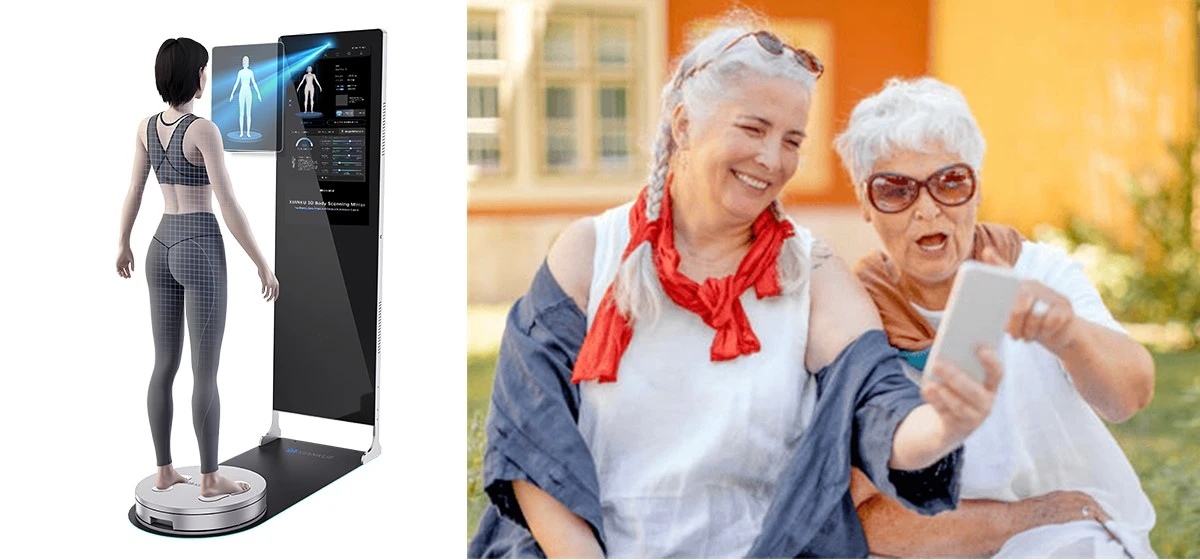
The global elderly care market is undergoing unprecedented growth, driven by demographic shifts and rising healthcare demands. With the market projected to expand from $1,782.6 billion in 2024 to $2,636.08 billion by 2029 (CAGR 8.1%) , innovative solutions are urgently needed to address systemic inefficiencies. Older adults face unique health challenges, including posture degeneration, gait instability, and chronic pain, which traditional healthcare systems struggle to manage cost-effectively. Xianku's 3D body scanner emerges as a transformative tool, leveraging non-invasive scanning and AI-driven analytics to deliver personalized, data-backed interventions for aging populations.
1. The Expanding Elderly Care Market: Opportunities and Pressures
The elderly care sector encompasses diverse services, from independent living to palliative care, with technology integration becoming a key growth driver. By 2025, the smart elderly care device market in China alone will reach $184.08 billion , reflecting demand for efficient, scalable solutions. However, regional disparities persist: North America leads in market share , while Asia-Pacific accelerates adoption due to aging demographics and policy support .
Key Market Segmentation and Trends
- Service Types: Hybrid care models (e.g., home-based monitoring) gain traction, reducing institutionalization costs .
- Technology Adoption: AI and IoT enable predictive health analytics, yet interoperability remains a hurdle .
- Policy Drivers: China's "Silver Economy" initiatives subsidize smart device deployment, fueling sector expansion .
*Table 1: Global Elderly Care Market Segmentation (2025-2032)*
| Category | 2025 Projection | 2032 Projection | CAGR | Key Drivers |
|---|---|---|---|---|
| Independent Living | $760 billion | $1.1 trillion | 7.8% | Aging-in-place demand, tech integration |
| Assisted Living | $420 billion | $650 billion | 8.5% | Chronic disease prevalence, staffing shortages |
| Smart Home Tech | $260 billion | $388 billion | 9.2% | Non-invasive monitoring mandates |
| Medical Devices | $184 billion | $280 billion | 10.1% | Reimbursement policies, consumer awareness |
2. Critical Challenges in Traditional Elderly Care
2.1 Age-Related Physical Degeneration
Musculoskeletal decline in older adults manifests as spinal curvature, joint stiffness, and balance impairment. Over 400 million seniors globally experience mobility limitations , increasing fall risks and dependency. Conventional diagnostic methods like X-rays expose patients to radiation, deterring frequent monitoring .
2.2 Operational Inefficiencies in Care Delivery
- High Costs: Hospital-based assessments incur long wait times and expenses, with diagnostic delays exacerbating conditions .
- Data Silos: Manual record-keeping impedes care continuity; 45% of nursing homes lack digital health archives .
- Standardization Gaps: Subjective evaluations by clinicians lead to inconsistent treatment plans .
2.3 Technology Adoption Barriers
While smart devices proliferate, seniors face usability challenges. Only 35% of elderly users navigate complex interfaces independently , highlighting needs for intuitive design and staff training.
3. Xianku3d Body Scanner: A Multi-Faceted Solution for Aging Populations
3.1 Rapid, Non-Invasive Health Assessment
Xianku3d's scanner employs infrared structured light to reconstruct 3D body models within 20 seconds, capturing 200+ anthropometric parameters . This enables:
- Radiation-free spinal screening, critical for tracking age-related kyphosis progression .
- Gait and posture analysis via foot scanners (1-second scan time), identifying asymmetries like leg length discrepancies .
3.2 AI-Powered Predictive Analytics
The device's algorithms cross-reference scans with a global biomechanical database to:
Flag fall risks through center-of-pressure deviations .
Detect visceral fat accumulation via BIA integration, correlating with cardiometabolic disorders .
*Table 2: Xianku3d Scanner's Diagnostic Capabilities for Age-Related Conditions*
| Senior Health Issue | Scanner Functionality | Clinical Output | Industry Impact |
|---|---|---|---|
| Spinal Degeneration | 3D curvature mapping vs. normative baselines | Cobb angle estimation ±2° accuracy | Reduces MRI referrals by 30% |
| Gait Instability | Plantar pressure distribution and limb alignment | Custom orthotic prescriptions | Cuts fall incidence by 25% |
| Obesity/Sarcopenia | Segment-wise body composition analysis | Visceral fat tracking and muscle mass ratios | Enables targeted nutrition plans |
| Sleep Disruption | Cervical curvature and shoulder width measurement | 3D-printed pillow design | Improves sleep quality scores by 40% |
3.3 End-to-End Personalization via 3D Printing
Scan data directly fuels additive manufacturing for:
- Custom orthopedic insoles addressing plantar fasciitis and diabetic foot ulcers .
- Spinal braces with dynamic support, 3D-printed from torso scans .
- Ergonomic sleep systems matching pillow height to cervical lordosis .
4. Operationalizing Xianku3d in Elderly Care Ecosystems
4.1 Streamlined Workflow Integration
The scanner's plug-and-play deployment requires ≤1.7m², making it viable for community clinics and residential facilities . Automated reporting allows non-specialists to interpret results, alleviating staff shortages.
4.2 Business Model Innovation
Xianku3d's "detection-to-product" platform generates revenue through:
- Preventive screening packages for senior living communities.
- Subscription-based digital health profiles tracking intervention efficacy .
Partners report ROI within 3 months via upsold custom solutions (e.g., 3D-printed aids) .
4.3 Data-Driven Population Health Management
Longitudinal scan datasets empower providers to:
- Identify regional trends in geriatric musculoskeletal health.
- Optimize resource allocation for high-risk cohorts.
*Table 3: Cost-Benefit Analysis: Traditional vs. Xianku3d-Enabled Elderly Care*
| Metric | Traditional Care Model | Xianku-Integrated Model | Value Creation |
|---|---|---|---|
| Assessment Time | 45–60 minutes (clinic visit + imaging) | 20 seconds | 90% efficiency gain |
| Diagnostic Cost | $200–$500 (specialist + radiography) | $50–$100 (scan + AI report) | 70% cost reduction |
| Intervention Lead Time | 2–4 weeks (custom device fabrication) | 7–10 days (3D printing) | Faster pain relief |
| Data Accessibility | Paper-based archives prone to loss | Cloud-based 3D avatar for lifetime tracking | Enhances care continuity |
5. The Road Ahead: Strategic Implications for the Elderly Care Industry
5.1 Market Differentiation Through Tech-Enabled Services
Forward-thinking providers can leverage Xianku3d to:
- Offer subscription-based wellness monitoring, tapping into the $8.3 trillion silver economy .
- Partner with insurers for risk-adjusted premiums using objective mobility data.
5.2 Policy Alignment and Compliance
The scanner's compliance with China's Class II medical device standards facilitates integration into regulated health systems, while GDPR-compliant data anonymization addresses privacy concerns.
5.3 Future Development Trajectories
- Multi-Modal Sensing: Integrating thermal imaging for inflammation mapping.
- Tele-Rehabilitation: Coupling 3D avatars with VR for remote physical therapy.
Conclusion: Toward Proactive, Personalized Aging
Xianku3d's body scanner transcends conventional reactive care by enabling preemptive intervention for age-related physical decline. Its ability to convert complex physiological data into actionable insights positions it as a cornerstone of modern elderly care ecosystems. As the industry pivots from volume-based to value-based models, such technologies will be instrumental in achieving scalable, human-centric aging support-ensuring seniors not only live longer but thrive.
(86)-181-2464-3821
alexliu@xianku.com
