

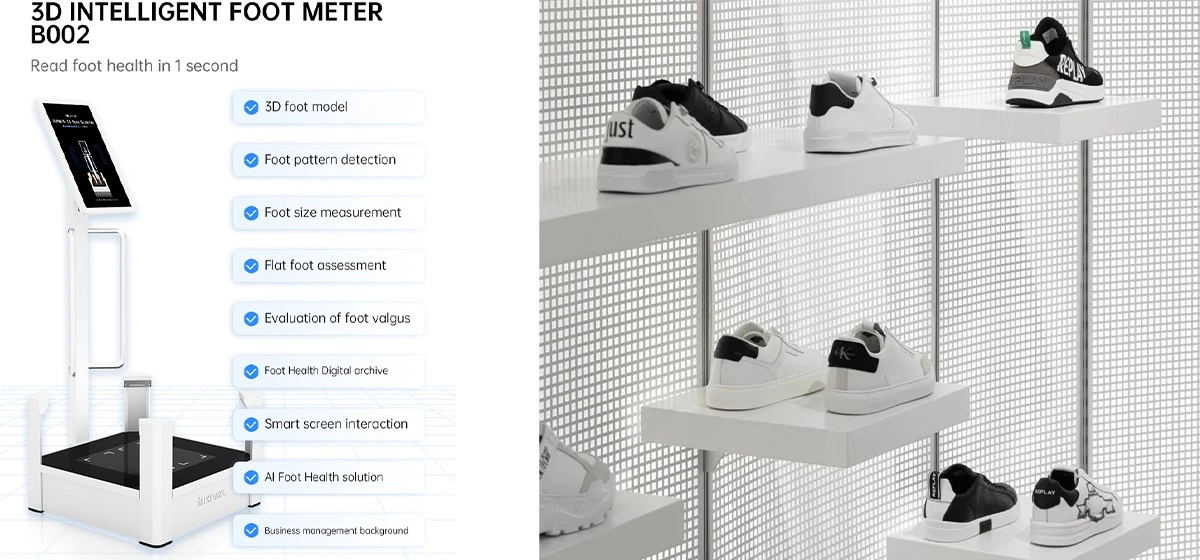
The global children's footwear industry is experiencing significant growth, with the market size projected to reach billions of dollars by 2032. However, this expansion is accompanied by pressing challenges, including low product differentiation, insufficient functional health features, and weak customer retention. The industry remains highly competitive, led by key players like Nike, Adidas, and Carter's, which dominate a substantial share of the market. Amid these challenges, innovative technologies such as the Xianku3D foot scanner are emerging as transformative solutions. By enabling precise, data-driven footwear customization, enhancing functional attributes, and streamlining retail operations, this technology offers a new pathway for brands to differentiate themselves and meet evolving consumer demands.
1 The Expanding Children's Footwear Market: An Overview
The global children's footwear market has demonstrated resilient growth, driven by rising disposable incomes, increasing awareness of child foot health, and the demand for stylish yet functional shoes. According to recent market analyses, the children's footwear sector is poised to achieve a steady compound annual growth rate (CAGR), with the market size expected to grow from approximately RMB 92.391 billion in 2024 to an estimated RMB 129.492 billion by 2030. Asia-Pacific, particularly China, represents the largest and fastest-growing market, accounting for over 52% of global sales in the children's footwear segment. This growth is further fueled by the rising emphasis on child health and wellness, creating opportunities for brands that can successfully merge style with functionality.
The market is segmented by product type-including sports shoes, casual shoes, toddler shoes, and sandals-and by age groups, such as under 3 years, 3–6 years, and 6–14 years. Sports shoes dominate the market, owing to their versatility and alignment with active lifestyles. Demographically, the 3–6 years age group represents a significant share, as this period involves rapid foot development and a higher frequency of shoe replacement.
1.1 Regional Market Insights
- Asia-Pacific: This region leads the global children's footwear market, with China alone contributing 28.4% of global children's apparel and 30.4% of footwear sales. The presence of major manufacturing hubs and growing middle-class populations further accelerates demand.
- North America and Europe: These regions also hold substantial market shares, characterized by high brand consciousness and a preference for premium, health-oriented products.
- Latin America and the Middle East & Africa: Emerging markets in these regions are witnessing gradual growth, driven by urbanization and increasing consumer awareness.
Table 1: Global Children's Footwear Market Overview (2024–2030)
| Category | 2024 Baseline | 2030 Projection | CAGR |
|---|---|---|---|
| Global Market Size | RMB 92.391 billion | RMB 129.492 billion | 5.79% |
| Asia-Pacific Share | 52.03% | Similar dominance expected | - |
| Key Product Segments | Sports, casual, toddler | Sports shoes leading | - |
| Leading Age Segment | 3–6 years | 3–6 years | - |
2 Critical Challenges in the Children's Footwear Industry
Despite the promising growth, the children's footwear sector faces several systemic issues that hinder innovation and long-term brand sustainability.
2.1 Low Differentiation and Brand Saturation
The market is heavily reliant on brand influence rather than product innovation. Established players like Nike and Adidas dominate with their marketing prowess, while emerging brands struggle to differentiate themselves. This saturation results in a "copycat" culture, where designs and features are replicated, diminishing uniqueness and consumer appeal. For instance, many brands prioritize aesthetics over functionality, leading to a market filled with similar-looking products that fail to address the specific needs of developing feet.
2.2 Lack of Functional Health Features
While terms like "health shoes" are frequently used in marketing, most products offer only superficial comfort rather than genuine functional benefits. For example, approximately 25% of children have flat feet or other podiatric issues, yet few shoes in the market provide adequate arch support, heel stabilization, or corrective capabilities. This gap not only impacts foot health but also represents a missed opportunity for brands to create value-added products.
2.3 Poor In-Store Experience and Customer Education
The traditional retail model relies heavily on sales associates to communicate product value, often without tools to demonstrate health benefits tangibly. Customers, particularly parents, leave stores without fully understanding how a shoe supports their child's foot development. This lack of engagement undermines trust and fails to justify premium pricing. A survey by Bain & Company highlighted that 25–30% of consumers desire involvement in product design, indicating a strong appetite for personalized experiences that are largely unmet.
2.4 Fast-Fashion Mentality and Price Competition
Many brands operate on a fast-fashion model, competing primarily on price and market share rather than quality or functionality. This approach leads to low customer loyalty and negligible repeat purchases. As price wars intensify, profit margins shrink, making it difficult for brands to invest in research, development, and innovative solutions.
2.5 Inefficient Sales SOPs and High Entry Barriers
Traditional retail strategies emphasize store location, advertising spend, and brand recognition, creating high entry barriers for newcomers. Without substantial capital, emerging brands find it challenging to secure prime retail spaces or launch large-scale marketing campaigns. Even for established brands, scaling operations efficiently remains a hurdle due to outdated standard operating procedures (SOPs) that do not leverage technological advancements.
2.6 Lack of Data Utilization
Many brands operate without data-driven inventory management or product optimization systems. This results in overstocking, understocking, or misaligned product designs that do not reflect actual consumer needs. The absence of comprehensive data on foot morphology and consumer preferences further limits the ability to innovate and respond to market trends.
Table 2: Key Challenges and Their Business Impacts in the Children's Footwear Industry
| Challenge | Business Impact |
|---|---|
| Low Differentiation | Reduced brand loyalty; price-based competition; limited market share for new brands |
| Lack of Functional Health Features | Missed niche markets; inability to justify premium pricing; low repeat purchases |
| Poor In-Store Experience | Lower conversion rates; inability to demonstrate value; weakened customer trust |
| Fast-Fashion Mentality | Eroded profit margins; high inventory waste; unsustainable business models |
| Inefficient Sales SOPs | High operational costs; slow expansion; difficulties in training and scaling |
| Lack of Data Utilization | Poor inventory management; suboptimal product designs; ineffective trend response |
3 Xianku 3D Foot Scanner: A Game-Changing Solution for the Industry
The Xianku3D foot scanner employs advanced 3D structured light technology to capture precise foot morphology data within seconds, generating comprehensive health reports that include arch analysis, toe morphology, heel inclination, and potential issues like flat feet or bunions. This technology enables footwear brands to bridge the gap between mass production and personalized health-focused solutions.
3.1 Enhancing Differentiation Through Service and Experience
By integrating the Xianku 3D foot scanner into retail environments, brands can create a tech-driven, interactive customer journey. For example, Dr. Kong, a Hong Kong-based health footwear brand, implemented 3D foot scanners to offer personalized shoe recommendations, significantly enhancing its brand identity as a leader in podiatric health. This approach not only differentiates brands from competitors but also positions them as innovators in the health and wellness space.
3.2 Enabling Functional and Health-Oriented Design
The scanner's detailed metrics allow brands to incorporate functional elements such as arch support, heel cups, and metatarsal pads into their designs. For instance, the data can be used to create custom insoles that address specific conditions like plantar fasciitis or overpronation. This transforms ordinary shoes into therapeutic products, offering tangible health benefits that justify premium pricing.
3.3 Elevating the Customer Experience
The scanning process itself becomes an engaging centerpiece in stores. Customers step onto the platform, and within seconds, they receive a 3D model of their feet and a detailed health report. Sales associates use this data to recommend suitable shoe models, shifting their role from passive sellers to informed consultants. This interactive experience fosters trust and empowers customers to make educated purchasing decisions based on their specific needs.
3.4 Facilitating Customized Health Products
With precise foot data, brands can offer personalized footwear solutions, such as tailored insoles or made-to-order shoes. This customization not only meets individual needs but also creates opportunities for higher-margin sales. For example, brands can promote "health-centric" product lines that incorporate corrective features, appealing to health-conscious parents willing to invest in their children's well-being.
3.5 Streamlining Sales SOPs and Training
The scanner simplifies the sales process by providing clear, data-driven recommendations. New staff can quickly learn to operate the device and interpret results, reducing training time and ensuring consistent service quality. This efficiency enables brands to scale operations without compromising on expertise or customer satisfaction.
3.6 Enabling Data-Driven Decision Making
The aggregated foot scan data provides invaluable insights into regional foot morphology trends, common podiatric issues, and sizing patterns. Brands can leverage this information to optimize inventory, refine product designs, and forecast demand accurately. For example, a brand might discover that a significant portion of its customer base requires wide-fit shoes, prompting adjustments in production and stock allocation.
Table 3: Functional Capabilities of the Xianku3D Foot Scanner and Their Applications
| Feature | Technical Specification | Application in Footwear |
|---|---|---|
| 3D Structured Light Scanning | Captures sub-millimeter accuracy in 1 second | Precise shoe sizing; custom insole design |
| Multi-Parameter Analysis | Measures arch height, foot width, heel inclination | Detects flat feet, high arches; recommends support |
| Real-Time Reporting | Generates health reports within 5 seconds | In-store immediate recommendations |
| Cloud Data Integration | Stores and compares historical foot data | Tracks foot development; informs product innovation |
| Customization Interface | Compatible with CAD/CAM software | Enables tailored shoe and insole production |
4 Case Studies: Success Stories in the Industry
4.1 Dr. Kong's Integration of 3D Foot Scanning
Dr. Kong, a prominent health footwear brand based in Hong Kong, incorporated 3D intelligent foot scanners to revolutionize its retail experience. The technology enabled the brand to conduct quick foot assessments, identify issues like flat feet or overpronation, and recommend appropriate shoe models. This strategy not only boosted customer trust but also increased sales of their functional footwear lines. Dr. Kong's collaboration with medical institutions, such as the Fudan University Sports Medicine and Rehabilitation Institute, further reinforced its credibility and appeal among health-conscious consumers.
4.2 Leading Global Brands Embracing 3D Scanning
Internationally, brands like Nike and Adidas have experimented with similar technologies to enhance customization and customer engagement. Although these brands dominate the market, the adoption of 3D scanning represents a broader industry shift toward personalized products. For smaller brands, emulating this approach can level the playing field and create unique value propositions.
5 Future Outlook and Strategic Recommendations
The children's footwear industry is at a pivotal juncture, where technology and tradition converge to redefine consumer expectations. The integration of 3D foot scanning technology not only addresses existing challenges but also opens new avenues for growth. Looking ahead, brands that prioritize data-driven customization, functional design, and seamless customer experiences will lead the market.
To capitalize on these opportunities, industry players should consider the following strategies:
- Invest in Technology Integration: Incorporate 3D foot scanners in flagship stores and partner with retailers to expand accessibility.
- Collaborate with Health Experts: Work with podiatrists and orthopedic specialists to validate and enhance product functionality.
- Leverage Data Analytics: Use aggregated foot data to inform product development, marketing strategies, and inventory management.
- Educate Consumers: Develop campaigns that highlight the importance of foot health and the role of customized footwear.
- Explore Direct-to-Consumer Models: Use online platforms to offer virtual foot scanning services or mail-in customization options.
Conclusion
The children's footwear industry is poised for transformation, driven by technological advancements and evolving consumer demands. The Xianku3D foot scanner stands out as a powerful tool to overcome longstanding challenges, from low differentiation to inefficient retail practices. By embracing this innovation, brands can not only enhance their product offerings but also build lasting relationships with customers through personalized, health-focused experiences. The future of children's footwear lies in the seamless fusion of data, design, and customer-centricity-and the time to act is now.
(86)-181-2464-3821
alexliu@xianku.com
