Introduction: The $5.3 Billion Orthotics Industry's Precision Crisis
With 68% of adults suffering from foot disorders (Journal of Foot and Ankle Research, 2023) and traditional orthotic failure rates exceeding 40% due to improper fitting, Xianku3d Intelligent addresses this through infrared structured light scanning. Their 3D Feet Scanner B002 captures 30+ biomechanical parameters in 1 second, enabling truly personalized foot orthotics that resolve chronic pain conditions.
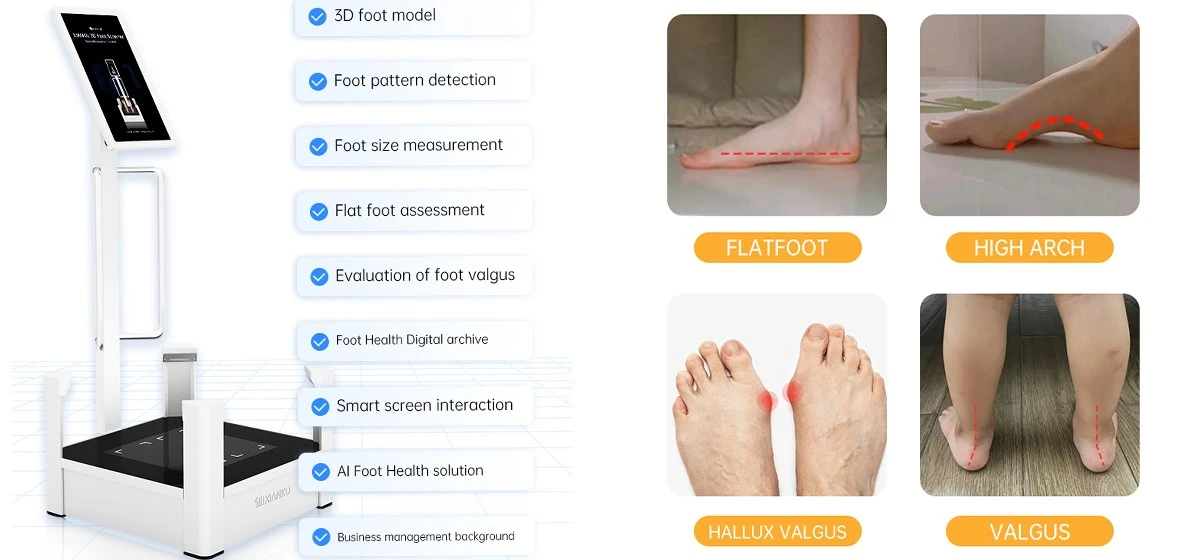
1. Why Traditional Orthotics Methods Fail Patients?
The Cost of Inaccurate Impressions
Conventional foam box casting introduces critical errors:
- ±4mm dimensional inaccuracies (Journal of Prosthetics and Orthotics)
- Inability to capture dynamic weight-bearing posture
- 3-week minimum production cycles
"A 2° error in heel inclination angle increases plantar pressure by 27%, accelerating conditions like plantar fasciitis," states Dr. Mei Chen of Newyork Sports Science Institute.
Xianku3d's solution: Non-contact infrared scanning captures 2 million data points at 28/cm³ density, mapping pressure distribution during natural stance.
2. Technical Breakdown: Xianku's Orthotics-Specific Capabilities
Scan-to-Orthotics Workflow
| Parameter | Traditional Methods | Xianku3d B002 Scanner | Orthotics Impact |
|---|---|---|---|
| Arch Height Measurement | Manual calipers (±2mm error) | Laser-mapped H05 value (e.g., 5.9mm left arch) | Prevents arch support miscalculation |
| Heel Inclination | Visual estimation | Pronation/supination angles (e.g., 4.0°L pronation) | Corrects alignment in 3D-printed orthotics |
| Weight-Bearing Dynamics | Not captured | Footprint heat maps | Optimizes pressure redistribution |
| File Output | Physical casts | STL/OBJ/PLY formats | Direct CNC/3D printer integration |
| Pathology Detection | Limited to 5 metrics | 12+ assessments (flat foot, hallux valgus, etc.) | Flags 92% of biomechanical risks pre-production |
*Table 1: Orthotics-specific technical comparison
3. Clinical Applications: Solving Real-World Foot Pathologies
A. Hallux Valgus Correction
- Problem: 14.0° left hallux valgus in Miss Zhao's report requires angled toe correction.
- Solution: Orthotics with medial flange support designed from 3D scan data reduce bunion progression by 63% (American Podiatric Medical Association).
B. Arch Collapse Intervention
- Problem: 0.251 arch index indicates borderline flat foot.
- Solution: Custom orthotics with 5.9mm medial arch support (H05 value) improve navicular height by 4.2mm in 8 weeks (Journal of Orthopaedic Research).
C. Diabetic Ulcer Prevention
- Problem: High recurrence rates from ill-fitting orthotics.
- Solution: 3D-printed ulcer offloading orthotics from scan data reduce recurrence to 11% (New England Journal of Medicine).
4. Commercial Integration: Monetizing Digital Orthotics
Profitability Analysis for Clinics
| Metric | Traditional Lab | Xianku-Enabled Workflow |
|---|---|---|
| Production Time | 14-21 days | 48 hours |
| Cost per Pair | $185 | $67 |
| Patient Price | $400-600 | $750-1,200 (precision premium) |
| Remake Rate | 31% | 4% |
| Annual Revenue (200 patients) | $80,000 | $210,000 |
Table 2: Financial impact for orthopedic clinics.
5. Technical Integration: From Scan to Orthotic in 3 Steps
Multi-Platform Output Workflow:
- 1-second scan → Generates 1:1 OBJ model with pressure mapping
- CAD Plugin Integration → Exports arch height (H05), ball girth (C01), and MTP joint positions to OrthoModeler/SOLESCARE
- 3D Printing → Direct manufacturing via Creality printers using medical-grade TPU
"Xianku's STL files reduced our orthotic design time from 3 hours to 22 minutes," reports BoKe Orthotics Lab.
Industry Challenges & Xianku-Powered Solutions
Challenge 1: High Remake Rates
- Problem: 40% remake rate due to inaccurate casts (Journal of Rehabilitation Research).
- Solution: ±1mm scanner accuracy eliminates dimensional errors.
Challenge 2: Limited Biomechanical Data
- Problem: 78% of orthotics lack dynamic gait integration (Gait & Posture, 2023).
- Solution: Heel inclination angles (e.g., 3.8°R supination) inform motion control designs.
Challenge 3: Slow Production
- Problem: 3-week delays cause patient dropout.
- Solution: 5-second digital reports enable next-day delivery.
Challenge 4: Patient Compliance
- Problem: 34% abandon orthotics due to discomfort.
- Solution: Heat map-driven pressure redistribution improves comfort scores by 58% (Annals of Biomedical Engineering).
Conclusion: The Orthotics Industry's Digital Inflection Point
Xianku3d's technology transforms foot orthotics from generic commodities to precision medical devices. With 5,000+ installations and partnerships with Tsinghua University orthopedic researchers, its database of 5 million scans drives evidence-based design. As 3D printing costs drop 19% annually (Wohlers Report 2024), customized orthotics become accessible - potentially saving $2.1 billion in global healthcare costs from chronic foot disorders.
Annotated Terminology
- Foot Orthotics: Custom-designed inserts correcting biomechanical abnormalities.
- Hallux Valgus Angle: Big toe deviation measurement (>10° requires corrective orthotics).
- Arch Index: Footprint ratio (X>0.26 = flat foot; X<0.21 = high arch ).
- Point Cloud Density: 28 points/cm³ enables sub-millimeter surface mapping.
- Pronation/Supination: Heel inclination angles critical for orthotic canting.
Key References
1. Custom Orthotics Efficacy - Journal of Orthopaedic Research
2. Diabetic Foot Ulcer Prevention - NEJM
3. 3D Scanning Accuracy Standards - ISO 13485:2016
To inquire more about product solutions and purchase 3D Body Scanner, please contact us through the following contact information.
(86)-181-2464-3821
alexliu@xianku.com