

The custom orthotics industry stands at a pivotal juncture. As global demand for personalized foot care solutions grows, the industry faces significant challenges in delivering consistent, high-quality products efficiently. With the global custom made orthotics insoles market projected to grow from $3.2 billion in 2025 to $5.8 billion by 2032, representing a robust CAGR of 7.8%, the pressure to innovate has never been greater.
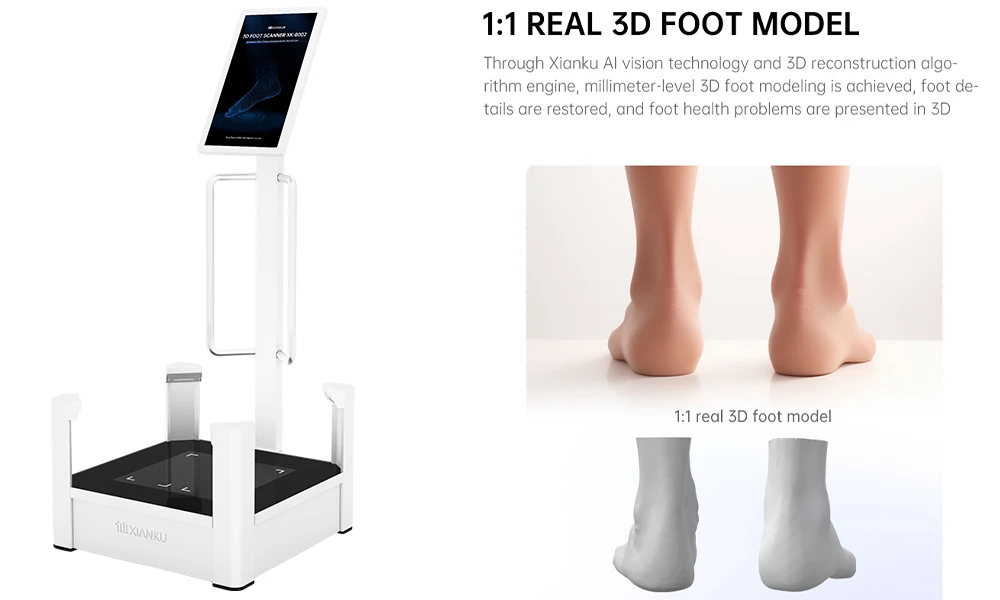
The Xianku3D Foot Scanner emerges as a transformative solution, addressing longstanding industry challenges through cutting-edge technology that combines precision scanning, data analytics, and seamless integration into clinical and retail environments. This technology not only enhances the patient experience but also revolutionizes how orthotics professionals approach assessment, design, and manufacturing.
1. Market Overview: Growth Drivers and Industry Dynamics
1.1 Market Size and Projections
The global custom orthotics market is experiencing substantial growth, driven by several key factors:
- Aging Population: By 2030, nearly 25% of the global population will be over 60, increasing the prevalence of foot-related conditions requiring orthotic intervention
- Rising Health Awareness: Growing recognition of foot health's importance to overall wellbeing, particularly among active adults and athletes
- Technological Advancements: Innovations in 3D scanning, materials science, and manufacturing technologies making custom orthotics more accessible and effective
Table 1: Global Custom Orthotics Market Projections (2025-2032)
| Year | Market Value (USD Billion) | Growth Rate | Key Drivers |
|---|---|---|---|
| 2025 | 3.2 | - | Base year |
| 2027 | 3.7 | 7.5% | Increased diabetes prevalence, aging population |
| 2029 | 4.5 | 8.0% | Technological adoption, sports medicine growth |
| 2031 | 5.4 | 7.8% | Preventive care focus, telehealth integration |
| 2032 | 5.8 | 7.4% | Market maturation, emerging economies adoption |
Source: Market Reports Insights (2025)
1.2 Regional Market Variations
The market shows significant regional variation in adoption rates and technological sophistication:
- North America: Dominates market share with advanced healthcare infrastructure and high consumer awareness
- Europe: Strong growth driven by aging population and progressive healthcare policies
- Asia-Pacific: Emerging as the fastest-growing region due to increasing healthcare access and rising disposable incomes
2. Critical Industry Challenges
2.1 Standardization and Quality Consistency
The custom orthotics industry suffers from significant standardization issues:
- Manual Processes: Traditional casting and impression methods yield inconsistent results, with error rates exceeding 15-20%
- Subjectivity: Reliance on practitioner skill leads to variability in outcomes and patient experiences
- Quality Control: Lack of unified standards results in inconsistent product quality across providers
2.2 Operational Inefficiencies and Cost Pressures
- Labor-Intensive Production: Traditional methods require skilled technicians and multiple appointments, increasing costs
- High Return Rates: Improper fit due to inaccurate assessments leads to return rates of 20-30% in some segments
- Scalability Limitations: Manual processes prevent efficient scaling of operations, particularly for small and medium enterprises
2.3 Patient Experience and Accessibility Issues
- Lengthy Processes: Traditional assessment and fitting can require multiple visits over several weeks
- Discomfort: Physical casting and impression methods can be uncomfortable for patients
- Limited Accessibility: Geographic constraints prevent many potential users from accessing quality orthotic services
2.4 Market Fragmentation and Competitive Pressures
The market remains highly fragmented, with:
- Major Players: Established companies like Bauerfeind AG, Aetrex Worldwide, and Foot Science International dominating market share
- Specialized Providers: Niche players focusing on specific conditions or patient demographics
- Local Artisans: Small workshops offering custom solutions but lacking technological capabilities
Table 2: Custom Orthotics Industry Challenge Analysis
| Challenge Category | Specific Issues | Business Impact | Patient Impact |
|---|---|---|---|
| Standardization | Inconsistent assessment protocols, variable outcomes | High remake rates, increased costs | Unpredictable results, multiple adjustments |
| Operational Efficiency | Manual processes, skilled labor dependency | Limited scalability, high overhead | Lengthy wait times, higher costs |
| Technology Adoption | High implementation costs, training requirements | Barrier to entry for smaller providers | Limited access to advanced solutions |
| Market Competition | Price pressure, differentiation challenges | Margin compression, consolidation | Confusing choice, variable quality |
3. Xianku3D Foot Scanner: Technological Solution for Industry Challenges
The Xianku3D Foot Scanner represents a paradigm shift in orthotic assessment and design, addressing core industry challenges through advanced technology.
3.1 Precision Measurement and Comprehensive Assessment
- Advanced Scanning Technology: Utilizes infrared structured light to capture over 2 million data points in under 1 second
- Comprehensive Metrics: Measures 29+ parameters including arch index, heel inclination, toe angles, and pressure distribution patterns
- Millimeter Accuracy: Achieves scanning precision of ±0.5mm, far surpassing traditional methods
3.2 Enhanced Patient Experience and Engagement
- Non-Invasive Process: Eliminates uncomfortable physical casting and impressions
- Immediate Results: Generates detailed 3D models and PDF reports within 5 seconds of scanning
- Visual Education: Interactive 3D models help patients understand their foot issues and treatment rationale
3.3 Operational Efficiency and Integration
- Rapid Assessment: Completes full foot assessment in 1 second versus 30+ minutes for traditional methods
- Reduced Labor Dependency: Automated process requires minimal technical expertise to operate
- Seamless Integration: Digital output integrates with CAD/CAM systems for streamlined orthotic design and manufacturing
3.4 Business Intelligence and Market Differentiation
- Data Analytics: Aggregated anonymized data provides insights into population foot morphology trends
- Brand Positioning: Technology enables providers to position themselves as innovative, data-driven solutions providers
- Revenue Diversification: Scan data drives sales of complementary products and services
Table 3: Traditional vs. Xianku3d-Enhanced Orthotic Assessment
| Parameter | Traditional Methods | Xianku 3D Foot Scanner | Improvement |
|---|---|---|---|
| Assessment Time | 30-45 minutes | 1 second | 99.9% reduction |
| Data Points Collected | 5-10 manual measurements | 2,000,000+ data points | 200,000x increase |
| Accuracy | ±3-5mm (subjective) | ±0.5mm (objective) | 6-10x improvement |
| Patient Comfort | Uncomfortable impressions | Non-contact, painless | Significant enhancement |
| Report Generation | Manual documentation, days | Automated PDF, 5 seconds | Near-instantaneous |
| Integration Potential | Limited digital integration | Full digital workflow integration | Complete modernization |
4. Competitive Landscape Analysis
4.1 Established Market Leaders
- Bauerfeind AG: German company offering premium orthotic solutions with focus on medical quality and clinical validation
- Aetrex Worldwide: American company combining foot scanning technology with orthotic manufacturing
- Foot Science International: New Zealand-based company with focus on biomechanically designed orthotics
4.2 Innovative and Technology-Focused Players
- Superfeet Worldwide: Known for their adaptive fit technology and extensive retail presence
- SIDAS: French company specializing in sports orthotics with advanced materials expertise
- Xianku3d Intelligent: Technology leader in 3D foot scanning and digital orthotic workflow solutions
4.3 Market Differentiators
- Technology Integration: Companies combining scanning, design, and manufacturing capabilities gaining competitive advantage
- Clinical Validation: Providers with scientific research supporting product efficacy commanding premium positioning
- Direct-to-Consumer Approaches: Emerging models bypassing traditional healthcare channels for improved accessibility
5. Implementation and Integration Framework
5.1 Clinical Integration Pathways
- Podiatry and Orthopedic Clinics: Enhancing existing practices with digital assessment capabilities
- Physical Therapy Centers: Incorporating scanning technology for improved rehabilitation outcomes
- Retail Settings: Implementing scanning stations in footwear stores for preventive recommendations
5.2 Technological Integration
- CAD/CAM Systems: Direct digital workflow from scan to orthotic design
- Electronic Health Records: Integration with patient management systems for comprehensive care coordination
- Telehealth Platforms: Remote assessment capabilities for expanded geographic reach
5.3 Business Model Evolution
- Service Diversification: From product sales to comprehensive foot health management
- Subscription Models: Recurring revenue through ongoing assessment and adjustment services
- Partnership Ecosystems: Collaboration with footwear brands, healthcare providers, and wellness centers
6. Future Outlook and Industry Transformation
6.1 Technological Trends
- Artificial Intelligence Integration: Machine learning algorithms for predictive orthotic design and outcome optimization
- Materials Advancements: New polymers and composites offering improved comfort and durability
- Additive Manufacturing: 3D printing enabling completely personalized orthotic structures
6.2 Market Evolution
- Preventive Focus: Shift from corrective to preventive foot health management
- Consumer Empowerment: Increased patient involvement in orthotic selection and customization
- Integration with Footwear: Closer collaboration between orthotic providers and footwear manufacturers
6.3 Regulatory and Standards Development
- Quality Standards: Development of industry-wide standards for digital orthotic assessment and manufacturing
- Reimbursement Policies: Evolution of insurance coverage for digitally-produced custom orthotics
- Certification Requirements: Professional credentials for digital orthotic design and manufacturing
7. Conclusion: Stepping Into a Digital Future
The custom orthotics industry faces significant challenges-from standardization issues and operational inefficiencies to inconsistent patient experiences-but these also represent opportunities for transformation. The Xianku3D Foot Scanner and similar technologies are paving the way for a new era in foot health management, one characterized by precision, efficiency, and personalization.
As the market continues to grow and evolve, success will increasingly depend on the ability to leverage technology for improved outcomes and experiences. The integration of advanced scanning, data analytics, and digital manufacturing will separate industry leaders from followers, creating new opportunities for innovation and value creation.
For orthotic providers, footwear retailers, and healthcare professionals, the message is clear: the future of foot health is digital, data-driven, and patient-centric. Embracing this transformation today will position organizations for success in the evolving landscape of custom orthotics.
References
- Market Reports Insights. (2025). Netherlands Custom Made Orthotics Insoles Market Perspective.
- Xianku3d Intelligent Co., Ltd. (2024). 3D Smart Foot Scanner Product Specifications.
- Global Custom Orthotics Industry Report. (2023). Competitive Landscape Analysis.
- 3D Printing in Orthotics Market Analysis. (2025). Technology Adoption Trends.