
Spinal disorders-particularly scoliosis (lateral curvature), kyphosis (excessive forward rounding), and degenerative conditions-affect over 500 million people globally, with adolescents facing the highest risks. In USA alone, >5 million students have scoliosis, yet early detection rates remain below 0.3% due to screening limitations. Left untreated, these conditions cause chronic pain, cardiopulmonary impairment, and reduced mobility. Early screening is critical: interventions before skeletal maturity can reduce surgery needs by 90%.
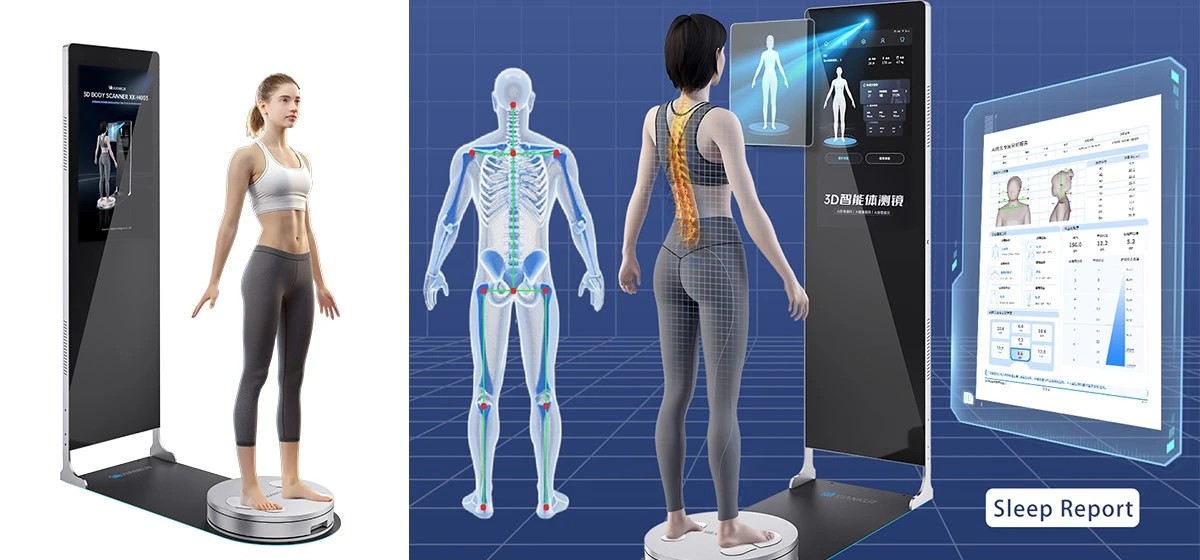
Why 3D Body Scanning Changes the Game
3D body scanners use structured light (non-laser patterns) to map body surfaces in seconds. AI algorithms then reconstruct spinal alignment by correlating external landmarks with internal vertebral positions trained on >500,000 X-ray datasets. This eliminates radiation while quantifying Cobb angles, pelvic tilt, and thoracic curvature with clinical-grade precision. Ideal for schools, military enlistment centers, and rehabilitation clinics, these devices enable large-scale, zero-radiation screening-addressing a critical gap in preventive healthcare.
1. Manual Screening: The Human Factor
How It Works: Clinicians visually inspect posture asymmetry, shoulder/hip imbalances, or rib humps using functional tests like the Adam forward bend test. A scoliometer may quantify torso rotation angles.
Pros:
- Low-cost and portable, requiring only trained personnel and minimal equipment.
- Effective for initial risk stratification in resource-limited settings.
Cons:
- High variability: In a French study of 1,994 children, Adam tests showed a 14.8% kyphosis rate-far exceeding the 0.5–2% literature baseline-due to subjectivity in interpretation.
- Misses mild cases: Accuracy plummets for curves <15°, delaying critical early intervention.
- Skill-dependent: Requires extensive training; consistency drops with screener fatigue.
Expert Note: "22.2% of French schoolchildren 'lost' during manual screening underscores workflow flaws".
2. Hospital X-ray Systems: Gold Standard with Risks
How It Works: X-rays penetrate tissues to image bones directly. Cobb angles-the diagnostic benchmark-are measured from vertebral endplates on radiographs. Newer systems like EOS imaging capture 3D skeletal models at 90% lower radiation than CT scans.
Pros:
- Unmatched precision: Measures internal spinal geometry to within 3°–5° error margins.
- Dynamic assessment: EOS scans patients in weight-bearing positions, revealing functional instabilities missed in supine MRIs.
Cons:
- Radiation hazards: Cumulative exposure from repeat scans raises cancer risk in children-girls with scoliosis face elevated breast tissue damage.
- Cost/access barriers: Single EOS scans cost ~$500; few hospitals own these systems.
- Slow throughput: MRI/CT scans take ≥30 minutes, bottlenecking mass screenings.
Comparative Analysis: Five Critical Dimensions
| Dimension | Manual Screening | Hospital X-ray | Xianku3D Scanner |
|---|---|---|---|
| Professional Reliability | Low (high skill-dependence) | High (clinical gold standard) | High (AI trained on 500K+ cases) |
| Precision | Moderate (≥15° curves) | High (1°–3° error) | High (2°–5° error vs. X-ray) |
| Safety | No radiation | Radiation exposure | No radiation |
| Mass Screening | Slow (22% attrition) | Impractical | Rapid (200+ people/day) |
| Revenue Potential | Low (labor-intensive) | High ($500/scan) | Subscription models + cross-selling rehab (e.g., $150/scanner/day at schools) |
Trust-Building Advantages
- Instant 3D reports visually show patients their spinal misalignments, boosting compliance with rehab plans.
- Longitudinal tracking detects subtle changes between clinical visits-critical for monitoring brace/exercise efficacy.
- Foot-spine bundled assessments justify custom orthotics + therapy packages, increasing average transaction value by 40%.
Implementation Scenarios: Where Each Excels
- Schools/Military: Xianku3d's portability and speed screen 100s daily; EOS impractical here.
- Spine Clinics: Use Xianku for initial triage and progress checks; reserve EOS for surgical planning.
- Rehab Centers: Combine Xianku with posture correction systems like AI motion capture (e.g., Yunnan's ethnic-exercise rehab).
The Future: Predictive Analytics and Global Scaling
Emerging systems now fuse 3D scans with motion sensors to predict curve progression risks. As AI datasets grow, "digital twin" spine models will personalize rehab in real time. With China's scoliosis screening mandate, technologies like Xianku's-cost-effective, safe, and scalable-are poised to become the frontline defense against spinal disability.
Bottom Line: While manual methods fade and X-rays remain niche for severe cases, 3D scanners have redefined accessible precision-turning schools and clinics into early detection powerhouses.
To inquire more about product solutions and purchase 3D Body Scanner, please contact us through the following contact information.
(86)-181-2464-3821
alexliu@xianku.com