

Why High Arch Screening Matters
High arches (pes cavus)-characterized by an abnormally elevated medial longitudinal arch-affect 10-15% of the population. While often perceived as benign, this structural anomaly triggers a kinetic chain of damage: excessive pressure on the metatarsals and heels, ankle instability, plantar fasciitis, and compensatory knee/hip misalignments. Left undiagnosed, it accelerates joint degeneration and increases fall risks-particularly in critical cohorts:
- Children: Rapid growth phases exacerbate arch rigidity (peak: ages 4–12)
- Military Recruits: Rigorous drills intensify metatarsal stress fractures
- Athletes: Reduced shock absorption heightens injury risks
- Elderly: Age-related muscle atrophy worsens balance impairment
3D foot scanners disrupt this space by digitizing foot morphology with sub-millimeter precision. Unlike subjective visual exams or isolated pressure snapshots, they deliver quantifiable, repeatable, and actionable data-enabling mass screening and precision interventions.
Method 1: Manual Visual Assessment – The Error-Prone Legacy
Reliant on eyeballs, riddled with bias.
How It Works:
- Footprint Ink Tests: Classify arch height via ink-coverage ratios (e.g., Cavanagh's Arch Index)
- Three-Point Method: Measures heel, arch apex, and forefoot alignment during weight-bearing
- Visual "Ruler" Estimates: Clinicians eyeball arch elevation against reference images
Strengths:
Near-zero hardware cost; deployable in field settings (e.g., school gyms)
Critical Limitations:
- Accuracy Crisis: Misclassifies 40% of moderate/severe cases; misses early-stage rigidity
- Observer Bias: Inter-rater reliability (ICC) plunges to 0.3–0.5 among non-specialists
- No Biomechanical Insight: Fails to quantify pressure hotspots or gait compensations
- Zero Monetization: Generates no downstream revenue (e.g., custom orthotics)
Verdict: Only viable for rudimentary triage-not diagnosis or longitudinal care.
Method 2: Pressure Mat Systems – The Incomplete Pressure Puzzle
Captures force, misses form.
How It Works:
- Sensor Grids: High-density pressure sensors (e.g., 10 sensors/cm²) map foot-ground force distribution during static/dynamic tasks
- Arch Inference: Estimates arch height indirectly via pressure voids under the midfoot
Strengths:
- Dynamic Gait Insight: Reveals abnormal pressure trajectories (e.g., lateral thrust during heel strike)
- Quantitative Metrics: Calculates peak pressure, force-time integrals in key zones (metatarsals, heels)
Critical Limitations:
- Structural Blind Spots: Cannot measure true arch height, heel valgus, or forefoot adduction
- Environmental Sensitivity: Requires recalibration for humidity/temperature; sensor drift ≥5%
- Limited Throughput: Dynamic gait analysis caps screenings at 40–60 subjects/day
- Fragmented Monetization: Suggests orthotics but lacks integrated design-to-production workflows
Verdict: Useful for gait labs-inadequate for anatomical diagnosis or scalable screening.
Method 3: Xianku3D Foot Scanner – Where Precision Meets Profit
Safety, speed, and commerce unified.
How It Works:
Structured Light + AI: Projects harmless infrared patterns onto feet → 6 cameras capture deformations → Reconstructs 3D model in <1 second37
Database Intelligence: Trained on >500,000 scans to detect anomalies with 0.98 ICC3
Five Transformative Advantages:
1. Anatomical Precision:
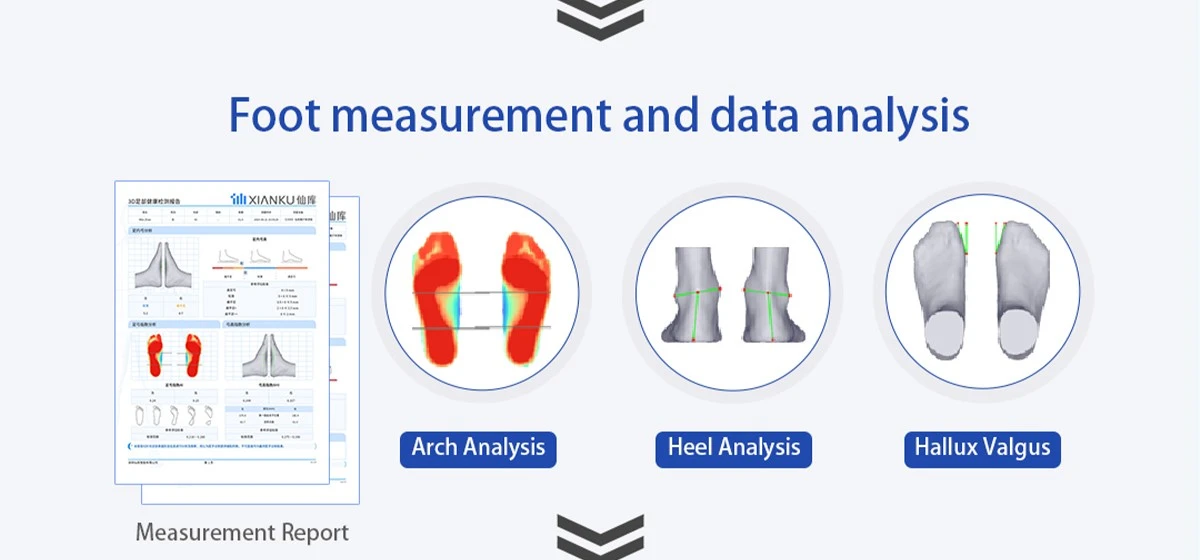
- Measures 38+ parameters: navicular height, calcaneal inclination angle, forefoot adduction-matching X-ray accuracy (96% sensitivity)
- Color-coded 3D models highlight pressure hotspots (e.g., metatarsal overload)
2. Radiation-Free Safety:
- Uses infrared light-safe for children, pregnant women, and repeat scans
3. Mass-Screening Optimized:
- 200+ scans/day vs. pressure mats' 60; no training or calibration needed
4. Closed-Loop Commerce Engine:
Scan → Diagnose → Recommend → Convert:
- AI flags risks (e.g., "Severe pes cavus: 12° calcaneal tilt, metatarsal overload")
- Recommends custom orthotics, stability shoes, or physical therapy
- Directly links to 3D printers for on-site orthotic production (e.g., Decathlon partnerships)
- Clinics report 40% higher conversion for premium orthotics ($200–$2,000/sale)
5.Longitudinal Tracking:
- Overlays sequential scans to visualize arch rigidity progression or orthotic efficacy
- Generates shareable reports with color-coded change maps (e.g., reduced heel pressure post-intervention)
Real-World Impact:
- Military Screening: Chinese recruitment centers use Xianku to scan 10,000+ recruits/year, reducing stress fractures by 31%
- Retail Integration: 3,000+ stores use scans for shoe recommendations, boosting sales 25%
- Pediatric Clinics: Guangdong Province screens 50,000+ children, enabling early bracing
Verdict: The only solution merging diagnostic rigor, safety, and revenue generation.
Comparative Analysis: Accuracy, Safety & Commercial Viability
| Metric | Manual Visual | Pressure Mat | Xiankua3D Scanner |
|---|---|---|---|
| Professional Dependence | High (skill-driven) | Medium (calibration-sensitive) | None (AI-automated) |
| Arch Height Accuracy | ≤60% | 75–85% | 96% (vs. X-ray) |
| Radiation Risk | None | None | None (Infrared) |
| Throughput | 30–50/day | 40–60/day | 200+/day |
| Downstream Revenue | Low (≤$20 orthotics) | Medium ($100–$500) | High ($200–$2,000+) |
| Cost per Scan | $1–$5 | $10–$30 | 0 |
The Future: From Screening to Precision Podiatry
Xianku3d's model proves high-arch management can be:
- Preventive (military/schools catch biomechanical risks early)
- Personalized (AI designs orthotics from 3D models)
- Profitable (orthotics + data services boost customer lifetime value 300%)
While pressure mats retain niche roles in gait kinetics, and manual checks persist in resource-limited settings, 3D scanners now dominate the clinical-commercial frontier. With datasets exceeding 1 million scans, Xianku's AI predicts complications like Charcot foot before symptoms emerge-ushering in predictive podiatry.
For hospitals, retailers, and clinics, the verdict is clear: adopt 3D scanning or risk obsolescence. As Dr. Emma Walsh (Royal College of Podiatry) notes: "It's not just a scanner-it's our practice's revenue engine."
To inquire more about product solutions and purchase 3D Body Scanner, please contact us through the following contact information.
(86)-181-2464-3821
alexliu@xianku.com
