
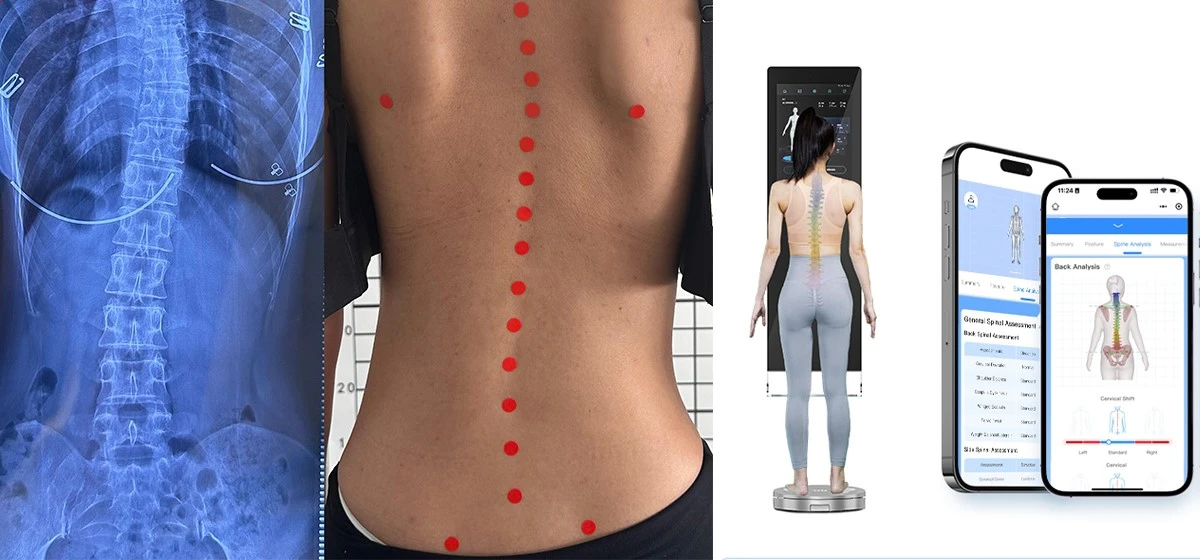
The spinal health and scoliosis assessment industry faces significant challenges including radiation exposure from traditional X-rays, high costs, limited accessibility, and subjective diagnostic approaches. As the global spinal implants and devices market is projected to grow from $20 billion in 2025 to $26 billion by 2032, representing a 5.51% CAGR, innovative solutions are urgently needed. Emerging technologies like Xianku's 3D body scanner offer a transformative approach through non-invasive assessment, addressing critical gaps in current spinal healthcare delivery while creating new opportunities for preventive care and practice growth for healthcare providers.
Introduction to Spinal Health Challenges
Spinal disorders represent a growing global health concern, with particular impact on adolescent populations through conditions like scoliosis, characterized by lateral curvature of the spine exceeding 10°. Traditional diagnostic methods, particularly Cobb angle measurement through X-ray imaging, have remained the gold standard despite significant limitations. This reliance on radiographic assessment creates barriers to widespread screening and early intervention, particularly in school settings and primary care environments where specialized medical expertise may be limited.
The healthcare industry faces a critical juncture in addressing spinal disorders, as timely detection and intervention can prevent progression to more severe complications including physical deformity, chronic pain, and even respiratory issues. Current diagnostic paradigms create bottlenecks in care pathways, often delaying intervention until conditions have progressed to more advanced stages. The development of accurate non-radiation methods for spinal assessment represents a significant advancement in making spinal health monitoring more accessible and sustainable.
Current Industry Landscape and Market Analysis
Global Spinal Health Market Overview
The spinal health assessment and treatment market encompasses a broad ecosystem including diagnostic equipment, surgical implants, and therapeutic devices. The global spinal implants and devices market is projected to experience steady growth,with a compound annual growth rate of 5.51%.
This market segmentation includes various product categories:
Table 1: Global Spinal Implants and Devices Market Segmentation by Product Type
| Product Category | Examples | Primary Applications |
|---|---|---|
| Non-fusion Devices | Dynamic stabilization systems, artificial discs | Motion preservation in spinal treatment |
| Vertebral Compression Fracture Treatment | Vertebroplasty, kyphoplasty devices | Osteoporotic fracture management |
| Spinal Bone Growth Stimulators | Electrical stimulation devices | Enhancing fusion rates in spinal surgery |
| Spinal Biologics | Bone grafts, BMP | Promoting bone growth in fusion procedures |
| Spinal Fusion Cages | Interbody devices, PLIF, TLIF cages | Spinal fusion surgery |
The competitive landscape includes prominent medical device companies such as Medtronic, Johnson & Johnson, Globus Medical, Stryker Corporation, Zimmer Biomet Holdings, and NuVasive, among others . These established players primarily focus on surgical solutions rather than non-invasive assessment technologies, creating opportunities for innovative approaches in the diagnostic segment.
Regional Market Distribution
Geographically, the spinal health market shows varied distribution patterns:
Table 2: Regional Analysis of Spinal Health Market
| Region | Market Characteristics | Key Trends |
|---|---|---|
| North America | Mature market with high adoption of advanced technologies | Focus on minimally invasive procedures |
| Europe | Strong regulatory framework and reimbursement landscape | Emphasis on cost-effective solutions |
| Asia-Pacific | Rapidly growing market, particularly in China and Japan | Increasing healthcare expenditure and awareness |
| China | Specific market expected to reach RMB 32.20 billion by 2025 | Growing middle class demanding better healthcare |
Critical Challenges in Traditional Spinal Assessment
Radiation Exposure and Safety Concerns
Conventional X-ray imaging, the current gold standard for scoliosis diagnosis, exposes patients, particularly vulnerable children and adolescents, to ionizing radiation. This presents a significant concern for serial monitoring of spinal conditions, as multiple exposures over time may cumulatively increase cancer risk. The problem is particularly acute for school screening programs where large populations require assessment, making radiation-based methods impractical from a safety perspective.
The clinical standard for scoliosis assessment, Cobb angle measurement, requires manual analysis of X-ray images by trained physicians, introducing both inter-observer variability and radiation burden . Recent research has highlighted these limitations, spurring investigation into non-radiative alternatives that can provide accurate assessment without associated health risks.
Accessibility and Economic Barriers
The current spinal health assessment paradigm creates significant economic and accessibility challenges:
- High Costs: Traditional diagnostic pathways involving specialized medical facilities, radiographic equipment, and expert interpretation create financial barriers to widespread screening.
- Geographic Limitations: Access to specialized spinal care remains concentrated in urban centers, creating disparities in rural healthcare delivery.
- Referral Inefficiencies: Traditional screening methods like the Adams Forward Bend Test have high false-positive rates, resulting in unnecessary specialist referrals and associated costs .
- Equipment Expenses: Advanced diagnostic equipment represents significant capital investment for healthcare facilities, particularly affecting smaller clinics and practices.
These economic barriers disproportionately affect underserved populations and create disparities in early detection and intervention for spinal conditions.
Clinical Workflow and Diagnostic Limitations
Current spinal assessment methodologies present several clinical challenges:
- Subjectivity in Assessment: Manual Cobb angle measurement introduces inter-observer variability, with studies showing significant differences between practitioners .
- Static Evaluation Limitations: Traditional X-ray assessment captures spinal alignment in static positions, potentially missing dynamic functional impairments during movement.
- Workflow Inefficiencies: The multistep process of image acquisition, interpretation, and reporting creates administrative burdens and delays in diagnosis.
- Limited Functional Data: Radiographic methods provide excellent structural information but lack data on how spinal alignment affects functional movement patterns.
These limitations in current diagnostic approaches have fueled research into automated assessment methods, including AI-driven analysis of spinal images and development of non-radiative functional assessment technologies.
Emerging Technological Solutions in Spinal Assessment
Advancements in Automated Assessment
Recent research has demonstrated progress in addressing traditional limitations through technological innovation. A 2025 study published in Scientific Reports developed an end-to-end pipeline for automated scoliosis diagnosis using deep learning models, achieving a CMAE (Cobb Mean Absolute Error) of 3.50 and SMAPE (Symmetric Mean Absolute Percentage Error) of 7.35 on the SpineWeb dataset .
This automated approach incorporated multiple technological components:
- Spine Region Detection: Automated cropping of relevant spinal regions from X-ray images
- Vertebral Landmark Identification: Deep learning models for precise localization of vertebral structures
- Multi-scale Image Enhancement: Quality improvement through algorithms like MUSICA
- Standardized Reporting: Integration with SNOMED CT for consistent clinical terminology
Such technological advances demonstrate the potential for increased consistency in spinal assessment while reducing dependency on specialized expertise for initial screening and measurement.
Non-Radiation Alternative Technologies
Several radiation-free approaches to spinal assessment have emerged as potential alternatives to traditional X-ray:
- Surface Topography: Systems using moiré topography or structured light patterns to assess surface anatomy related to spinal alignment.
- Inertial Measurement Units (IMUs): Wearable sensor systems like ScolioDetect that use motion capture during gait to identify asymmetries associated with scoliosis, achieving measurement accuracy within 3° of traditional Cobb angle .
- 3D Body Scanning: Technologies using non-invasive optical methods to create detailed digital models of body surface anatomy.
These non-invasive technologies eliminate radiation exposure while providing quantitative data relevant to spinal assessment, making them suitable for repeated measurements and large-scale screening scenarios.
Xianku3D Body Scanner: Technological Solution Overview
Technical Specifications and Capabilities
Xianku's 3D body scanning technology represents a significant advancement in non-invasive assessment for spinal health. Utilizing 3D structured light technology, the system achieves millimeter-level precision in body surface measurement, rapidly constructing 1:1 accurate 3D digital human models . This approach enables comprehensive assessment without the radiation concerns associated with traditional X-ray methods.
The scanning process requires approximately 20 seconds for complete data acquisition, making it highly efficient for clinical environments with high patient volumes. The system generates detailed reports covering 9 categories and 128 individual parameters of 3D digital body health data, including critical metrics relevant to spinal assessment such as spinal curvature, body symmetry, and postural alignment .
Clinical Applications and Workflow Integration
The Xianku3d scanner integrates into diverse clinical workflows with specific applications:
- Preliminary Screening: Efficient identification of potential spinal irregularities in primary care, chiropractic, and school settings
- Progress Monitoring: Serial assessment of spinal conditions without radiation exposure
- Complementary Assessment: Providing supplementary data to traditional diagnostic methods
- Patient Education: Visual representation of assessment findings enhances understanding and engagement
The technology's rapid assessment capability enables healthcare providers to implement efficient screening protocols, potentially expanding service reach while optimizing resource utilization.
Addressing Industry Challenges Through Technological Innovation
Overcoming Economic and Accessibility Barriers
Xianku's 3D scanning technology addresses multiple economic challenges in spinal healthcare:
- Reduced Equipment Costs: Compared to specialized radiographic systems, the technology offers a more accessible price point for smaller clinics
- Operational Efficiency: Rapid assessment (20 seconds per scan) enables higher patient throughput
- Minimal Consumables: Non-contact optical scanning eliminates ongoing supply expenses
- Staff Utilization: Reduced dependency on highly specialized personnel for assessment administration
These economic advantages make spinal assessment more financially viable for a broader range of healthcare settings, potentially expanding access to underserved communities and non-traditional venues like schools and community health centers.
Enhancing Clinical Capabilities and Standardization
The technology addresses several limitations in current clinical practice:
- Objective Metrics: Quantitative, reproducible measurements reduce subjectivity in assessment
- Standardized Protocols: Consistent scanning and analysis procedures enhance comparability across time and locations
- Comprehensive Data: Multiple parameters provide broader context for spinal assessment beyond single metrics like Cobb angle
- Visual Documentation: 3D models create permanent visual records for tracking changes over time
This standardized assessment approach complements traditional expertise while reducing variability in serial monitoring and multi-provider care scenarios.
Comparative Analysis: Traditional vs. Technological Solutions
Table 3: Comparison of Spinal Assessment Technologies
| Assessment Parameter | Traditional X-ray | Wearable Sensors (e.g., ScolioDetect) | Xianku 3D Body Scanner |
|---|---|---|---|
| Radiation Exposure | Yes, ionizing radiation | None | None, uses infrared/structured light |
| Assessment Time | 10-15 minutes plus analysis | Gait analysis period (minutes) | Approximately 20 seconds |
| Primary Output | Cobb angle measurements | Gait asymmetry metrics | 3D model with multiple parameters |
| Equipment Cost | High | Moderate | Moderate to high |
| Expertise Required | Radiologist/physician | Technical operator | Minimal after training |
| Dynamic Assessment | No, static images only | Yes, during gait | Limited, primarily static |
| Screening Suitability | Limited by radiation | Suitable for screening | Highly suitable for screening |
Business Implications and Market Opportunities
Clinical Practice Enhancement
The integration of 3D body scanning technology offers significant benefits for healthcare providers:
- Expanded Services: Non-specialist clinics can offer spinal assessment without radiographic capabilities
- Patient Acquisition: Advanced technology serves as a practice differentiator and marketing tool
- Revenue Diversification: Screening services create new revenue streams while identifying candidates for therapeutic programs
- Enhanced Credibility: Objective data and visual documentation strengthen clinical recommendations
These advantages address the business challenges faced by spinal clinics, chiropractic practices, and traditional Chinese medicine clinics identified in the initial requirements, particularly regarding revenue generation and practice scalability.
Market Positioning and Competitive Advantage
Xianku3d's technology occupies a strategic position in the evolving spinal health market, positioned between basic screening methods and advanced radiographic assessment. As a radiation-free assessment tool, it addresses growing consumer and professional concerns about repeated radiation exposure, particularly in pediatric populations.
The technology's ability to generate comprehensive 3D visualizations provides a significant communication advantage, enhancing patient understanding and engagement compared to traditional numerical reports or abstract X-ray images. This visual documentation also supports objective tracking of treatment progress, addressing the challenge of outcome visualization in spinal care.
Future Directions and Industry Evolution
Technological Development Trajectory
The field of non-invasive spinal assessment continues to evolve with several promising directions:
- Integration with AI Analysis: Combining 3D scanning with artificial intelligence for automated interpretation and risk stratification
- Longitudinal Monitoring Platforms: Cloud-based data management for tracking patient progress across multiple timepoints
- Telehealth Applications: Remote assessment capabilities supporting decentralized care models
- Predictive Analytics: Using baseline and serial measurements to identify progression risk and optimize intervention timing
These advancements will further enhance the clinical utility and accessibility of non-invasive assessment technologies in spinal health.
Market Growth Opportunities
The spinal health assessment market presents significant expansion potential:
- School Screening Programs: Large-scale implementation in educational settings addresses the limitations of current visual screening methods
- Preventive Healthcare Integration: Incorporation into executive health programs and wellness initiatives
- Sports Medicine Applications: Assessment of athletes for spinal asymmetry and injury risk
- Geriatric Care: Monitoring age-related postural changes and fall risk assessment
These diverse applications demonstrate the broad market potential for advanced non-invasive assessment technologies beyond traditional clinical settings.
Conclusion: Transforming Spinal Health Assessment
The spinal health and scoliosis assessment industry stands at a technological inflection point, with innovative solutions like Xianku's 3D body scanner addressing critical limitations in traditional approaches. By eliminating radiation exposure, reducing costs, standardizing assessment protocols, and enhancing visual communication, these technologies have potential to democratize access to spinal health evaluation while creating sustainable business models for providers.
As the global spinal implants and devices market continues its growth trajectory, reaching an anticipated RMB 175.69 billion by 2032, parallel advancement in assessment technologies will be essential to optimize patient selection, treatment planning, and outcome monitoring . The integration of non-invasive assessment solutions into clinical workflows represents a significant step toward more accessible, safer, and more comprehensive spinal healthcare delivery.
The future of spinal health assessment lies in technologies that balance clinical accuracy with practical implementation, enabling earlier detection, more frequent monitoring, and enhanced patient engagement. Through continued innovation and adoption of these advanced assessment capabilities, healthcare providers can transform their approach to spinal disorders, shifting emphasis from late intervention to early detection and preventive management.
(86)-181-2464-3821
alexliu@xianku.com