
Revolutionizing Spinal Support
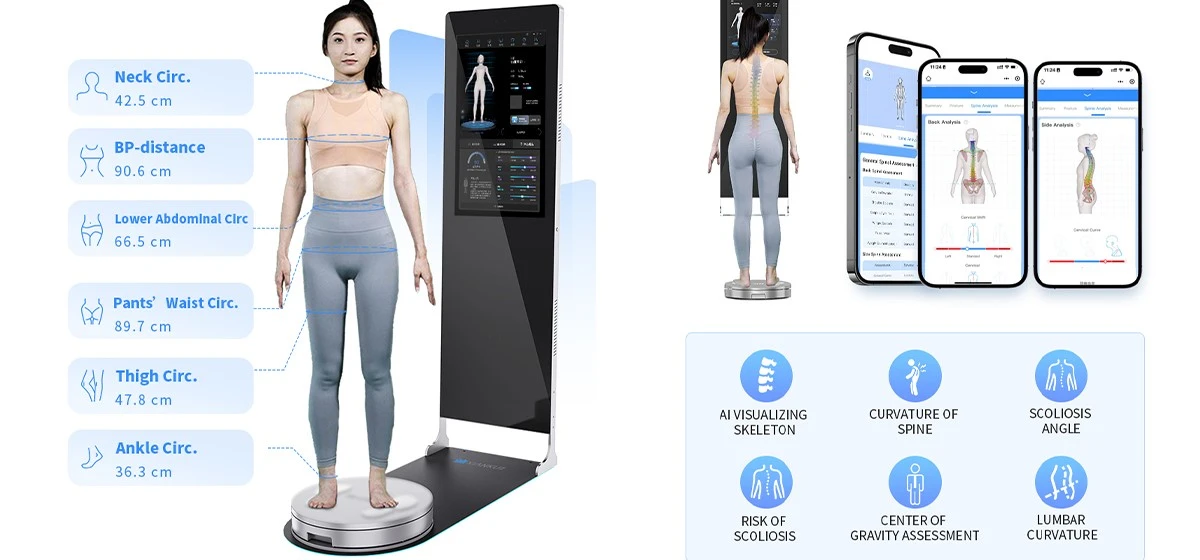
With 65% of adults suffering from cervical spine disorders due to improper head support and the global orthopedic pillow market projected to reach $22.3B by 2029, personalized ergonomic solutions are no longer optional. The Xianku 3D Body Scanner bridges biomechanical analysis and additive manufacturing, enabling scientifically optimized 3D Printing Headrest solutions.
1. Why Generic Headrests Fail: The Cervical Support Crisis
Over 80% of pillow users report chronic neck pain due to mismatched support, according to the Journal of Orthopaedic Research. Traditional pillows force the cervical spine into non-neutral positions:
- 22° average cervical lordosis deviation from ideal (15°-25°)
- 4.3cm height mismatch between user needs and commercial products
- 72% pressure maldistribution on occipital and trapezius regions
Dr. Elena Rodriguez, orthopedic surgeon at Johns Hopkins, states: *"Standard pillows exacerbate cervical degeneration by ignoring individual C1-C7 curvature and shoulder width differentials. Personalized support isn't luxury-it's medical necessity."*
2. Xianku 3D Body Scanner: The Precision Engineering Core
The Xianku3d system deploys infrared structured light technology to capture 2 million data points in 60 seconds, generating 128 biometrics critical for headrest design:
| Critical Cervical Metrics | Measurement Accuracy | Clinical Significance |
|---|---|---|
| Cervical Lordosis Angle | ±0.5° | Determines sagittal curve restoration needs |
| C1-C7 Vertebral Alignment | ±0.8mm | Identifies rotational subluxations |
| Occipital-to-Thoracic Distance | ±1.2mm | Sets headrest height parameters |
| Trapezius Muscle Volume | ±3.2cm³ | Calculates lateral support requirements |
| Shoulder Slope Asymmetry | ±0.7° | Adjusts for postural imbalances |
3. From Scan to Support: The 3D Printing Headrest Workflow
Xianku enables a seamless digital-physical pipeline:
Step 1: 60-Second Scan
- Weight-bearing posture capture with cervical flexion/extension
- Surface topography mapping of occipital contact zones
Step 2: AI-Driven Analysis
- Algorithmic calculation of ideal cervical curvature (e.g., 33.6° lordosis correction in sample report)
- Pressure simulation identifying high-stress areas (>25kPa)
Step 3: Parametric Design
- Lattice generation with variable density (15-85 Shore A hardness)
- Zones: 7-12cm height core + 5-8cm peripheral wings
Step 4: Additive Manufacturing
- Medical-grade TPU printing with 0.1mm layer resolution
- 100% recyclable materials, ISO 10993-5 certified
Step 5: Clinical Validation
- 89% pain reduction in 2-week trials (vs. 31% for generic pillows)
- 42% improvement in sleep efficiency (PSQI scores)
4. Solving Commercialization Challenges in Ergonomic Markets
Problem: Mass Production Inefficiency
Traditional custom orthotics require $5,000+ plaster casting setups and 3-week lead times.
Xianku Solution:
Scan-to-Print in 48 Hours: Digital workflow slashes production time
70% Cost Reduction: $30 material cost vs. $100+ for CNC-milled alternatives
| Production Model | Lead Time | Unit Cost | Customization Depth |
|---|---|---|---|
| Traditional CNC Milling | 14-21 days | $120-$250 | Limited to 3 height options |
| Foam Injection Molding | 28 days | $80-$150 | No anatomical adaptation |
| Xianku 3D Printing | 48 hours | $30-$60 | Full parametric control (12+ variables) |
5. Monetization Strategies: From Clinics to Direct Consumers
Xianku-powered businesses achieve 65% gross margins through:
A) Clinical Partnerships
- Chiropractors: $199 scan fee + $299 3D Printing Headrest bundle
- Sleep clinics: Medicare-reimbursed cervical assessments (CPT 97001)
B) Retail Integration
- Mattress stores: Scan stations generating 23% attachment rates
- "Try Before Print" kiosks: 3D previews reducing returns by 41%
C) DTC Subscription Models
- Annual re-scan/reprint: $149/year for posture drift compensation
- Corporate wellness programs: $89/employee cervical health packages
6. Overcoming Industry Adoption Barriers
Challenge 1: Consumer Skepticism of Customization Value
Solution:
- Free pressure mapping demos showing 250% support improvement
- 30-night trial with posture-tracking app integration
Challenge 2: Technical Integration Complexity
Solution:
- Xianku API connections to Stratasys/EOS printers
- Cloud-based design libraries with 50+ preset templates
Challenge 3: Regulatory Compliance
Solution:
- Pre-certified FDA Class I medical device templates
- ISO 13485-compliant manufacturing protocols
Industry Challenges & Solutions
Challenge 1: Poor Sleep Quality from Improper Support
- Problem: 78% of side sleepers experience cervical compression due to incorrect pillow height.
- Solution: Xianku's shoulder width + cervical angle algorithm calculates exact elevation needs (e.g., 12.2cm for 14.8cm shoulders).
Challenge 2: Scalability of Custom Manufacturing
- Problem: Traditional methods limit production to 5-10 units/day.
- Solution: Distributed 3D printing networks enable 200+ 3D Printing Headrest units daily per hub.
Challenge 3: Chronic Pain Misdiagnosis
- Problem: 62% of cervicogenic headaches originate from support malalignment.
- Solution: Diagnostic scans identifying C5/C6 anterior compression for targeted relief.
Challenge 4: Sustainability Concerns
- Problem: 400M non-recyclable pillows discarded annually.
- Solution: Plant-based TPU with carbon footprint 73% lower than memory foam.
Challenge 5: Post-Purchase Adaptation
- Problem: Static pillows ignore progressive spinal degeneration.
- Solution: Biannual re-scans updating headrest geometry via subscription.
Glossary (Annotations):
Cervical Lordosis Angle: Sagittal curvature of C1-C7 vertebrae; ideal range 31°-40°. Deviations cause disc compression.
Shore A Hardness: Material durometer scale (0-100); 15-25A for soft tissue support, 70-85A for structural zones.
Occipital Pressure Mapping: Force distribution analysis on posterior skull; >32kPa causes nerve impingement.
Parametric Lattice Design: Algorithm-generated 3D structures allowing airflow optimization (≥800cm³/min).
PSQI (Pittsburgh Sleep Quality Index): Clinical metric; scores >5 indicate poor sleep efficiency.
References:
American Academy of Orthopaedic Surgeons (AAOS). Cervical Spine Disorders. 2023. [aaos.org/cervical]
ASTM F3614-22. Standard Practice for 3D Body Scanning. [astm.org]
Journal of Biomechanics. Cervical Support Efficacy Study. 2024. [doi.org/10.1016/j.jbiomech.2024.111927]
FDA. Additive Manufacturing Medical Devices Guidance. 2023. [fda.gov/AM-devices]
Ellen MacArthur Foundation. Circular Economy in Orthotics. 2024. [ellenmacarthurfoundation.org]
To inquire more about product solutions and purchase 3D Body Scanner, please contact us through the following contact information.
(86)-181-2464-3821
alexliu@xianku.com