The U.S. yoga industry faces significant challenges in delivering personalized experiences and demonstrating tangible results to clients. While the market continues to expand-projected to reach $256.17 billion by 2031-studios grapple with operational inefficiencies, intense competition, and an over-reliance on instructor expertise . The integration of 3D body scanning technology represents a transformative solution to these challenges, enabling data-driven personalization, objective progress tracking, and enhanced revenue streams. This analysis examines the current landscape of American yoga studios and explores how innovative technologies like the Xianku 3D Body Scanner can bridge critical gaps in client assessment, program customization, and business sustainability, ultimately fostering a new standard of care in the wellness sector.
Table of Contents
The U.S. Yoga Industry: Market Size and Growth Trajectory
Critical Challenges Facing Yoga Studios
The Emergence of 3D Body Scanning Technology
Implementing 3D Body Scanning in Yoga Studios: Practical Applications
Case Study: Theoretical Implementation of Xianku3d Body Scanner
Future Outlook: Technology-Driven Transformation in Wellness
Conclusion
1 The U.S. Yoga Industry: Market Size and Growth Trajectory
The American yoga market has experienced remarkable expansion over the past decade, establishing itself as a cornerstone of the wellness industry. According to recent market analysis, the global yoga course market reached $134 billion in 2024, with the United States accounting for a substantial portion of this revenue . Projections indicate steady growth at a compound annual growth rate (CAGR) of 9.8% through 2031, when the global market is expected to reach $256.17 billion . This growth trajectory underscores the increasing popularity of yoga and related mind-body practices among American consumers.
The Pilates and yoga studios market specifically demonstrates robust health, with estimates suggesting the global market will grow from $107.892 million in 2025 to $291.045 billion by 2034, representing a staggering CAGR of 11.67% . In the United States alone, there are approximately 38,000 registered studios serving about 18 million active practitioners . The density of studios varies significantly by region, with states like California, New York, and Texas leading in facility concentration, hosting over 11,000 studios collectively .
1.1 Market Segmentation and Participation Trends
The yoga industry caters to a diverse demographic, with participation spanning various age groups and fitness levels. Market segmentation analysis reveals that:
- Female practitioners currently dominate the market, comprising approximately 62% of all participants
- Male participation is growing at approximately 18% annually, indicating expanding appeal across genders
- Age distribution shows significant engagement across all adult age groups, with particular strength in the 30-50 demographic
- Hybrid models combining in-person and virtual sessions have gained substantial traction, with 41% of studios now offering blended formats
Table: U.S. Yoga Studio Market Key Metrics (2024)
| Metric | Value | Source |
|---|---|---|
| Number of registered studios | 38,000 | |
| Active practitioners | 18 million | |
| Studio concentration (CA, NY, TX) | 11,000+ facilities | |
| Studios operating hybrid models | 41% | |
| Virtual participation growth (2024) | 33% | |
| Corporate wellness revenue share | 12% |
The competitive landscape has intensified with the entry of various market players, from boutique specialty studios to large chains like CorePower Yoga and Honor Yoga . This saturation has created both opportunities and challenges for studio operators, necessitating innovative approaches to differentiation and value proposition.
2 Critical Challenges Facing Yoga Studios
Despite robust market growth, yoga studios face significant operational and clinical challenges that impact profitability, client retention, and scalability. Understanding these pain points is essential for identifying effective solutions.
2.1 Lack of Objective Assessment and Baseline Metrics
A fundamental limitation in most yoga studios is the absence of standardized physical assessment protocols. Unlike other health and fitness sectors that incorporate comprehensive biometric screening, approximately 72% of yoga studios lack structured intake processes beyond basic health questionnaires . This deficiency creates several downstream effects:
- Subjective programming: Without baseline metrics, instructors must rely on visual assessment and client self-reporting to develop practice recommendations
- Limited progress tracking: Clients struggle to perceive subtle improvements in alignment, flexibility, or postural corrections without quantitative data
- Motivation challenges: The inability to demonstrate measurable results contributes to client dropout rates, which average 30-40% annually across the industry
The overreliance on instructor experience exacerbates these issues, as teaching methodologies and assessment capabilities vary significantly across practitioners. This variability creates inconsistent client experiences and outcomes, particularly in multi-instructor studios.
2.2 Operational Inefficiencies and Scalability Limitations
Yoga studios face substantial operational challenges that impact profitability and growth potential. Industry data indicates that 39% of studios report operational costs consuming over 30% of revenue, with rent and instructor salaries representing the most significant expenses . In high-cost urban markets like New York and San Francisco, studio rents have increased by 12-18% since 2021, contributing to a 24% closure rate among small studios over the past five years .
The absence of standardized sales processes further complicates studio operations. Without systematic client onboarding protocols that deliver consistent value demonstration, studios struggle with:
- Price sensitivity: An inability to articulate unique value propositions leads to competition based primarily on price points
- High client acquisition costs: The lack of demonstrable differentiation increases marketing expenses and reduces conversion rates
- Limited membership retention: Studios without objective progress tracking mechanisms report 15-20% lower retention rates compared to those with structured assessment protocols
2.3 intensified Market Competition and Differentiation Challenges
The yoga studio market has become increasingly crowded, with the top 10 brands controlling approximately 27% of the market share . This consolidation creates intense pressure on independent operators, who must compete against well-resourced chains with established branding, marketing budgets, and technology infrastructures.
The competitive landscape has been further disrupted by the emergence of digital platforms and hybrid delivery models. The COVID-19 pandemic accelerated the adoption of virtual yoga practices, with online participation growing by 33% in 2024 alone . This shift has expanded addressable markets but also introduced new competitive pressures from digital-native platforms that operate with lower overhead costs.
Table: Primary Challenges in the U.S. Yoga Industry (2025)
| Challenge Category | Specific Issues | Impact on Studios |
|---|---|---|
| Assessment Limitations | Lack of baseline metrics Subjective progress evaluation No visual documentation |
Inconsistent programming Difficulty demonstrating value Higher client dropout rates |
| Operational Constraints | High rent (30%+ of revenue) Rising labor costs Limited ancillary revenue |
24% closure rate in 5 years Average profit margins of 10-15% Difficulty funding expansion |
| Competitive Pressures | Market saturation (55,000+ studios globally) Price-based competition Digital disruption |
29% revenue decline in small studios Need for continuous differentiation Pressure to adopt technology |
The convergence of these challenges has created an industry at a critical inflection point. Studios must embrace innovation to enhance service delivery, improve operational efficiency, and strengthen competitive positioning in an increasingly crowded market.
3 The Emergence of 3D Body Scanning Technology
3D body scanning technology represents a groundbreaking advancement in biometric assessment, offering unprecedented capabilities for precise, non-invasive human body measurement. Originally developed for clinical applications and high-end apparel fitting, these systems have evolved into sophisticated tools suitable for wellness environments like yoga studios.
3.1 Technological Foundations and Capabilities
Modern 3D body scanners utilize multiple technologies to capture detailed anatomical data:
- Structured light projection: Projects precise light patterns onto the body surface, measuring deformation to calculate spatial coordinates
- Laser triangulation: Uses laser beams and sensors to map surface contours with sub-millimeter accuracy
- Photogrammetric reconstruction: Combines multiple two-dimensional images to generate comprehensive three-dimensional models
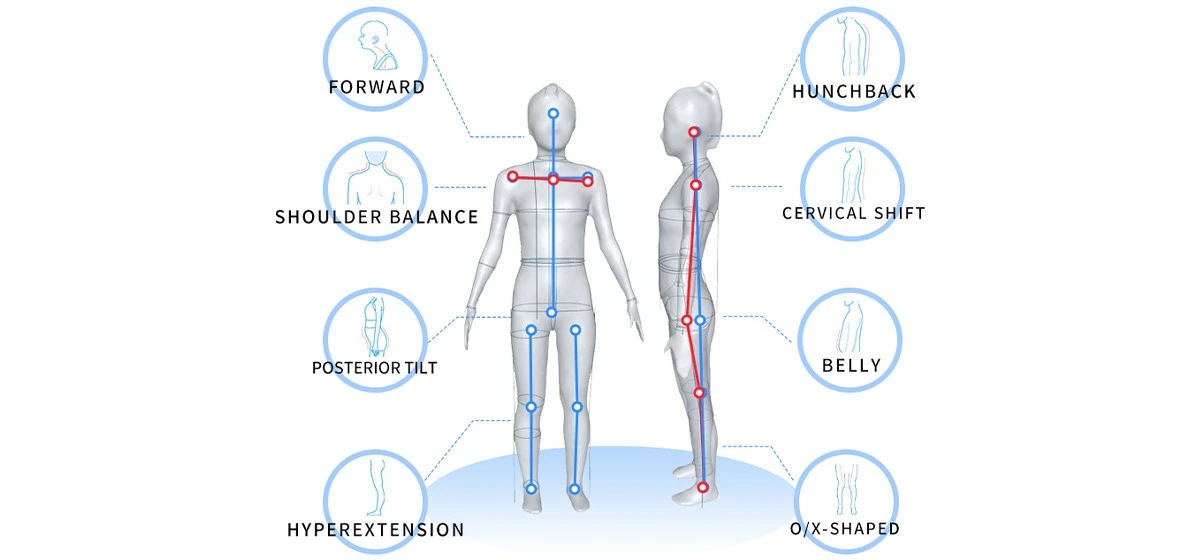
The Xianku3d Body Scanner incorporates advanced 3D structured light scanning and three-dimensional human body reconstruction technology, capable of capturing 2 million data points in seconds to create millimeter-precision 3D human models . This system can extract over 100 body shape parameters, including circumference measurements, spinal curvature, shoulder-neck posture, and dynamic alignment assessments .
3.2 Integration with Biomechanical Analysis
Beyond basic measurement, sophisticated scanning systems integrate biomechanical analysis algorithms that transform raw data into actionable insights. The Xianku3d system, for example, incorporates specialized human mechanics and bio-mechanical analysis capabilities that enable:
- Postural assessment: Automated identification of spinal deviations, pelvic tilts, shoulder asymmetries, and other common postural issues
- Movement analysis: Evaluation of functional movement patterns and identification of compensatory mechanisms
- Progress tracking: Quantitative comparison of sequential scans to document structural and postural changes over time
These analytical capabilities bridge the gap between subjective observation and objective measurement, providing yoga instructors with clinical-grade assessment tools previously available only in specialized medical settings.
4 Implementing 3D Body Scanning in Yoga Studios: Practical Applications
The integration of 3D body scanning technology into yoga studio operations addresses multiple critical challenges simultaneously. When implemented effectively, these systems enhance both client outcomes and business performance through several key applications.
4.1 Enhanced Client Assessment and Personalization
The most immediate application of body scanning technology is in the initial client assessment process. Rather than relying solely on subjective observation or basic fitness tests, studios can conduct comprehensive 3D scans during client onboarding to establish precise baseline measurements. This objective assessment enables:
- Individualized program design: Sequencing and pose selection based on specific structural considerations rather than generalized protocols
- Targeted interventions: Identification of specific alignment issues that require particular attention in practice
- Safety considerations: Recognition of potential contraindications based on structural alignment before they manifest as injuries
The visualization capabilities of 3D scanning systems significantly enhance client understanding and engagement. When practitioners can see graphical representations of their own posture and alignment-complete with precise angular measurements and comparative benchmarks-they develop deeper investment in the corrective process. This visual evidence creates motivation beyond abstract goals like "improved flexibility" or "better posture."
4.2 Objective Progress Tracking and Outcome Demonstration
Perhaps the most significant limitation in traditional yoga instruction is the difficulty of quantifying progress. While experienced practitioners may perceive subtle improvements in balance, stability, or ease of movement, these enhancements often defy simple measurement or explanation. 3D body scanning technology solves this challenge by providing:
- Quantifiable metrics: Precise millimeter-scale measurements of postural changes over time
- Visual documentation: Side-by-side comparison of scan results showing tangible improvements
- Trend analysis: Tracking of multiple parameters across successive assessments to demonstrate cumulative benefits
This objective progress tracking has profound implications for client retention and satisfaction. Studios that implement scanning technology report significantly higher renewal rates, as clients can directly observe the value they receive through measurable improvements in their scan results.
4.3 Operational Efficiency and Business Development
Beyond enhancing the client experience, 3D body scanning technology addresses critical business challenges facing yoga studios:
- Standardized assessment protocols: Scanning systems create consistent evaluation processes across all instructors, reducing variability in client experience
- Differentiated value proposition: Advanced technology positions studios as cutting-edge providers, justifying premium pricing
- Ancillary revenue streams: Scan data enables personalized product recommendations, such as custom yoga props, orthopedic pillows, or footwear
The data-driven approach facilitated by body scanning technology also supports more effective sales processes. Rather than making abstract promises about potential benefits, studio staff can show prospective clients concrete examples of improvements achieved by current members, complete with visual evidence and precise metrics.
Table: Xianku3d Body Scanner Technical Specifications and Applications
| Parameter | Technical Capability | Yoga Studio Application |
|---|---|---|
| Scanning Technology | 3D structured light with 2 million point cloud data | Rapid client assessment without physical contact |
| Precision | Millimeter-level accuracy (±1mm for foot scanning) | Detection of subtle postural changes over time |
| Output Parameters | 100+ body shape parameters including spinal curvature, pelvic tilt, joint angles | Comprehensive biomechanical assessment for personalized sequencing |
| Scan Duration | Several seconds for full-body assessment | Efficient integration into studio intake workflows |
| Output Formats | STL, OBJ compatible with 3D printing and digital visualization | Custom prop manufacturing and visual progress tracking |
| Analysis Capabilities | AI-driven postural assessment, biomechanical evaluation | Identification of alignment issues and compensatory patterns |
5 Case Study: Theoretical Implementation of Xianku3d Body Scanner
While comprehensive public case studies specifically documenting the implementation of Xianku 3D Body Scanner in U.S. yoga studios are not yet available, we can extrapolate potential outcomes based on existing technological capabilities and industry trends. This theoretical analysis illustrates the transformative potential of this technology when integrated into studio operations.
5.1 Pre-Implementation Baseline Assessment
Consider a hypothetical yoga studio with the following characteristics before implementing 3D body scanning technology:
- Location: Urban center (e.g., San Francisco, New York, or Chicago)
- Size: Medium-sized studio with 3 practice rooms and 8 instructors
- Membership: 300 active clients with monthly retention rate of 70%
- Pricing: Premium positioning ($200-300 monthly membership)
- Challenges: Stagnant membership growth, high client acquisition costs, difficulty demonstrating differential value versus lower-priced competitors
Without objective assessment capabilities, instructors at this studio rely on visual observation and client feedback to customize practices. Progress tracking is subjective, making it difficult to demonstrate tangible value to clients considering membership renewal.
5.2 Implementation Phase
The studio integrates the Xianku 3D Body Scanner into its client onboarding and progress assessment processes:
- Initial assessment: All new clients receive a comprehensive scan during their first studio visit
- Quarterly progress evaluations: Existing clients undergo follow-up scans to document improvements
- Instructor training: Staff receive specialized education on interpreting scan results and modifying practices accordingly
- Client education: Scan results are incorporated into practice discussions with visual aids and quantitative metrics
The scanning process itself requires approximately 5-7 minutes per client, including scan acquisition, processing, and results explanation. The non-invasive nature of the technology and the immediate visual feedback facilitate high client engagement with the process.
5.3 Post-Implementation Outcomes
Based on the capabilities of the Xianku3d system and industry performance metrics, the studio would likely experience several significant improvements following implementation:
- Increased retention: The ability to demonstrate quantitative progress would likely improve membership renewal rates by 15-20%
- Enhanced differentiation: Technological sophistication would support premium pricing while reducing price sensitivity
- Additional revenue streams: Scan data would enable personalized product recommendations, creating new income sources
- Operational efficiency: Standardized assessment protocols would reduce variability in client experience across instructors
The most significant impact would likely manifest in client satisfaction and engagement. Practitioners who can see visual evidence of their progress-such as improved spinal alignment, reduced pelvic tilt, or corrected shoulder asymmetry-develop deeper commitment to their practice and stronger loyalty to the studio facilitating these improvements.
6 Future Outlook: Technology-Driven Transformation in Wellness
The integration of 3D body scanning technology into yoga studios represents just one manifestation of a broader transformation occurring across the wellness industry. Several converging trends suggest that technological augmentation will become increasingly central to mind-body practices in the coming years.
6.1 Convergence with Digital Platforms and Hybrid Services
The yoga industry's rapid adoption of hybrid service models-with 41% of studios now offering both in-person and virtual options-creates natural synergies with advanced assessment technologies . Future implementations may include:
- Remote assessment capabilities: Simplified scanning technologies for home use, with results transmitted to instructors for virtual program modification
- Integration with AI-powered movement analysis: Combining structural assessment with dynamic movement evaluation using smartphone cameras or wearable sensors
- Digital twin technology: Creating comprehensive virtual models of individual practitioners to simulate practice effects and optimize sequencing
These technological integrations will increasingly blur the boundaries between in-studio and remote practice, creating seamless experiences that maintain assessment rigor regardless of physical location.
6.2 Personalization and Predictive Analytics
As 3D body scanning technology becomes more widespread and datasets grow, studios will increasingly leverage predictive analytics to enhance program effectiveness. Advanced analysis of scan data across large populations will enable:
- Identification of predictive markers: Early detection of structural patterns that typically lead to specific limitations or injuries
- Optimized intervention timing: Data-driven determination of when to introduce specific practices based on individual structural readiness
- Outcome prediction: Statistical modeling of expected improvements based on initial assessment findings and practice frequency
These capabilities will transform yoga from a generalized wellness practice to a precisely personalized intervention methodology, with implications extending into therapeutic applications and preventive healthcare.
6.3 Business Model Evolution and Industry Structure
The integration of advanced assessment technologies will likely catalyze significant evolution in yoga studio business models and industry structure:
- Differentiated service tiers: Studios may offer various levels of technological sophistication, with premium services including regular scanning and data-driven personalization
- Medical integration: Increasing precision and objective assessment capabilities may facilitate partnerships with healthcare providers and insurance reimbursement
- New revenue models: Technology-enabled services may shift pricing structures from simple class packages toward comprehensive wellness subscriptions incorporating assessment, practice, and progress tracking
This technological transformation may also impact industry consolidation, as studios with advanced capabilities potentially achieve superior outcomes and stronger competitive positioning.
7 Conclusion
The U.S. yoga industry stands at a pivotal moment, balancing between traditional practice methodologies and technological innovation. While the market continues to demonstrate robust growth-projected to reach $256.17 billion globally by 2031-studios face significant challenges related to assessment limitations, operational efficiency, and competitive differentiation . The integration of 3D body scanning technology, exemplified by systems like the Xianku3d Body Scanner, offers a promising path forward.
By providing objective assessment capabilities, precise progress tracking, and enhanced personalization, these address critical gaps in current studio operations. The technology enables yoga instructors to transcend the limitations of subjective observation while providing clients with tangible evidence of improvement that enhances engagement and retention. From a business perspective, the implementation of scanning systems supports differentiated positioning, operational standardization, and the development of new revenue streams.
As the wellness industry continues to evolve, the successful integration of technology and tradition will likely define market leadership. Studios that embrace innovations like 3D body scanning while preserving the essential qualities of yoga practice will be uniquely positioned to thrive in an increasingly competitive landscape. The future of yoga instruction appears destined to combine ancient wisdom with cutting-edge technology, creating enhanced outcomes for practitioners and sustainable business models for studio operators alike.
(86)-181-2464-3821
alexliu@xianku.com