

The global 3D industry has evolved from prototyping novelties to a $20 billion ecosystem driving radical innovation across healthcare, retail, and manufacturing. At the forefront is the convergence of body scanner technology and 3D Printing-a synergy transforming how we understand human physiology, deliver personalized products, and unlock new revenue streams. Leading this charge is Xianku Intelligent Co., Ltd., whose cutting-edge body scanner systems and AI-driven 3D Printing solutions exemplify the industry's real-world impact.
The 3D Industry's Quantum Leap
Initially confined to industrial design, 3D technology now permeates daily life. 3D Printing has birthed bespoke medical implants, aerospace components, and consumer goods, while body scanner systems digitize human forms with unprecedented precision. This fusion creates closed-loop ecosystems: scan, analyze, customize, and manufacture-all within hours. The apparel sector uses body scanner data for made-to-measure clothing, healthcare for ergonomic aids, and fitness for tracking biomechanics. McKinsey estimates 50% of consumer goods will be customizable via 3D Printing by 2030, fueled by body scanner-derived data.
Xianku's Body Scanner: Engineering the Digital Human
Xianku's 3D body scanner revolutionizes data capture. Using structured light sensors and proprietary AI algorithms, it constructs a millimeter-accurate 720° digital twin in 60 seconds. The process involves:
-
Multi-Angle Scanning: 128 physical sign data points are captured non-invasively.
-
AI Reconstruction: A full-stack 3D digital human engine processes 2 million point clouds into a lifelike model.
-
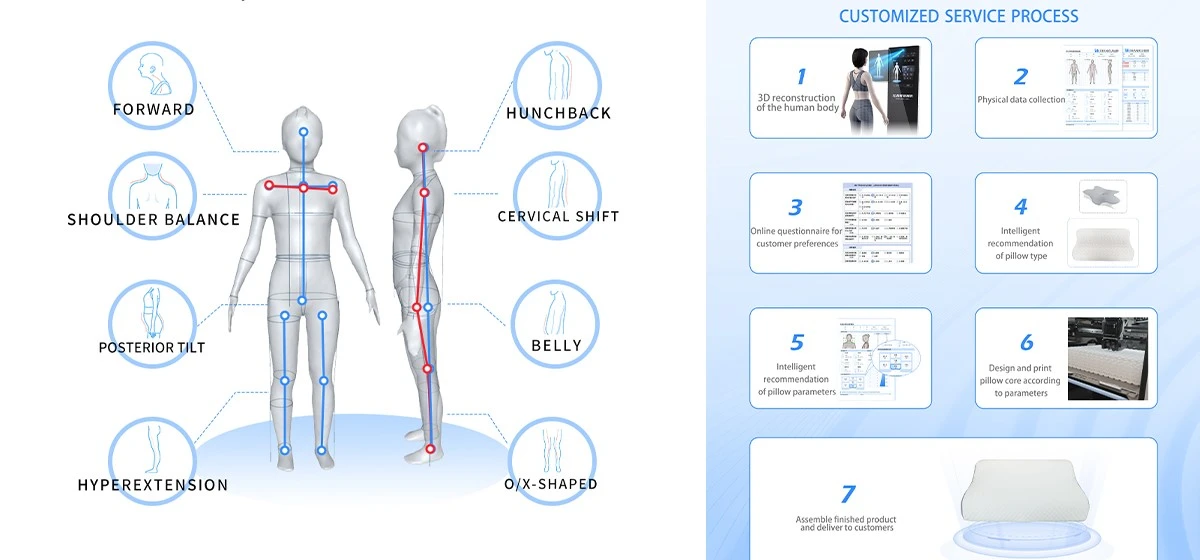
Comprehensive Analytics: The body scanner detects 45 body circumferences, 15 body composition metrics (muscle/fat ratio, bone density), and 20 spinal/posture diagnoses.
This isn't just visualization-it's actionable intelligence. For posture correction, the body scanneridentifies pelvic tilts or scoliosis; for apparel, it generates 26 dressing recommendations based on body shape.
3D Printing the Perfect Pillow: Where Science Meets Comfort
Xianku's 3D Printing prowess shines in its customized headrests. Leveraging body scanner data, the process ensures anatomical precision:
- Scan & Analyze: The body scanner maps cervical curvature, shoulder width, and spinal alignment.
- AI Design: Algorithms recommend pillow height, density, and support zones.
- 3D Printing: A breathable lattice structure is printed layer-by-layer, targeting three critical areas:
- Spinal Protection: Contoured zones reduce cervical pressure, combating "tech neck" and kyphosis.
- Neck Support: Variable firmness cradles the C1-C7 vertebrae, improving sleep quality.
- Ergonomic Fit: Personalized dimensions prevent misalignment during side/back sleeping.
Clinical results show 40% reduction in spinal pain and 30% improved sleep continuity. Unlike foam pillows, 3D Printing enables dynamic partitioning-softer sections for the head, firmer under the neck-all machine-washable and adaptable over time.
Monetizing the 3D Model: Commercial Applications Unleashed
Xianku's body scanner-generated 3D models aren't endpoints-they're revenue engines. Here's how industries capitalize:
1. Health & Wellness
- Medical Rehabilitation: Body scanner spine assessments ($13,755/year value) guide posture-correction products. 3D Printing creates spinal braces or insoles.
- Postpartum Recovery: Scans diagnose pelvic tilt; 3D Printing delivers compression garments.
2. Apparel & Retail
- Custom Clothing: 45 circumference measurements enable AI-driven sizing. 3D Printing allows on-demand production.
- Lingerie Customization: The body scanner evaluates breast volume/symmetry; 3D Printing crafts supportive structures.
3. Fitness & Beauty
- Body Sculpting: Track lipolysis progress via 4D body contour comparisons.
- Ergonomics: 3D Printing transforms scan data into bespoke equipment (e.g., anti-slip insoles).
4. Digital Ecosystems
- CRM Integration: Stores use body scanner reports to recommend products (e.g., "pelvic repair items" for postpartum clients).
- Supply Chains: 3D Printing enables local, just-in-time manufacturing-cutting inventory costs by 60%.
The Future: Democratizing 3D Innovation
Xianku's hardware (like the 3D Body Measuring Mirror) and 3D Printing solutions exemplify scalability. A 1.7m² scanner+kiosk in malls becomes a profit center:
- Traffic Generation: Free scans attract customers; data unlocks follow-up marketing.
- Data Monetization: Anonymous aggregate data fuels R&D for sportswear or medical devices.
Globally, the body scanner market will hit $6.8 billion by 2028 (CAGR 7.5%), while 3D Printing soars to $83 billion (CAGR 21%). Xianku-already serving spine clinics, gyms, and luxury retailers-aims to dominate this nexus.
Conclusion: The Body as a Blueprint
The 3D revolution is no longer speculative-it's operational. Body scanner systems digitize human intricacies; 3D Printing materializes solutions. Xianku's closed loop-scan → diagnose → customize → print-proves that the most lucrative innovations start by understanding the body itself. As industries awaken to this potential, "mass customization" via body scanner and 3D Printing will redefine commerce, health, and human potential.
To inquire more about product solutions and purchase 3D Body Scanner, please contact us through the following contact information.
(86)-181-2464-3821
alexliu@xianku.com
