

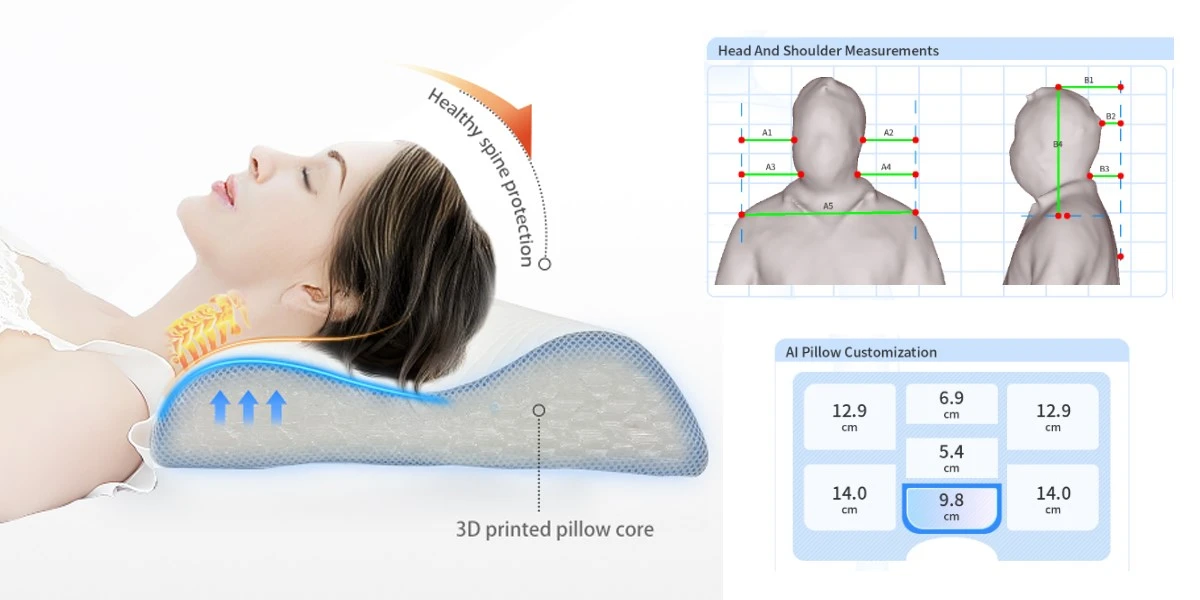
For centuries, the humble pillow has been a one-size-fits-all solution to a deeply personal need: restorative sleep. Millions suffer from neck pain, stiffness, and poor sleep quality, often unknowingly caused by a fundamental mismatch between their unique anatomy and their generic pillow. The emerging field of pillow customization seeks to solve this, but has been hampered by guesswork and simplistic adjustments. Enter the Xianku3D Body Scanner. This technology shatters the old paradigm, transforming pillow customization from an art into a precise science. By creating a data-driven, closed-loop system from body scan to 3D-printed product, Xianku3d is not just selling a better pillow; it is offering a clinically-informed sleep solution, unlocking a new frontier in personalized wellness and commercial profitability.
The High Cost of a Mismatched Pillow: Beyond Neck Pain
The primary function of a pillow is to maintain spinal neutrality-keeping the cervical spine in a straight, natural alignment with the thoracic and lumbar spine when lying down. A pillow that is too high, too low, too firm, or too soft disrupts this alignment, forcing the neck muscles and ligaments to strain throughout the night to provide support.
The consequences are significant. Studies, including those published in the Journal of Physical Therapy Science, have linked improper pillow use to:
- Cervicogenic Headaches: Pain referred from aggravated cervical facets and muscles.
- Exacerbated Sleep Apnea: Improper neck positioning can obstruct airways.
- Chronic Postural Dysfunction: Poor sleep posture perpetuates imbalances seen during the day, such as forward head posture.
Traditional pillow customization relies on superficial metrics like height and sleep position (back, side, stomach). However, this ignores critical individual anatomical variables: the curvature of the cervical spine (Cervical Lordosis), the distance from the shoulder to the ear (which dictates side-sleeping height), the size of the cranium, and the individual's body weight, which affects sinkage. Xianku's system is the first to integrate all these variables into a quantifiable pillow customization process.
The Anatomy of a Perfect Pillow: Data-Driven Design via 3D Scanning
The Xianku3D Body Scanner moves far beyond a simple photograph. It performs a full-body topographic analysis in seconds, capturing over 2 million data points with millimeter-level accuracy. For pillow customization, it extracts a specific set of critical biometrics that form the digital blueprint for the ideal pillow.
Table 1: Key Anatomical Metrics for Pillow Design & Their Functional Impact
| Xianku3d Scan Metric | Clinical / Anatomical Significance | Application in Pillow Design |
|---|---|---|
| Cervical Curve Angle (Lordosis) | The natural inward curve of the neck. A severe angle (>27°) or loss of curve (military neck) indicates stress and altered biomechanics. | The Core Design Parameter. Dictates the contour and depth of the cervical roll. A deeper lordosis requires a more pronounced, supportive curve to fill the space without pushing the head forward. |
| Shoulder Width & Height | Determines the structural foundation and the distance from the mattress to the neck in side-sleeping. | Crucial for Side-Sleep Support. Directly determines the necessary pillow height to keep the spine horizontal. A broader shoulder requires a taller pillow to prevent the neck from bending downward. |
| Head-to-Shoulder Offset (Side Position) | The vertical distance from the acromion (shoulder bone) to the ear. | The Primary Input for Side Pillow Loft. This measurement is used to calculate the exact loft (height) needed to maintain cervical neutrality when sleeping on one's side. |
| Cranial Volume & Weight | The mass and size of the head. | Determines Firmness and Material Density. A heavier head will sink deeper into a given material. This data informs the choice of 3D printing material density and the lattice structure's resistance to compression. |
| Thoracic Kyphosis & Postural Analysis | The curvature of the upper back. Increased kyphosis (hunchback) often accompanies forward head posture. | Informs Holistic Design. A severely kyphotic spine may benefit from a slightly different cervical angle to encourage gentle traction and opening of the chest during sleep. |
| Body Mass Index (BMI) | A general indicator of body composition. | Secondary Factor for Sinkage Calculation. Helps fine-tune the material properties to ensure the pillow provides consistent support regardless of the user's weight. |
This dataset moves pillow customization from a vague concept to a precise engineering specification. The scanner's AI doesn't just suggest a "medium loft, firm pillow"; it generates a detailed report specifying, for example, a "5.5cm loft for side sleep with a 42° cervical contour and a 70kg compression resistance lattice."
From Data to Dream Pillow: The Xianku-Powered 3D Printing Pipeline
The genius of the Xianku3d system is its closed-loop, end-to-end solution. It doesn't just provide data; it provides a direct path to a physical product.
1. Scan: The user is scanned in under a minute, fully clothed or in form-fitting attire. The process is safe, using non-contact infrared structured light.
2. Analyze: The software automatically calculates all relevant postural and anatomical metrics, with a specific module for sleep health. It generates a "Spinal Health Report" that highlights cervical issues and directly links them to the need for a custom solution.
3. Design: This is where the Closed-Loop Recommendation engine shines. The AI takes the biometric data and feeds it into a generative design algorithm. This algorithm creates a unique, multi-zone 3D model of a pillow core:
- A central cervical well with a curvature matching the user's lordosis.
- Variable loft regions for side and back sleeping, calculated from shoulder width and head size.
- An internal lattice structure whose density and geometry are graded to provide specific levels of support and breathability in different zones.
4. Print: The digital design file is sent directly to an industrial 3D printer. Using advanced materials like Thermoplastic Polyurethane (TPU) or flexible polymers, the printer constructs the pillow core layer by layer. This allows for complexities impossible with traditional foam molding, such as a single core with multiple firmness zones.
5. Assemble & Deliver: The 3D-printed core is placed inside a hypoallergenic, breathable fabric cover, and the product is shipped directly to the customer.
Table 2: Competitive Advantage: Xianku3d's End-to-End Ecosystem vs. Standard Body Scanners
| Aspect | Standard Body Composition Scanner (e.g., Inbody) | Xianku3D Body Scanner with Pillow Customization |
|---|---|---|
| Relevant Data Output | Weight, BMI, muscle mass, body fat %. No postural or spinal data. | Comprehensive 3D model: Spinal angles, shoulder offset, postural alignment, volumetric data. |
| Pillow Recommendation | None, or generic based on height/weight. | Precise, data-driven prescription for loft, contour, firmness, and material density. |
| Manufacturing Link | None. | Fully integrated. Seamless workflow from scan data to 3D printable file for bespoke pillow cores. |
| Value Proposition | Health metric tracking. | A tangible, high-margin product (a custom pillow) derived from scan data. |
| Commercial Application | Selling subscriptions or follow-up consultations. | Selling a physical product with a high perceived value ($200-$500+), creating a new revenue stream. |
| Customer Experience | Informative. | Transformative. Customers receive a product uniquely engineered for their body, solving a direct pain point. |
Solving Industry Pain Points:
Problem 1: High Product Return Rates and Customer Dissatisfaction in the Sleep Industry
Solution: The mattress and pillow industry suffers from notoriously high return rates due to the subjective nature of "comfort." Xianku3d's data-driven approach removes the guesswork. The sales process is no longer subjective; it's a consultative, diagnostic experience. The retailer can show the customer their spinal misalignment on a report and explain exactly how the custom pillow is designed to correct it. This clinical justification drastically reduces returns and builds immense trust, turning a commodity transaction into a professional health service.
Problem 2: Lack of Differentiation for Wellness Clinics and Physical Therapists
Solution: Chiropractors, physiotherapists, and wellness centers constantly seek effective, retail-able products to complement their hands-on care. A generic pillow sold in the lobby has little credibility. A 3D-printed pillow prescribed based on a scan taken in the clinic is a differentiator. It extends the clinician's expertise into the patient's home, reinforcing treatment (e.g., maintaining cervical alignment after an adjustment) and providing a significant ancillary revenue stream. It represents a true fusion of healthcare and product.
Problem 3: The Complexity and Cost of Custom Manufacturing
Solution: Traditionally, creating a custom molded pillow was a messy, expensive, and time-consuming process involving plaster casts and manual fabrication. Xianku3d's digital workflow automates and demystifies this. The scan-to-print process is clean, digital, and scalable. A wellness center or furniture store doesn't need manufacturing expertise; they simply need the Xianku scanner. The backend AI and partnered manufacturing hubs handle the complex design and production, making advanced pillow customization accessible to any business.
References & Technical Notes
- Cervical Lordosis: The natural inward curvature of the cervical spine (neck). A normal range is typically between 20° and 40°. Hypolordosis (straight neck) or hyperlordosis can lead to pain and dysfunction. (Source: Journal of Manipulative and Physiological Therapeutics).
- Generative Design: An iterative design process that uses AI algorithms to generate optimal structures based on constraints (e.g., support here, softness there). This is ideal for creating complex, graded lattice structures inside 3D printed pillows.
- TPU (Thermoplastic Polyurethane): A flexible, durable, and elastic polymer that is perfect for 3D printing applications requiring cushioning and rebound, such as pillow cores and midsoles.
- Shoulder-to-Ear Distance: A critical anthropometric measurement for ergonomics. In side-sleeping, this distance, minus the compression of the mattress and shoulder tissue, determines the optimal pillow loft to maintain spinal neutrality.
- Gordon, S. J., et al. (2010). A randomized comparative trial of cervical pillows for the treatment of chronic neck pain. This study found that subjects using pillows matched to their sleeping posture experienced significant reductions in neck pain and disability.
- The Sleep Health Foundation: Publishes extensive data on the economic and social costs of poor sleep, often related to poor sleep hygiene and unsuitable sleep environments.
Conclusion
The journey to better sleep and spinal health has long been fraught with trial and error. The Xianku3D Body Scanner and its integrated pillow customization platform bring this journey to an end. By leveraging precise biometric data, AI-driven design, and the flexibility of additive manufacturing, Xianku3d delivers a product that is as unique as the individual using it. This is more than a technological innovation; it is a commercial paradigm shift. It empowers retailers, clinicians, and wellness experts to move beyond selling products to providing engineered solutions, creating unparalleled customer value and unlocking powerful, high-margin revenue streams in the burgeoning market of personalized health. The future of sleep is not just smart; it is bespoke.
(86)-181-2464-3821
alexliu@xianku.com
