

The core issues are twofold
First, the "Demand-Supply Mismatch." Manufacturers and retailers rely on historical sales data and broad demographic trends to predict what will sell. A 2022 report by the Home Furnishings Association indicated that in the U.S. alone, inefficiencies in demand forecasting contribute to an estimated $7.3 billion in excess inventory annually, much of which ends up discounted or written off. This isn't just a hit to the bottom line; it's a monumental waste of resources.
Second, the "Differentiation Dilemma." In a market crowded with lookalike products, brands struggle to move beyond price competition. While giants like IKEA have mastered affordable, modular design and efficient flat-pack logistics, and Roche-Bobois is celebrated for its high-end, customizable designer furniture, the mid-market often gets stuck in a cycle of imitation. Brands like Pottery Barn and West Elm have built loyal followings through strong lifestyle branding and consistent quality, yet the actual product selection for an individual's unique physiological needs remains limited. Tempur-Pedic revolutionized sleep with its memory foam, marketing "personalized comfort" through material science, but even this relies on the customer's subjective feel during a brief store lie-down, not objective bodily data.
The question emerges: In an age of hyper-personalization-from Netflix algorithms to custom Nike sneakers-why does the industry that impacts our postural health and daily comfort the most remain so generically standardized?
The answer, until now, has been a lack of scalable, objective technology to bridge the gap between the unique human body and the products built to support it. Enter the next phase of retail innovation: professional body scan technology. This isn't a sci-fi gimmick; it's a clinical-grade tool moving into the retail environment, and it's poised to redefine "custom fit" for the home.
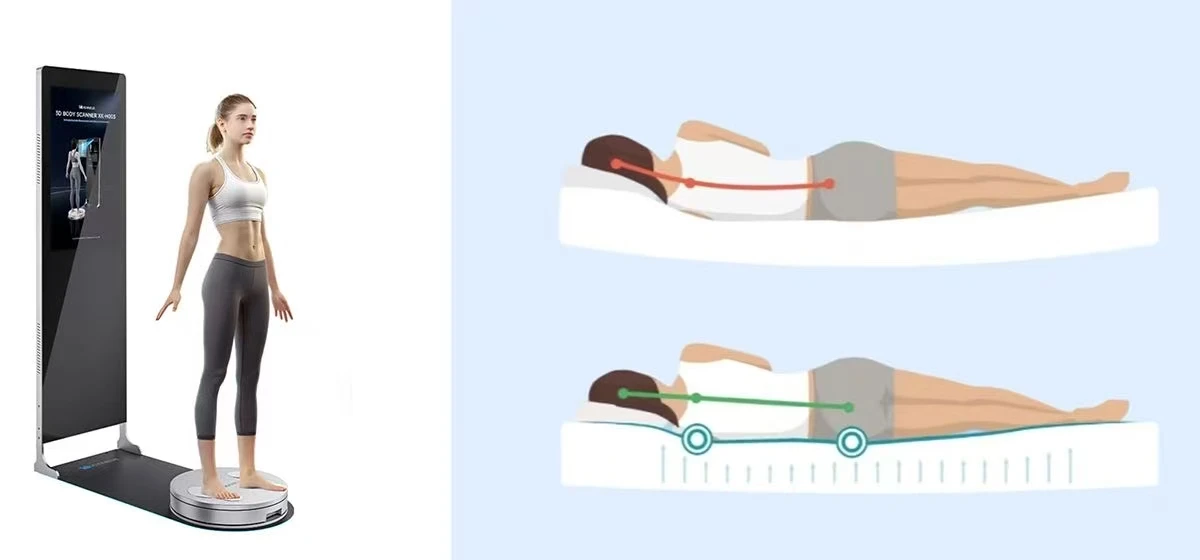
Leading this charge is the Xianku3d Body Scanner, a sophisticated device that leverages 3D structured light scanning and AI-powered analytics. In just 20 seconds, it captures over 1 million data points to construct a precise, true-to-scale 3D avatar of an individual. Within a minute, it generates a comprehensive report that moves far beyond simple weight and BMI. The true differentiator lies in its AI-driven postural and spinal health assessment.
This is where the narrative shifts from selling a product to offering a diagnostic service. The scanner quantifies what was once guesswork:
- Spinal Alignment: It calculates the curvature angles of the cervical, thoracic, and lumbar spine, identifying conditions like hyperlordosis (excessive inward curve) or kyphosis (hunchback).
- Pelvic Tilt: It measures the orientation of the pelvis, a critical factor in lower back stress.
- Shoulder and Head Posture: It assesses forward head posture and shoulder asymmetry, common issues in the desk-bound modern workforce.
Table 1: Key Postural Metrics Analyzed by the Xianku3d Body Scanner
| Metric | What It Measures | Why It Matters for Furniture |
|---|---|---|
| Cervical Curvature | The natural inward curve of the neck (lordosis). | Critical for pillow design. A straightened cervical spine requires contoured support to maintain airway alignment and reduce muscle strain during sleep. |
| Thoracic Curvature | The outward curve of the upper back (kyphosis). | Informs backrest design for chairs and sofas. Increased kyphosis requires targeted lumbar and mid-back support to prevent slouching. |
| Lumbar Curvature | The inward curve of the lower back (lordosis). | The cornerstone of mattress and seating support. Loss of lumbar curve can lead to disc pressure; excessive curve can cause facet joint stress. Support must be zone-specific. |
| Pelvic Tilt (Anterior/Posterior) | The forward or backward rotation of the pelvis. | Directly impacts spinal alignment when seated or lying down. A tilted pelvis can throw the entire spine out of balance, requiring calibrated cushioning. |
| Scapular Symmetry | Evenness of shoulder blade height and position. | Indicates muscular imbalances or spinal scoliosis, affecting how weight is distributed across a mattress or chair. |
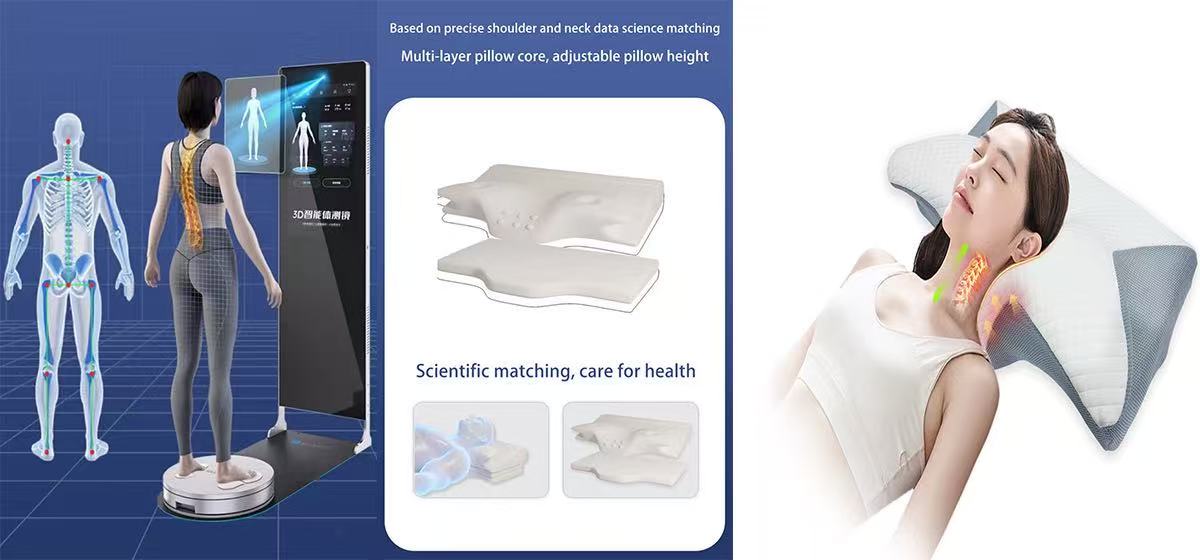
Armed with this data, combined with a simple lifestyle questionnaire (desk job hours, sleep positions, existing pain points), the scanner's AI does not simply spit out a mattress firmness level. It executes a Multi-Factor Match Algorithm. It cross-references the individual's unique physiological map with a proprietary database of product specifications-from the zoning and density of a mattress's foam layers to the height and fill of a pillow's loft profile.
The in-store experience is transformed. The process"Scan → Analyze → Recommend"feels less like a sales push and more like a professional consultation. Customers are engaged not by a pitch about coil counts, but by a visualization of their own spinal alignment and a clear explanation of how a specific product configuration will address their unique geometry. A 2023 pilot study with retailers in California and Texas using the Xianku system reported a 42% decrease in post-purchase "comfort-related" inquiries and a 28% reduction in mattress returns within the 100-night trial period-a massive cost saver in an industry where return logistics can erase all profit.
The implications ripple far beyond the sales floor.
For Product Design & Inventory Management
Brands can move away from designing for a mythical "average" body. Aggregated, anonymized data from thousands of scans reveals real-world postural trends across different demographics. This enables evidence-based product innovation. For instance, data might show a high prevalence of anterior pelvic tilt in the 30-45 age group, guiding the development of a new mattress line with enhanced lumbar support zoning.
Table 2: Business Impact: Traditional vs. Body-Scan Integrated Model
| Aspect | Traditional Model | Body-Scan Integrated Model |
|---|---|---|
| Customer Engagement | Transactional; focused on features/price. | Consultative; focused on personalized health & comfort data. |
| Differentiation | Brand story, aesthetics, material quality. | Objective, data-driven personalization. |
| Demand Forecasting | Based on past sales & trend extrapolation. | Informed by real-time, aggregated biomechanical data of the customer base. |
| Return Rates | High (often 5-12% for mattresses online). | Significantly reduced due to precise, data-validated matching. |
| Upsell/Cross-sell Path | Subjective suggestions ("This pillow looks nice"). | Logical, data-led recommendations (e.g., specific pillow for cervical support, ergonomic chair for pelvic tilt). |
| Customer Data Asset | Basic contact info, purchase history. | Rich, 3D biomechanical profile enabling true lifecycle marketing. |
For Marketing and Customer Lifecycle Management
The initial body scan serves as a powerful "foot in the door," often offered as a complimentary "Postural Health Assessment." Once a customer is in the system, the relationship is transformed. They are not just a name on a list; they have a "body profile." Follow-up communications can be highly relevant: "Tips for maintaining your spinal curvature while working from home," or "An update on our new pillow line designed for your cervical support category." This builds a health-centric brand community, akin to the wellness ecosystems built by fitness tech companies.
The value proposition expands further. The precise data from a full body scan doesn't just guide a mattress purchase. It creates a blueprint for a holistic supportive environment. It can recommend an office chair with specific lumbar depth and seat pan angle, or suggest the optimal firmness for a car seat cushion. It opens avenues for partnerships with ergonomic brands, chiropractors, and wellness centers, positioning the furniture retailer as the hub of "environmental health."
Of course, trust is paramount. The technology must be presented with transparency and professionalism, emphasizing its role as an advisory tool. The body scan analysis is not a medical diagnosis but a detailed assessment of alignment and measurements to inform product fit-a crucial distinction that upholds both utility and ethical responsibility.
Conclusion
the home furnishings industry's stagnation in the face of inventory gluts and thin margins isn't just a business problem; it's a disconnect from the fundamental human need for comfort and support. As trailblazers like Hästens, with its ultra-luxury, hand-crafted beds, understand, the future belongs to those who offer not just a product, but a personalized sanctuary. Technology like the Xianku3d Body Scanner provides the scalable, scientific toolkit to make this level of personalization accessible. It turns the vague promise of "comfort" into a data-verified reality, guiding customers to their perfect match with unparalleled precision. This isn't just about moving inventory faster; it's about building a healthier, more responsive, and deeply loyal relationship with every person who walks through the door, finally solving the "one-size-fits-none" conundrum for good.
Table 3: The Personalized Furniture Journey: A Step-by-Step Look
| Step | Activity | Technology & Data Used | Customer Benefit |
|---|---|---|---|
| 1. Engagement | Complimentary "Posture & Fit Assessment" offered. | Marketing funnel tool. | Low-barrier, high-value incentive to visit. Perceived as a service, not a sales tactic. |
| 2. Acquisition | 20-second 3D structured light body scan performed. | Xianku scanner captures 1M+ data points for 3D model. | Quick, non-intrusive, "high-tech" experience. Immediate visual engagement with 3D avatar. |
| 3. Analysis | AI generates report on spine, posture, and measurements. | AI algorithms analyze curvature, tilt, symmetry, and pressure points. | Receives objective, easy-to-understand health insights. Moves focus from price to personal need. |
| 4. Recommendation | AI matches profile to configured products. | Multi-Factor Match Algorithm cross-references scan data with product specs. | Presented with 2-3 highly tailored options, eliminating overwhelm. Recommendations are justified by their own data. |
| 5. Visualization | 3D avatar simulates interaction with recommended product. | Augmented Reality (AR) overlay or simulation software. | Sees how and why the product fits their body, building confidence pre-purchase. |
| 6. Transaction | Informed purchase decision. | Integrated POS with attached customer & scan profile. | Buys with high confidence, reducing buyer's remorse and likelihood of return. |
| 7. Retention | Profile stored for future needs; targeted wellness content. | CRM system with biomechanical data. | Becomes part of a health-focused community. Brand becomes a trusted advisor for lifelong comfort needs. |
