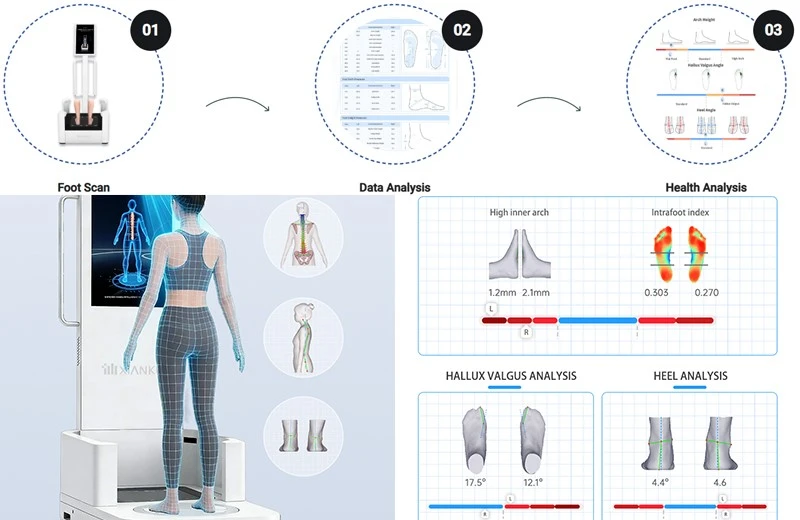
For centuries, foot assessment relied on the practitioner's trained eye. While clinical experience remains invaluable, research increasingly demonstrates that visual assessment alone misses critical information. This article explores how 3D scanning technology quantifies what the eye cannot see, enabling evidence-based podiatry practice.
The Subjectivity Problem in Traditional Assessment
When two practitioners assess the same patient, their conclusions often differ. Studies show inter-rater reliability for visual posture assessment ranges from 0.4 to 0.7 (where 1.0 is perfect agreement). This variability has significant clinical implications:
| Assessment Area | Visual Reliability | Clinical Impact |
|---|---|---|
| Flat foot classification | Moderate | Different treatment approaches |
| Heel alignment | Low | Incorrect orthotic posting |
| Arch height estimation | Low | Mismatched support levels |
| Hallux valgus staging | Moderate | Delayed surgical referrals |
The detection threshold gap is equally concerning. By the time an issue is visible to the naked eye, it has often been developing for years:
| Condition | Visual Detection Threshold | Xianku Detection Threshold |
|---|---|---|
| Flat foot progression | 5mm arch height change | 0.5mm change |
| Heel valgus | 4° visible asymmetry | 0.5° measurement |
| Hallux valgus | 15° noticeable deviation | 1° early detection |
| Leg length discrepancy | 10-15mm gait change | 1mm measurement |
What Xianku Quantifies
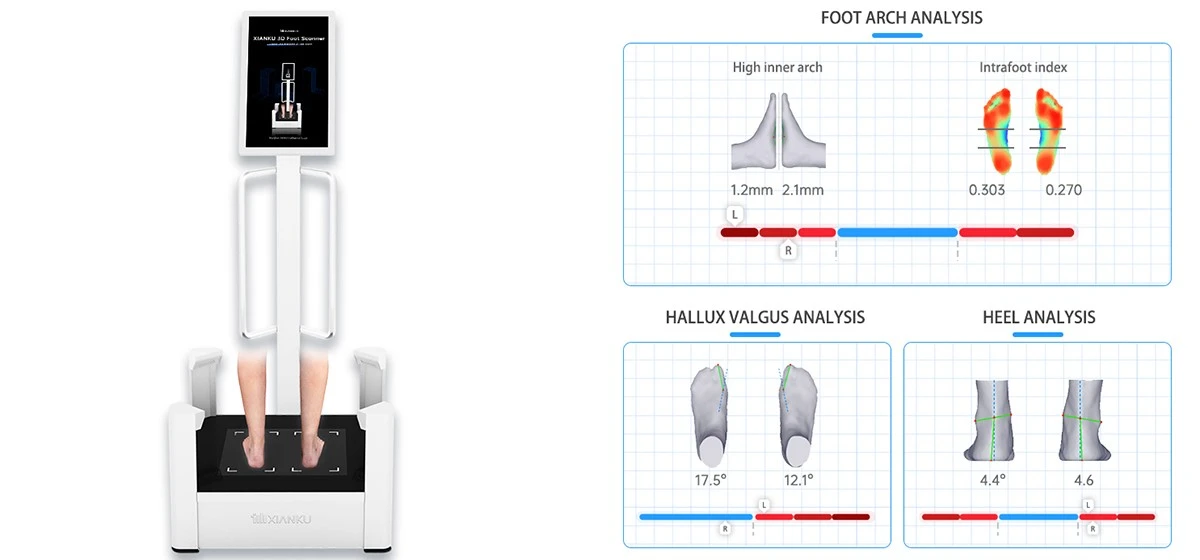
The Xianku 3D Foot Scanner captures objective measurements across 30+ parameters:
1. Arch Index (AI)
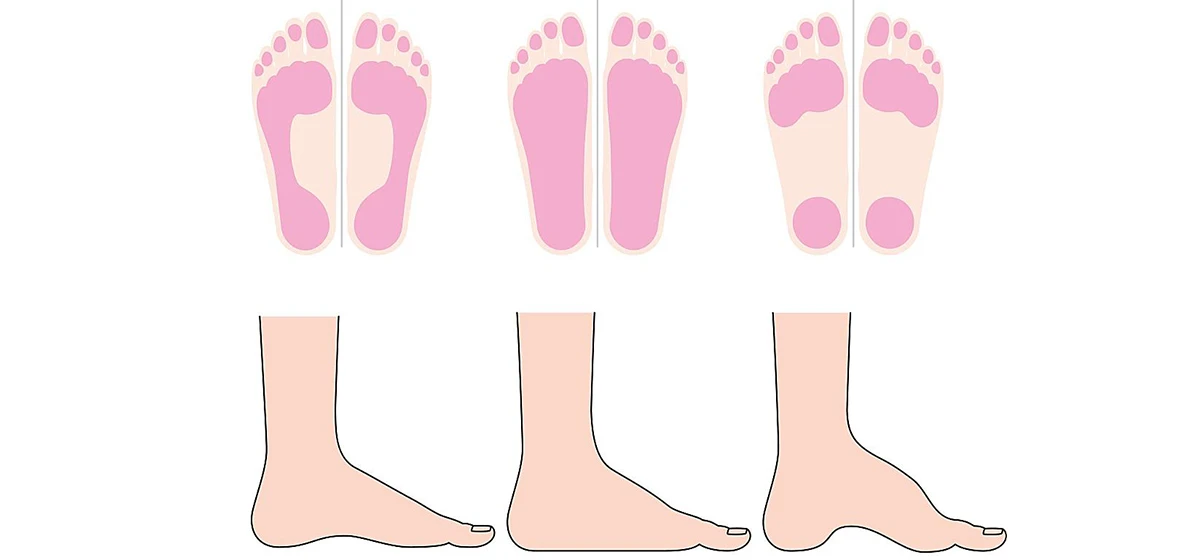
The ratio of the midfoot area to the total foot area (excluding toes). This scientifically validated metric classifies foot type with precision:
| Arch Index Range | Classification | Clinical Implications |
|---|---|---|
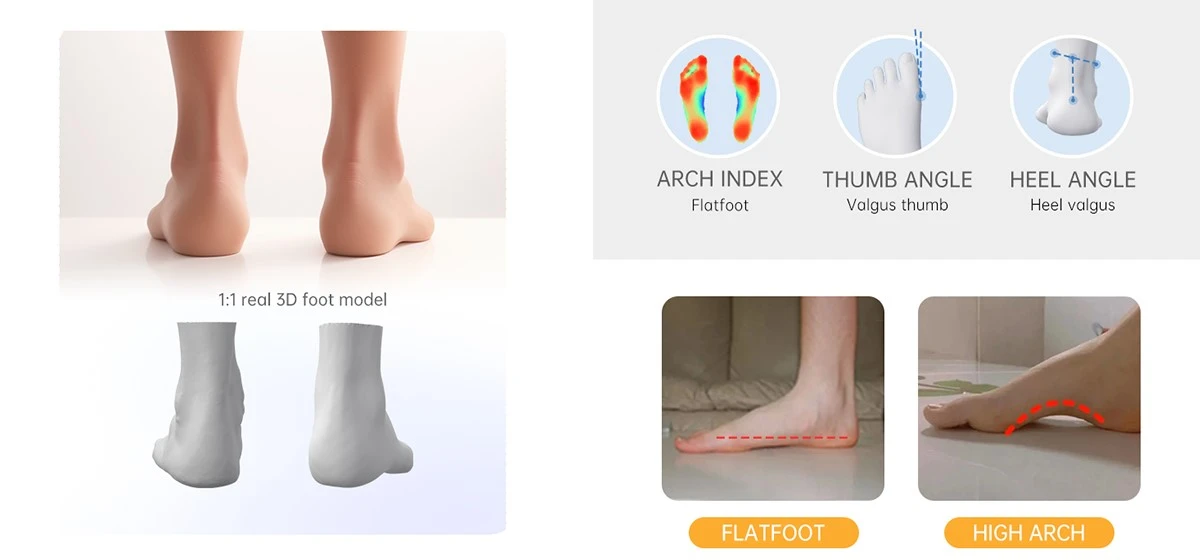
| >0.26 | Pes Planus (Flat Foot) | Overpronation risk, requires stability support |
| 0.21–0.26 | Neutral | Normal biomechanics, standard support |
| <0.21 | Pes Cavus (High Arch) | Reduced shock absorption, requires cushioning |
Research published in the Journal of Foot and Ankle Research demonstrates that Arch Index measurements from 3D scanning correlate strongly with radiographic assessment (r > 0.85).
2. Hallux Valgus Angle (HVA)
The angle between the first metatarsal and proximal phalanx provides objective bunion staging:
| HVA Range | Severity | Clinical Recommendations |
|---|---|---|
| 15°–20° | Mild | Conservative management, wider toe box |
| 21°–39° | Moderate | Orthotic intervention, consider splinting |
| >40° | Severe | Surgical consultation likely |
Early detection at mild stages enables conservative intervention before progression to surgical necessity.
3. Heel Inclination Angle
The vertical tilt of the calcaneus relative to the weight-bearing surface reveals critical biomechanical information:
| Measurement | Interpretation | Implications |
|---|---|---|
| >4° valgus (outward) | Overpronation | Medial knee stress, plantar fasciitis risk |
| >4° varus (inward) | Oversupination | Lateral ankle instability, stress fractures |
4. Ball Girth (MTP Joint Circumference)
Circumference around the metatarsal heads determines shoe fit requirements. Variance >5mm from standard sizing requires customized lasts to prevent metatarsalgia and neuroma formation.
5. Medial Arch Height
Peak height of the navicular bone from the supporting surface. Values <15mm correlate strongly with plantar fasciitis risk.
The Research-Grade Data Advantage
For podiatry researchers and evidence-focused clinicians, Xianku's measurement capabilities enable:
Longitudinal studies with precise, reproducible measurements across time. The 98% intra-class correlation coefficient ensures that changes reflect actual patient progression, not measurement error.
Multi-center research using standardized measurement protocols eliminates the variability that plagues multi-site studies using manual assessment.
Treatment outcome documentation with objective before/after comparisons strengthens publications and presentations.
Case Study: Research Collaboration Potential
A podiatry research institute in the Netherlands is using Xianku scanners across four clinical sites to study flat foot progression in adolescents. The standardized data collection enables:
- 500+ patients with baseline measurements
- Quarterly follow-up scans without radiation exposure
- Correlation of arch index changes with symptom development
- Identification of risk factors for progression
The lead researcher notes: "Before Xianku, multi-site studies were compromised by inter-rater variability. Now we know that an arch index of 0.28 in Amsterdam means the same thing as 0.28 in Rotterdam."
Integrating Objective Data into Clinical Practice
For practicing podiatrists, objective measurements enhance every aspect of care:
Diagnostic confidence: When the scanner confirms your visual findings, you proceed with certainty. When it reveals something you missed, you learn.
Treatment planning: Precise measurements guide orthotic prescription-arch index determines support level, heel inclination angles guide posting requirements.
Progress tracking: Follow-up scans provide objective evidence of improvement, justifying continued treatment to patients and payers.
Patient communication: Numbers don't lie. When patients see their hallux valgus angle decreasing or their arch index normalizing, compliance improves dramatically.
The Evidence Base
Xianku's measurement algorithms are trained on over 1.3 million foot scans, with ongoing validation against gold-standard methods. Key validation studies demonstrate:
- Cobb angle correlation: r > 0.85 with radiographic measurements for spinal parameters applicable to foot assessment
- Inter-rater reliability: 98% ICC across multiple operators
- Test-retest reliability: ±0.5mm maximum variation between scans
Conclusion
Visual assessment will always have a place in podiatry-the experienced clinician's intuition remains valuable. But intuition without measurement is guesswork. The Xianku 3D Foot Scanner provides the objective data that transforms podiatry from an art into a science, enabling evidence-based practice that benefits both clinicians and patients.
Call to Action: Bring objective measurement to your practice. Contact Xianku to learn how our 3D foot scanning technology enhances diagnostic precision and clinical outcomes.
Sources:
Xianku clinical validation studies
Foot and ankle research literature
Xianku technical specifications