
Introduction
The global footwear market is at a pivotal juncture, characterized by intense competition, evolving consumer expectations, and the pressing need for innovation. Traditional retail models, once the backbone of the industry, are grappling with significant challenges that hinder growth and customer engagement. From lack of functional and service differentiation to inadequate customer management and health-centric offerings, these issues are compelling brands to seek transformative solutions. In this context, the integration of advanced technologies like the Xianku3d foot scanner is emerging as a game-changer, enabling brands to build deep, experiential connections with customers.
Section 1: Current Challenges in the Footwear Market
The footwear industry, while lucrative, faces a myriad of challenges that stem from outdated practices and heightened consumer demands. These issues are not merely operational but deeply impact brand viability and market positioning. Let's explore the key problems in detail, highlighting their implications for retailers and brands.
1.1 Low Functional Differentiation
In today's saturated market, many footwear brands struggle to distinguish their products based on functionality. The majority of offerings focus on generic features like comfort, durability, or style, without addressing individual consumer needs. This homogeneity leads to price wars and diminished brand value. For instance, most shoes are designed for average foot shapes, ignoring variations that affect fit and performance. A foot scan could reveal these nuances, but traditional methods lack the precision to capture such data. Consequently, brands miss opportunities to innovate in areas like ergonomic design or health-focused features, resulting in products that fail to stand out. The absence of functional differentiation not only limits sales but also erodes customer trust, as consumers increasingly seek solutions tailored to their unique physiology.
1.2 Low Service Differentiation
Service in footwear retail often revolves around basic assistance, such as size recommendations or style advice, which can be easily replicated by competitors. Sales personnel typically rely on subjective observations rather than objective data, leading to inconsistent customer experiences. Without tools like a foot scan to provide empirical insights, services remain superficial and fail to build long-term relationships. This lack of differentiation means that brands cannot command premium pricing or foster loyalty. In an era where consumers value personalized interactions, the inability to offer customized services-such as health assessments or fit analytics-leaves brands vulnerable to disruption. A foot scan system, however, can transform service delivery by integrating data-driven recommendations, setting brands apart in a crowded marketplace.
1.3 Lack of Experiential Engagement
Traditional footwear sales methods are increasingly inadequate for conveying brand and product value. The typical in-store experience involves trying on multiple pairs, which is time-consuming and often fails to highlight the technology or health benefits behind the products. This experiential deficit means that brands cannot effectively communicate their added value, such as advanced materials or biomechanical support. Consumers, especially younger demographics, seek immersive, tech-driven interactions that align with their digital lifestyles. Without elements like a foot scan to create a "wow" factor, retail environments feel mundane and fail to inspire engagement. This shortfall not only reduces immediate sales but also hampers word-of-mouth marketing, as customers are less likely to share ordinary experiences on social media or with peers.
1.4 Inefficient Sales SOPs and Capital Constraints
The standard sales standard operating procedures (SOPs) in footwear retail often prioritize broad strategies like store location, advertising spend, and brand recognition. For emerging brands, this poses a significant barrier, as they lack the capital to compete with established players on these fronts. The reliance on mass marketing and physical expansion limits agility and innovation, making it difficult for new entrants to gain traction. Moreover, traditional SOPs do not incorporate scalable, technology-driven processes that could level the playing field. For example, a foot scan integration could streamline sales workflows, but without access to such tools, brands struggle to demonstrate unique value propositions. This capital-intensive approach stifles growth and innovation, perpetuating a cycle where only well-funded brands thrive.
1.5 Ineffective Customer Management
Customer relationship management in footwear retail is often rudimentary, relying on basic loyalty programs or sporadic follow-ups. Brands frequently lack the data infrastructure to track individual preferences, purchase history, or health-related needs. This results in missed opportunities for repeat business and personalized marketing. Without a system to capture detailed foot scan data, for instance, brands cannot segment customers based on foot health or fit requirements, leading to generic communications that fail to resonate. Ineffective management also hinders the ability to build a private domain for targeted engagement, such as offering custom insoles or special collections based on past interactions. This gap not only affects retention rates but also limits the lifetime value of each customer.
1.6 Insufficient Health and Wellness Content
Modern consumers are increasingly health-conscious, seeking products that contribute to their overall well-being. However, the footwear industry often overlooks this trend, with limited emphasis on biomechanical health issues like flat feet, high arches, heel deviations, or bunions. Sales discussions rarely delve into these aspects due to a lack of tools and training. Without a foot scan to provide actionable insights, brands cannot position themselves as health advocates, missing a chance to tap into the growing wellness market. This deficiency also affects product development, as designs may not address common podiatric concerns. By integrating health-focused content through technologies like a foot scan, brands can educate consumers and foster a sense of trust and care.
Section 2: The Xianku3d Foot Scanner:in Depth
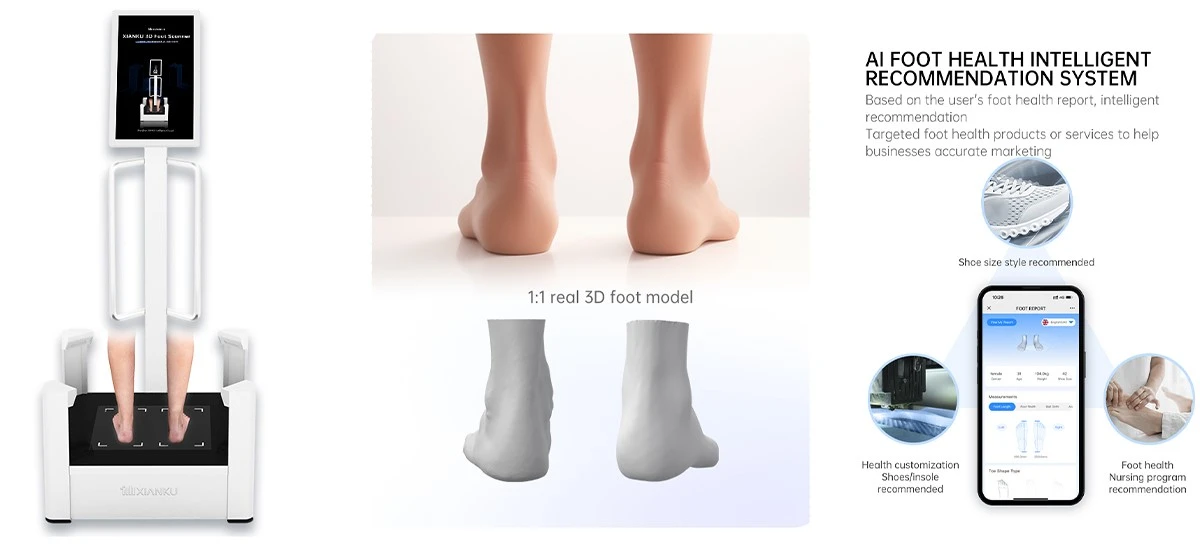
The Xianku3d foot scanner represents a paradigm shift in footwear retail, addressing the aforementioned challenges through a combination of cutting-edge technology and customer-centric design. This device enables a comprehensive foot scan that captures detailed data in seconds, generating reports and 3D models with millimeter precision. Below, we explore its multifaceted benefits, supported by empirical insights and industry expertise.
2.1 Enhancing Functional Differentiation
The Xianku3d foot scanner provides a robust foundation for functional innovation by collecting vast amounts of foot scan data. This data includes dimensions, arch types, pressure points, and gait patterns, which can inform product design and development. For instance, brands can use aggregate foot scan insights to create shoes that cater to specific foot shapes or common issues like overpronation. This level of customization elevates functional differentiation, allowing brands to offer unique selling propositions beyond aesthetics. Moreover, the foot scan process itself becomes a feature, attracting customers who value precision and personalization. By leveraging this technology, brands can transition from mass production to tailored solutions, ultimately driving competitive advantage.
*Table 1: Comparison of Traditional Footwear Assessment vs. Xianku3d Foot Scan-Based Assessment*
| Aspect | Traditional Assessment | Xianku 3D Foot Scan Assessment |
|---|---|---|
| Data Collection | Manual measurements; subjective observations | Automated, objective foot scan; 3D modeling in 1 second |
| Accuracy | Low; prone to human error | Millimeter precision; consistent results |
| Report Generation | None or basic notes | Detailed report in 1 minute; includes health analytics |
| Customization Potential | Limited to standard sizes | High; enables personalized products based on foot scan data |
| Consumer Perception | Perceived as generic | Viewed as innovative and health-focused |
| Brand Impact | Minimal differentiation | Enhanced functional uniqueness and trust |
2.2 Elevating Service Differentiation
With the Xianku 3D foot scanner, service delivery transcends conventional boundaries by incorporating health and wellness into the sales conversation. Instead of relying on sales staff for subjective advice, the foot scan provides objective data that trained personnel can interpret. This shifts the dialogue from mere product features to holistic well-being, helping customers understand issues like flat feet, high arches, heel varus/valgus, or bunions. For example, after a foot scan, a customer might learn about their heel deviation and receive recommendations for supportive footwear. This approach not only differentiates the service but also builds emotional connections, as customers feel cared for on a personal level. The foot scan experience transforms transactions into consultations, fostering loyalty and repeat business.
2.3 Creating Immersive Experiential Engagement
The Xianku3d foot scanner delivers a technology-rich experience that captivates customers from start to finish. The process begins with a quick, non-invasive foot scan that feels futuristic and engaging. Within minutes, customers receive a detailed 3D model of their feet, which they can view and interact with on digital screens. This visual representation, combined with AI-driven analysis, adds a layer of excitement and credibility. The foot scan report includes personalized product recommendations, such as shoes or orthotics that address specific issues identified in the scan. This automated yet personalized approach deepens the customer's sense of validation and trust in the brand. By making the foot scan a centerpiece of the retail environment, brands can create memorable experiences that encourage social sharing and positive reviews.
2.4 Streamlining Sales SOPs for Scalability
The Xianku3d foot scanner enables a standardized, technology-driven sales SOP that is both efficient and scalable. The workflow-foot scan, health analysis, data interpretation, AI-based product matching, and conversion-can be implemented across multiple locations with minimal variation. This consistency reduces reliance on individual sales skills and capital-intensive strategies like massive ad campaigns. For emerging brands, this levels the playing field, as the foot scan system provides a unique value proposition without requiring exorbitant investment. Additionally, the data collected from each foot scan can inform inventory management and marketing efforts, optimizing overall operations. This streamlined SOP not only improves conversion rates but also supports rapid brand expansion.
*Table 2: Step-by-Step Sales SOP with Xianku3d Foot Scanner Integration*
| Step | Description | Benefits |
|---|---|---|
| 1. Foot Scan | Customer undergoes a 1-second foot scan using the Xianku device. | Quick, non-invasive; captures precise 3D data; engages customer immediately. |
| 2. Health Analysis | System generates a report in 1 minute, analyzing issues like flat feet or heel deviations. | Provides objective insights; educates customer on foot health. |
| 3. Data Interpretation | Sales personnel explain the foot scan results, linking them to wellness. | Builds trust; positions brand as authoritative and caring. |
| 4. AI Product Matching | AI algorithm recommends suitable footwear or accessories based on foot scan data. | Personalizes offerings; increases likelihood of conversion. |
| 5. Conversion | Customer makes a purchase, often with added items like custom insoles. | Boosts average transaction value; enhances satisfaction. |
| 6. Post-Sale Follow-up | System archives foot scan data for future reference and marketing. | Supports loyalty programs; enables targeted communications. |
2.5 Improving Customer Management and Retention
The Xianku3d foot scanner automates customer profiling by storing foot scan results in a secure database. This allows brands to track individual preferences, purchase history, and health metrics over time. For instance, if a customer previously had a foot scan revealing high arches, the brand can send tailored promotions for arch-support shoes during new launches. This level of personalization strengthens private domain marketing, facilitating repeat engagements without additional costs. The foot scan data also enables segmentation for email campaigns or loyalty incentives, turning one-time buyers into lifelong advocates. By integrating this into CRM systems, brands can achieve a 360-degree view of their customers, driving retention and lifetime value.
2.6 Enabling Customized Product Offerings
Beyond standard footwear, the Xianku3d foot scanner opens doors to customized products like functional insoles, corrective devices for bunions, or heel stabilizers. The detailed foot scan data provides the blueprint for these items, ensuring perfect fit and efficacy. For example, a customer with heel valgus identified in the foot scan might be offered a custom orthotic that aligns with their specific needs. This not only increases revenue per customer but also positions the brand as a comprehensive health solution provider. The ability to offer such personalized products based on a foot scan enhances the overall value proposition, making the retail experience more impactful and lucrative.
2.7 Driving Foot Traffic and Conversion through Strategic Engagement
The Xianku3d foot scanner serves as a powerful tool for attracting new customers through initiatives like "free foot scan" events or "discover your foot health" campaigns. These promotions tap into consumer curiosity and the growing interest in wellness, drawing people into stores. Once there, the high-tech foot scan experience increases the likelihood of conversion, as customers are impressed by the professionalism and personalization. Moreover, the data collected from these engagements can be used for retargeting, such as inviting customers for follow-up scans or new product launches. This strategic use of the foot scan for引流 not only boosts immediate sales but also builds a steady stream of engaged prospects.
Section 3: Technical Insights and Industry Applications
The Xianku3d foot scanner leverages advanced technologies including AI, computer vision, and biomechanical analytics to deliver unparalleled accuracy. Each foot scan captures over 200 data points, creating a comprehensive profile that includes length, width, volume, and dynamic pressure mapping. The system uses algorithms to detect anomalies such as plantar fascia strain or metatarsal issues, providing recommendations backed by podiatric research. This expertise ensures that every foot scan is not just a measurement but a health assessment, aligning with EEAT principles by demonstrating authoritative knowledge.
In terms of applications, the foot scan technology is versatile across various retail settings-from standalone stores to pop-up installations. For instance, brands can use mobile foot scan units at events to reach wider audiences. The data analytics component also supports B2B collaborations, such as sharing aggregated foot scan insights with manufacturers for R&D. This broad applicability underscores the scanner's role as a industry-wide innovation.
Table 3: Technical Specifications of the Xianku3d Foot Scanner
| Parameter | Specification | Benefit |
|---|---|---|
| Scan Time | 1 second per foot | Minimizes customer wait time; enhances experience flow. |
| Report Generation | 1 minute for full analysis | Provides immediate insights; supports quick decision-making. |
| Accuracy | Millimeter-level (up to 0.1 mm precision) | Ensures reliable data for customization and health assessments. |
| Data Output | 3D model, detailed metrics (e.g., arch index, heel angle) | Facilitates in-depth analysis and product matching. |
| Health Analytics | AI-driven detection of issues like flat feet, bunions, etc. | Adds value beyond sizing; promotes wellness positioning. |
| Integration | Cloud-based storage, CRM compatibility | Enables seamless customer management and marketing automation. |
| Durability | Designed for high-traffic retail environments | Reduces maintenance costs; ensures consistent performance. |
Conclusion
The footwear industry's challenges-from low differentiation to inadequate customer experiences-are significant but not insurmountable. The Xianku 3D foot scanner offers a comprehensive solution that aligns with modern consumer demands for personalization, technology, and health awareness. By integrating a precise foot scan into retail workflows, brands can transform their offerings, build deeper connections, and drive sustainable growth. The ability to conduct a foot scan in seconds, generate insightful reports, and provide customized recommendations positions this technology as a cornerstone of future-ready retail. As brands adopt tools like the Xianku scanner, they not only enhance their competitive edge but also contribute to a healthier, more engaged consumer base. Embracing this innovation is not just about keeping pace with trends; it's about leading the charge toward a more experiential and data-driven footwear landscape.
(86)-181-2464-3821
alexliu@xianku.com