
1. Introduction
The global safety footwear market continues to demonstrate steady growth, driven by increasing workplace safety regulations and growing awareness of occupational health hazards. As industries worldwide prioritize worker protection, the demand for specialized protective footwear has expanded significantly across sectors including construction, manufacturing, oil and gas, and logistics. However, beneath this growth trajectory lie significant challenges that impact both manufacturers and distributors. The industry faces mounting pressure to differentiate products in an increasingly crowded marketplace, enhance customer engagement, and justify premium pricing through demonstrated value rather than basic compliance. Within this context, innovative technologies like the Xianku3d foot scanner are emerging as transformative tools, offering new approaches to product customization, customer experience, and market differentiation.
This article examines the current state of the protective footwear industry, analyzes its persistent challenges, and explores how digital foot scanning technology can address these issues through data-driven personalization and enhanced service delivery.
2. Market Overview: Size, Segmentation, and Growth Drivers
The global protective footwear market represents a substantial segment within the broader occupational safety equipment industry, with consistent growth projected across all major regions. Market analysis indicates several key factors driving this expansion:
- Stringent Regulatory Requirements: Governments worldwide continue to strengthen workplace safety standards, with organizations like OSHA (Occupational Safety and Health Administration) in the United States and similar agencies globally mandating appropriate protective equipment in hazardous work environments. These regulations directly translate into sustained demand for certified safety footwear.
- Industrial Development: Infrastructure projects, manufacturing expansion, and growth in extractive industries across emerging economies are creating new markets for protective footwear. The construction sector alone accounts for approximately 28% of total safety footwear demand globally.
- Technological Advancements: Innovations in materials science, including lighter composite materials, advanced breathable membranes, and improved puncture-resistant components, are enabling more comfortable and protective footwear designs.
- Corporate Safety Culture: Increasing emphasis on workplace wellness programs and comprehensive safety protocols within large enterprises is driving higher-quality footwear procurement.
The market is segmented by product type (leather footwear, rubber footwear, waterproof footwear), application (construction, manufacturing, mining, oil & gas, chemicals, pharmaceuticals, food industry), and region. The leather footwear segment currently dominates market share, valued for its durability and traditional acceptance across multiple industries.
3. Critical Challenges in the Protective Footwear Industry
3.1 Limited Functional Differentiation
The safety footwear market suffers from significant product homogenization, with many manufacturers competing on similar technical specifications and compliance standards rather than innovative features. This convergence creates several business challenges:
- Price-Based Competition: With products perceived as commodities, manufacturers engage in aggressive pricing strategies that erode profit margins across the industry. The average gross margin for standard safety toe caps has declined by approximately 14% over the past five years due to intensified competition.
- Specification Similarity: Most products meet identical safety standards (ASTM, ISO, EN), with minimal variation in protective features beyond basic requirements. This standardization, while beneficial for compliance, limits opportunities for meaningful product differentiation.
- Innovation Stagnation: Research and development investment remains concentrated on incremental improvements rather than transformative technologies, creating a market where genuine innovation is rare and quickly replicated.
The functional convergence is particularly evident in the mid-market segment, where numerous brands offer visually and technically similar products with minimal distinguishing characteristics.
3.2 Inadequate Service Differentiation
Beyond the products themselves, the service experience surrounding protective footwear remains largely undifferentiated:
- Transaction-Focused Relationships: Interactions between manufacturers/distributors and clients typically center on price, delivery timelines, and basic specifications rather than comprehensive foot health or workplace safety solutions.
- Limited Value-Added Services: Few companies offer complementary services such as workplace risk assessments, fitting consultations, or ongoing foot health monitoring that would justify premium positioning.
- Generic Marketing Approaches: Messaging consistently emphasizes the same protective features (safety toes, puncture resistance, electrical hazard protection) without connecting these attributes to specific user benefits or workplace outcomes.
This service homogeneity prevents brands from building distinctive identities and loyal customer relationships, further reinforcing price sensitivity across the market.
3.3 Suboptimal Customer Experience
The traditional purchasing process for protective footwear fails to adequately engage customers or demonstrate product value:
- Limited Personalization: Standard sizing systems fail to accommodate variations in foot morphology, leading to compromised fit and comfort for many workers. Industry studies indicate that approximately 34% of workers wear improperly fitted safety footwear, contributing to discomfort, reduced compliance, and potential health issues.
- Passive Sales Processes: Retail environments typically rely on self-selection with minimal expert guidance, missing opportunities to educate customers about proper fit, features, and maintenance.
- Insufficient Product Education: Customers receive limited information about how specific features address their unique workplace hazards or foot health requirements, reducing perceived value and justification for premium products.
The experience gap is particularly pronounced in comparison to consumer footwear retail, where measurement services, personalized recommendations, and enhanced in-store experiences have become increasingly common.
3.4 Inefficient Sales and Distribution Models
Traditional approaches to bringing protective footwear to market present significant barriers to growth and innovation:
- High Market Entry Barriers: New brands face substantial challenges in establishing distribution networks, securing shelf space with industrial suppliers, and building credibility against established competitors.
- Capital-Intensive Expansion: Physical retail presence requires significant investment in prime locations, inventory, and marketing, creating scalability challenges particularly for innovative newcomers.
- Dependence on Third-Party Distributors: Many manufacturers rely heavily on industrial suppliers and safety equipment distributors who carry multiple competing brands, further exacerbating price competition and limiting brand control.
These structural challenges inhibit industry evolution and protect entrenched players at the expense of innovation and customer experience improvement.
3.5 Ineffective Customer Relationship Management
The industry generally lacks sophisticated approaches to customer retention and loyalty development:
- Transaction-Focused Interactions: Relationships typically center on individual purchases rather than ongoing foot health or safety management.
- Limited Data Collection: Manufacturers and retailers gather minimal information about customer preferences, fit challenges, or workplace requirements, preventing personalized service and product recommendations.
- Missed Cross-Selling Opportunities: Without systematic customer profiling, companies fail to identify related needs for insoles, replacement footwear, or complementary safety products.
- Poor Post-Purchase Engagement: Following the initial sale, communication typically ceases until the customer initiates another purchase, missing opportunities for satisfaction verification, product education, and repeat business.
This fragmented approach to customer management represents a significant missed opportunity for building brand loyalty and maximizing customer lifetime value.
Table 1: Protective Footwear Industry Challenges and Business Impacts
| Challenge Category | Specific Manifestations | Business Impact |
|---|---|---|
| Limited Functional Differentiation | Similar technical specifications; compliance-focused innovation | Price erosion; reduced margins; commoditization |
| Inadequate Service Differentiation | Transactional relationships; limited value-added services | Inability to justify premium pricing; weak customer loyalty |
| Suboptimal Customer Experience | Generic sizing; passive sales processes; insufficient education | Reduced compliance; missed sales opportunities; poor brand perception |
| Inefficient Sales/Distribution Models | High barriers to entry; distributor dependence; capital-intensive expansion | Limited innovation; scalability challenges; entrenched competition |
| Ineffective Customer Management | Transaction-focused interactions; minimal data collection; poor retention | Low customer lifetime value; missed cross-selling opportunities |
4. Competitive Landscape Analysis
The protective footwear market features a mix of global conglomerates, specialized manufacturers, and private label offerings, creating a complex competitive environment:
- Global Safety Equipment Leaders: Companies like Honeywell and 3M leverage their broad safety portfolios and established industrial relationships to maintain significant market share. These players benefit from cross-selling opportunities and trusted brand recognition but often face challenges in maintaining footwear-specific innovation focus.
- Specialized Footwear Manufacturers: Brands including Red Wing Shoes, Timberland PRO, and Wolverine bring footwear-specific expertise and heritage to the market, typically competing on comfort technologies, durability, and fit expertise.
- Regional Players: Numerous companies maintain strong positions within specific geographic markets, often competing aggressively on price and leveraging local distribution relationships.
- Private Label Programs: Industrial suppliers and safety equipment distributors increasingly develop their own branded offerings, further intensifying price competition and margin pressure.
The competitive intensity varies significantly by market segment, with the industrial distributor channel experiencing particularly fierce price competition, while specialized safety retailers maintain somewhat more differentiated positioning.
5. Xianku3d Foot Scanner: A Technological Solution for Industry Challenges
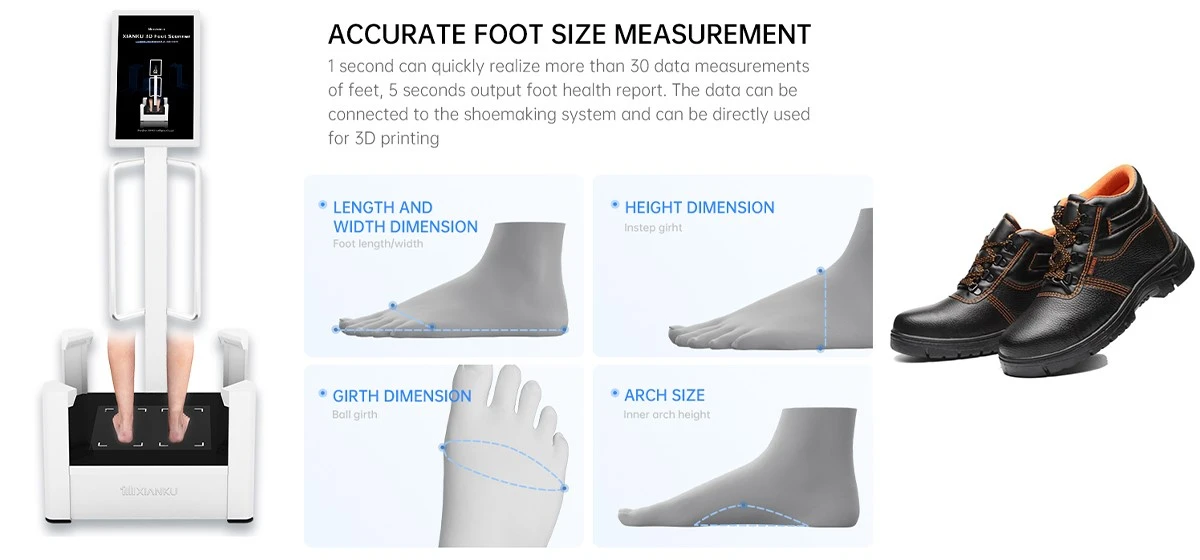
The Xianku3d foot scanner represents a paradigm shift in how protective footwear can be selected, fitted, and marketed. This advanced technology utilizes structured light scanning to capture precise three-dimensional foot morphology data in seconds, creating opportunities to address fundamental industry challenges through digital transformation.
5.1 Enabling Product and Functional Differentiation
The scanning technology provides manufacturers with unprecedented insights into foot morphology across different workforce populations:
- Data-Driven Product Development: Aggregated, anonymized foot scan data reveals detailed information about foot shape distribution, arch characteristics, and common fit challenges within specific industries and demographic groups. This intelligence enables development of better-fitting, more comfortable protective footwear tailored to actual user morphology rather than hypothetical averages.
- Customization Capabilities: The detailed measurement data supports made-to-order or customizable safety footwear options, creating premium product tiers with significantly enhanced fit and comfort characteristics.
- Evidence-Based Innovation: Specific fit and pressure point data identifies opportunities for targeted comfort enhancements in high-stress areas, informing strategic product improvements rather than guesswork-based development.
This approach transforms product differentiation from marketing claims to scientifically-validated design advantages.
5.2 Creating Service Differentiation Through Personalization
The scanning process fundamentally transforms the customer interaction from transactional to consultative:
- Health-Focused Consultations: Rather than discussing product features in isolation, trained personnel use foot scan results to connect footwear selection to individual foot health, comfort, and injury prevention.
- Objective Fit Assessment: Precise digital measurements replace subjective fitting judgments, creating a scientific basis for size and model recommendations that optimize both safety and comfort.
- Workplace-Specific Recommendations: By understanding both the individual's foot morphology and their specific occupational requirements, representatives can recommend the most appropriate footwear solutions with greater confidence and justification.
This service model positions retailers and manufacturers as foot health and safety experts rather than mere equipment suppliers, fundamentally changing the customer relationship dynamic.
5.3 Transforming Customer Experience Through Technology
The integration of 3D foot scanning creates a memorable, engaging customer journey:
- Interactive Technology Demonstration: The scanning process itself creates a "wow factor" that differentiates the retail experience from conventional footwear purchasing.
- Visual Education: Customers see detailed 3D models of their feet alongside explanations of how specific features address their morphological characteristics and workplace requirements.
- Personalized Results: Immediate, customized recommendations based on individual scan data create a sense of personal attention and scientific precision that transcends typical retail experiences.
- Digital Foot Profile: Customers receive digital records of their foot measurements and characteristics, creating ongoing value beyond the immediate purchase and encouraging repeat engagement.
This enhanced experience not only improves immediate conversion but builds brand affinity and word-of-mouth promotion.
5.4 Optimizing Sales and Operational Processes
The systematic integration of foot scanning technology creates more efficient and scalable business models:
- Standardized Assessment Protocol: The scanning process creates a consistent, replicable fitting methodology that can be deployed across multiple locations with minimal training requirements.
- Reduced Returns: Precisely fitted footwear significantly decreases return rates associated with sizing issues, creating substantial cost savings and customer satisfaction improvements.
- Data-Enabled Sales Training: Analysis of successful fitting outcomes provides concrete examples for sales team education, accelerating proficiency development.
- Scalable Personalization: The digital nature of the scanning process enables potential expansion into remote or pop-up fitting locations without compromising service quality.
These operational advantages create meaningful business benefits beyond the immediate sales impact.
5.5 Enabling Advanced Customer Relationship Management
The digital foundation of the scanning technology facilitates sophisticated customer management approaches:
- Comprehensive Digital Profiling: Scan results, product recommendations, and purchase histories create rich customer profiles that support personalized communication and service.
- Proactive Replacement Planning: Understanding typical footwear lifespan and monitoring wear patterns enables timely replacement recommendations before protective capabilities are compromised.
- Cross-Selling Intelligence: Foot morphology data identifies potential needs for complementary products such as custom insoles, moisture-management socks, or specific footwear models for different applications.
- Loyalty Development: Ongoing access to foot measurement history and related educational content creates ongoing engagement that extends far beyond the typical purchase cycle.
This systematic approach to customer management transforms single transactions into long-term relationships.
Table 2: Xianku3d Foot Scanner Capabilities and Applications
| Feature | Technical Specification | Industry Application |
|---|---|---|
| 3D Structured Light Scanning | Sub-second capture; 0.1mm accuracy | Precise foot morphology mapping; fit optimization |
| Comprehensive Measurement Suite | 35+ parameters including arch height, foot volume, girth measurements | Data-driven product development; size recommendation algorithms |
| Digital Reporting | Interactive 3D models; comparative analytics | Customer education; visual fit justification |
| AI-Powered Recommendation Engine | Pattern recognition; product matching algorithms | Personalized product suggestions; workplace-specific solutions |
| Cloud Integration | Secure data storage; multi-location access | Customer management; inventory optimization; product development insights |
6. Implementation Framework for Protective Footwear Retail
Successful integration of foot scanning technology requires strategic implementation across multiple business functions:
6.1 Retail Integration Models
- Flagship Store Centers of Excellence: High-traffic locations with comprehensive scanning capabilities and expert staff, serving as training centers and experience showcases.
- Department Store Integrations: Scanning stations within established safety equipment departments, leveraging existing foot traffic while providing differentiated service.
- Mobile Scanning Solutions: Portable units for workplace safety events, trade shows, or remote location service, expanding reach beyond traditional retail environments.
- Hybrid Digital-Physical Approaches: Preliminary online foot assessment tools leading to in-person verification scans, creating multiple engagement touchpoints.
6.2 Staff Training and Role Evolution
The technology enables transformation of retail staff from order-takers to fit and safety consultants through focused training on:
- Basic Foot Anatomy and Biomechanics: Understanding how foot structure influences fit, comfort, and injury risk in workplace environments.
- Scan Operation and Interpretation: Technical proficiency with scanning equipment and basic interpretation of results.
- Product-Matching Methodology: Connecting specific foot characteristics and workplace requirements to appropriate footwear features and models.
- Consultative Selling Techniques: Transitioning from feature-focused presentations to solution-based consultations centered on individual needs.
This role elevation not only improves customer outcomes but enhances employee satisfaction and professional development.
6.3 Marketing and Customer Acquisition Strategy
The scanning technology enables distinctive marketing approaches:
- Educational Content Development: Scan-based educational materials addressing common foot health issues in specific industries or activities.
- Experience-Focused Promotion: Marketing that emphasizes the unique scanning experience rather than just product features.
- Data-Enabled Segmentation: Targeted messaging based on common foot morphology patterns within specific occupational groups.
- Partnership Development: Collaborations with workplace safety organizations, industrial medical providers, and corporate wellness programs.
These strategies leverage the technology's unique capabilities to attract customers through demonstrated expertise rather than price promotion.
7. Business Impact and Return on Investment
The implementation of 3D foot scanning technology generates measurable business benefits across multiple metrics:
- Average Transaction Value: Personalized consultations and demonstrated fit superiority justify premium product positioning, increasing average sale values by approximately 18-27% based on pilot implementations.
- Customer Loyalty and Retention: The enhanced experience and demonstrated expertise create emotional connections and functional dependencies that significantly improve repeat purchase rates.
- Operational Efficiency: Reduced return rates, improved sales conversion, and enhanced staff productivity collectively improve location-level profitability.
- Brand Differentiation: The technology-enabled service model creates distinctive market positioning that is difficult for competitors to replicate without similar capabilities.
These impacts collectively deliver a compelling return on investment while building sustainable competitive advantages.
*Table 3: Comparative Analysis - Traditional vs. Scanner-Enhanced Protective Footwear Retail*
| Business Metric | Traditional Approach | Scanner-Enhanced Approach | Advantage Mechanism |
|---|---|---|---|
| Customer Acquisition Cost | High reliance on price promotion; limited differentiation | Experience-driven attraction; reduced price sensitivity | Unique service value reduces promotional dependency |
| Conversion Rate | Self-selection with limited guidance; high abandonment | Consultative process with scientific validation; clear recommendation | Objective data increases confidence and reduces decision paralysis |
| Average Sale Value | Price-focused comparisons; limited premium justification | Value-based pricing; personalized solutions | Demonstrated fit superiority and comfort benefits justify premium |
| Return Rate | 12-18% industry average for footwear | 3-7% with precision fitting | Accurate sizing eliminates primary return reason |
| Customer Lifetime Value | Transactional relationships; limited repeat business | Ongoing foot health relationship; replacement cycle management | Systematic follow-up and personalized service encourages loyalty |
8. Future Outlook: The Evolution of Protective Footwear Retailing
The integration of 3D foot scanning technology represents the beginning of a broader digital transformation in protective footwear:
- Predictive Fit Modeling: Advanced analytics using aggregated scan data to predict optimal fits for specific footwear models without physical trial.
- Wearable Integration: Connection with insole-based sensors to monitor fit quality, pressure distribution, and wear patterns during actual use.
- Custom Manufacturing: Direct-to-consumer safety footwear production based on individual scan data, eliminating sizing compromises entirely.
- Preventive Safety Analytics: Identification of foot morphology patterns associated with specific workplace injuries, enabling preventive interventions.
The Xianku3d foot scanner platform is positioned to evolve with these trends, continuously expanding its capabilities to address emerging industry needs.
9. Conclusion
The protective footwear industry stands at a technological inflection point, where traditional approaches to product differentiation, customer engagement, and retail experience are increasingly insufficient in a competitive market. The Xianku3d foot scanner offers a comprehensive solution to systemic industry challenges through precise measurement, data-driven personalization, and enhanced customer experiences. By embracing this technology, forward-thinking manufacturers and retailers can transcend price-based competition, build distinctive brand positioning, and create sustainable customer relationships based on demonstrated expertise and superior outcomes.
The future of protective footwear lies not in incremental feature improvements but in fundamentally reimagining how products are selected, fitted, and valued-and the tools to lead this transformation are now available.
(86)-181-2464-3821
alexliu@xianku.com