
1. Introduction
The global podiatry care market is undergoing significant transformation, driven by technological advancements and evolving patient expectations. Podiatry clinics, which form an essential component of the broader healthcare ecosystem, face mounting pressures to differentiate their services, improve patient engagement, and optimize operational efficiency. Traditional practice models, often reliant on practitioner expertise alone, struggle to meet modern demands for transparency, personalization, and measurable outcomes. Within this landscape, innovative technologies like the Xianku3d foot scanner are emerging as powerful tools to address systemic challenges.
This article examines the current state of the podiatry clinic sector, analyzes its persistent operational and competitive hurdles, and explores how integrated foot scan technology can enhance diagnostic precision, patient satisfaction, and business sustainability.
2. Market Overview: Growth and Segmentation
The global podiatry services market demonstrates steady expansion, with the broader foot care industry encompassing diverse segments including general podiatry, sports podiatry, and surgical podiatry . This growth is fueled by several key factors:
- Rising Prevalence of Foot Conditions: Increasing incidence of diabetes-related foot complications, musculoskeletal disorders, and age-related podiatric issues
- Growing Sports Medicine Demand: Expanding athlete and active population seeking performance optimization and injury prevention
- Aging Demographics: Older adult populations requiring specialized foot care and mobility solutions
- Technological Integration: Digital health technologies transforming diagnostic and treatment approaches
The market encompasses various service delivery models, including hospital-based departments, specialized clinics, and podiatry offices, each facing distinct operational challenges and competitive dynamics .
3. Critical Challenges Facing Podiatry Clinics
3.1 Low Service Differentiation
Many podiatry practices compete primarily on practitioner reputation, location convenience, and price points, with limited distinction in service quality or patient experience . This competitive homogeneity creates several business vulnerabilities:
- Price-Based Competition: Undifferentiated services lead to fee sensitivity and margin erosion
- Patient Commoditization: Individuals perceive minimal difference between providers, reducing loyalty
- Limited Premium Service Opportunities: Inability to justify value-based pricing for specialized care
- New Practice Barriers: Emerging clinics struggle to establish market presence against established competitors
The podiatry office/clinic segment represents a substantial portion of the industry, intensifying competition within this space .
3.2 Non-Transparent Service Delivery
Traditional podiatric assessments often lack objective visualization and clear patient education, creating trust barriers:
- Subjective Interpretation: Diagnostic conclusions rely heavily on practitioner judgment without tangible evidence
- Limited Patient Understanding: Complex foot conditions explained verbally without visual aids
- Reduced Compliance: Patients less likely to adhere to treatment plans they don't fully comprehend
- Undervalued Services: Patients underestimate the sophistication of care provided
This transparency deficit undermines the perceived value of professional podiatric services and weakens the practitioner-patient relationship.
3.3 Suboptimal Patient Experience
Conventional clinic experiences frequently fail to engage patients effectively:
- Technical Without Being Educational: Clinical procedures performed without adequate patient involvement
- Limited Interactive Elements: Passive patient role during assessment and diagnosis
- Insufficient Personal Connection: Transactional interactions rather than collaborative care relationships
- Outdated Technology Perception: Traditional methods appear less advanced than other healthcare specialties
The experience gap is particularly problematic for attracting younger, tech-savvy patients who expect interactive healthcare experiences.
3.4 Inefficient Practice Operations
Podiatry clinics face structural operational challenges that impact scalability and profitability:
- Practitioner-Dependent Workflows: Service quality and consistency vary with individual expertise
- High Customer Acquisition Costs: Marketing expenditures necessary to attract new patients
- Limited Scalability: Expansion constrained by availability of skilled practitioners
- Inconsistent Service Delivery: Standard operating procedures difficult to maintain across multiple locations
These operational inefficiencies are particularly challenging for new clinic entrants who lack established patient bases and referral networks .
3.5 Ineffective Patient Management Systems
Many practices utilize fragmented approaches to patient relationship management:
- Disconnected Records: Treatment histories, preferences, and outcomes stored in isolated systems
- Reactive Communication: Limited proactive engagement between appointments
- Missed Retention Opportunities: Poor follow-up systems for ongoing care and preventive services
- Ineffective Recall Processes: Manual systems for patient reactivation and maintenance care
This administrative fragmentation represents a significant missed opportunity for building long-term patient relationships and practice sustainability.
Table 1: Podiatry Clinic Challenges and Business Impacts
| Challenge Category | Specific Manifestations | Business Impact |
|---|---|---|
| Service Homogeneity | Competing on price/location; limited differentiation | Reduced profitability; patient commoditization; high customer acquisition costs |
| Lack of Transparency | Subjective assessments; limited visual evidence | Patient skepticism; reduced adherence; undervalued services |
| Poor Patient Experience | Non-interactive assessments; passive patient role | Decreased satisfaction; lower retention; negative word-of-mouth |
| Operational Inefficiency | Practitioner-dependent workflows; inconsistent service | Limited scalability; variable quality; high operating costs |
| Ineffective Patient Management | Disconnected records; poor follow-up systems | Missed revenue opportunities; reduced patient lifetime value |
4. Competitive Landscape in Podiatry Services
The podiatry services market features diverse participants ranging from hospital-based departments to specialized clinics and independent practices . The competitive environment is characterized by:
- Market Fragmentation: Numerous small to medium-sized practices with limited geographic coverage
- Specialization Trends: Emerging niche services in areas like sports podiatry and pediatric foot care
- Technology Adoption Variance: Differing levels of digital integration across practice types
- Consolidation Movements: Growing presence of podiatry networks and group practices
This competitive diversity creates both challenges and opportunities for clinics seeking to distinguish their services in a crowded marketplace.
5. Xianku3d Foot Scanner: Transforming Podiatry Practice
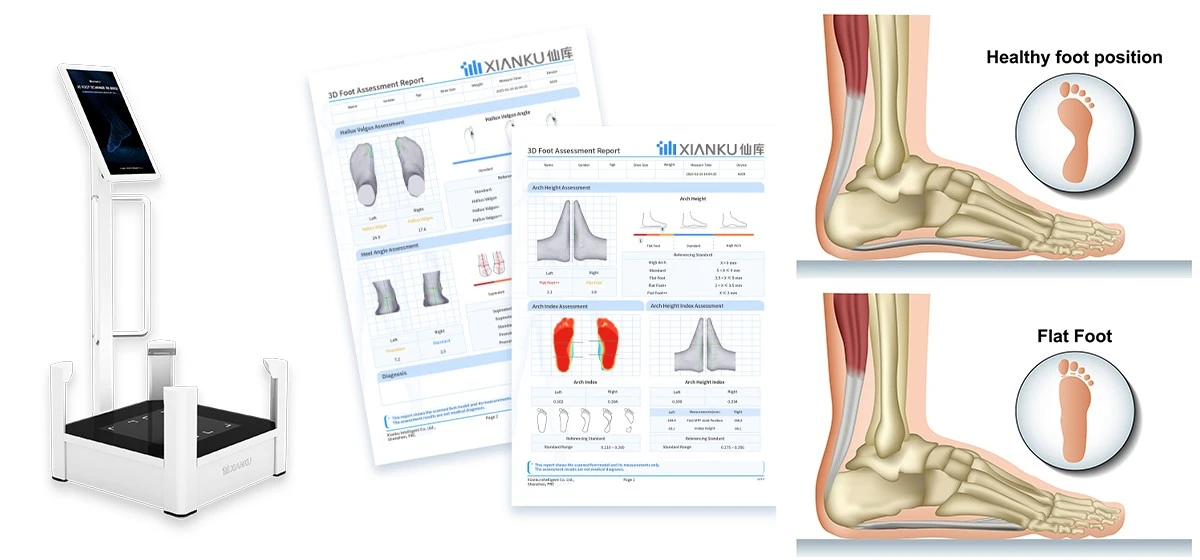
The Xianku3d foot scanner represents a paradigm shift in podiatric care delivery, integrating advanced 3D structured light technology to address fundamental industry challenges . This technology enables comprehensive foot assessment through non-contact scanning that captures millimeter-accurate foot morphology data in under one second .
5.1 Enhancing Service Differentiation
The scanner creates immediate practice distinction through:
- Technology-Enhanced Consultations: Integrating digital foot scan data into clinical assessments
- Visual Service Premium: Advanced imaging capabilities positioning the practice as technologically advanced
- Unique Value Proposition: Offering services unavailable at conventionally-equipped clinics
- Specialized Report Generation: Comprehensive digital reports including toe morphology, plantar analysis, and heel inclination
This technological differentiation helps practices transition from competing on price to competing on unique service value and demonstrated expertise.
5.2 Establishing Transparent Service Delivery
The scanning process creates unprecedented consultation transparency:
- Visual Evidence Base: 3D foot models provide tangible diagnostic evidence
- Interactive Education: Patients view and understand their foot structure and issues
- Collaborative Assessment: Practitioner and patient jointly review scan results
- Objective Baseline: Quantitative measurements replace subjective observations
This transparency builds patient trust and demonstrates professional competence through visible expertise.
5.3 Elevating Patient Experience
The foot scan integration transforms the clinical encounter into an engaging journey:
- Interactive Technology: Patients actively participate in the assessment process
- Immediate Visual Feedback: Real-time 3D model generation creates "wow factor"
- Educational Empowerment: Understanding foot health promotes proactive participation
- Personalized Engagement: Individual-specific results demonstrate customized attention
This enhanced experience strengthens patient-practice bonds and encourages ongoing loyalty.
5.4 Streamlining Practice Operations
The technology supports more efficient and scalable practice management:
- Standardized Assessments: Consistent data collection regardless of practitioner
- Time Efficiency: Rapid scanning reduces appointment duration
- Scalable Protocols: Replicable service processes across multiple locations
- Reduced Practitioner Dependency: Technologists can perform scanning operations
These operational improvements directly address key constraints on practice growth and consistency.
5.5 Enabling Advanced Patient Management
The integrated digital platform enhances long-term patient relationships:
- Automated Digital Profiling: Scan results and treatment histories stored in unified profiles
- Proactive Recall Systems: Automated reminders for follow-up assessments
- Personalized Communication: Condition-specific education and recommendation delivery
- Outcome Tracking: Longitudinal monitoring of treatment effectiveness
This systematic approach transforms sporadic visits into managed foot health relationships.
Table 2: Xianku3d Foot Scanner Capabilities and Clinical Applications
| Feature | Technical Specification | Clinical Application |
|---|---|---|
| 3D Structured Light Scanning | Sub-second capture; millimeter accuracy | Precise morphological assessment; treatment planning |
| Comprehensive Parameter Analysis | Toe morphology, arch height, heel inclination, plantar surface | Biomechanical assessment; condition diagnosis |
| Digital Reporting | Interactive 3D models; comparative analytics | Patient education; treatment justification; progress tracking |
| AI-Powered Recommendations | Pattern recognition; normative data comparison | Condition detection; product matching; treatment suggestions |
| Cloud Integration | Secure data storage; access across locations | Longitudinal tracking; multi-clinic consistency |
6. Implementation Framework for Podiatry Clinics
Successful integration of foot scan technology requires strategic implementation across clinical operations:
6.1 Clinical Workflow Integration
- Initial Consultation Enhancement: Scanning as standard component of new patient assessments
- Treatment Planning Integration: Scan data informing orthotic design and intervention strategies
- Progress Monitoring: Sequential scanning quantifying treatment effectiveness
- Preventive Care Applications: Baseline scanning for at-risk patient populations
6.2 Staff Training and Role Evolution
- Technical Operation: Training clinical staff in scanner operation and basic interpretation
- Results Communication: Developing patient-friendly explanation protocols
- Clinical Correlation: Enhancing practitioner ability to integrate scan data with clinical findings
- Technology Demonstration: Effectively presenting scanning capabilities to prospective patients
6.3 Practice Marketing and Patient Education
- Service Differentiation Highlighting: Emphasizing scanning technology in practice positioning
- Educational Content Development: Utilizing scan images in patient materials and online content
- Experience Demonstration: Showing scanning process through video and practice tours
- Professional Image Enhancement: Positioning practice as technologically advanced and specialized
7. Clinical and Business Benefits of Foot Scan Integration
The implementation of 3D foot scanning technology generates significant clinical and operational advantages:
7.1 Enhanced Diagnostic Capabilities
- Precision Measurement: Quantitative data supplementing clinical observation
- Early Detection: Identification of subtle morphological changes before symptom development
- Condition Monitoring: Objective tracking of progression or improvement
- Biomechanical Analysis: Structural assessment informing functional recommendations
7.2 Improved Patient Outcomes
- Informed Collaboration: Patients better understanding their conditions and treatment rationales
- Enhanced Adherence: Visual evidence increasing compliance with recommended interventions
- Preventive Orientation: Early identification of potential issues enabling proactive management
- Personalized Interventions: Treatments tailored to individual morphological characteristics
7.3 Practice Growth and Sustainability
- Revenue Diversification: New service lines including scanning assessments and monitoring programs
- Patient Retention: Enhanced experiences encouraging ongoing care relationships
- Referral Generation: Unique capabilities attracting referral partners and patient recommendations
- Premium Service Positioning: Technology enabling value-based pricing models
Table 3: Business Impact Analysis of Foot Scan Implementation
| Business Metric | Pre-Implementation | Post-Implementation | Change Driver |
|---|---|---|---|
| Patient Acquisition | Marketing-dependent | Technology-attracted | Unique service differentiation |
| Service Value Perception | Practitioner-dependent | Evidence-based | Visual demonstrations and objective data |
| Patient Retention | Relationship-dependent | Experience and outcome-dependent | Enhanced engagement and demonstrated results |
| Operational Efficiency | Variable by practitioner | Standardized and scalable | Consistent protocols and reduced appointment times |
| Revenue per Patient | Limited service options | Multiple service tiers | Scanning assessments, monitoring programs, premium products |
8. Future Outlook: The Evolution of Technology-Enhanced Podiatry
The integration of 3D foot scanning represents the beginning of a broader digital transformation in podiatric care:
- Predictive Analytics: AI algorithms identifying at-risk patients from morphological patterns
- Remote Monitoring: Home scanning technologies enabling continuous care
- Tele-podiatry Integration: Remote consultations enhanced by digital foot data
- Preventive Focus: Population health approaches leveraging foot morphology data
The Xianku3d foot scanner positions forward-thinking practices at the forefront of this evolution, creating opportunities to lead the specialty's technological advancement.
9. Conclusion
The podiatry clinic sector faces significant challenges in differentiation, patient experience, and operational efficiency. Traditional practice models limited by subjective assessments and practitioner-dependent workflows struggle to demonstrate distinctive value in an increasingly competitive market. The Xianku3d foot scanner offers a comprehensive solution to these challenges through objective measurement, enhanced patient engagement, and streamlined practice operations. By integrating this technology, podiatry practices can transform their service delivery, strengthen patient relationships, and build sustainable competitive advantages.
The future of podiatric care lies in leveraging digital technologies to enhance human expertise-and the practices embracing this integration today will lead the specialty's advancement tomorrow.
(86)-181-2464-3821
alexliu@xianku.com