

1. Introduction
Forward head posture (FHP), also known as "text neck" or anterior head carriage, has become increasingly prevalent in modern society, affecting individuals across various age groups and lifestyles. This postural deviation occurs when the head shifts forward from its optimal alignment with the spinal column, creating a cascade of musculoskeletal and neurological consequences. The condition has gained significant attention from healthcare professionals due to its association with chronic pain, reduced mobility, and diminished quality of life.
This comprehensive article examines the multifaceted nature of forward head posture, exploring its underlying causes, progressive health implications, and innovative approaches to assessment and correction. With advancements in digital health technology, new solutions like the Xianku3d body scanner are emerging to address postural issues through precise, data-driven methodologies.
2. Understanding Forward Head Posture: Definition and Clinical Presentation
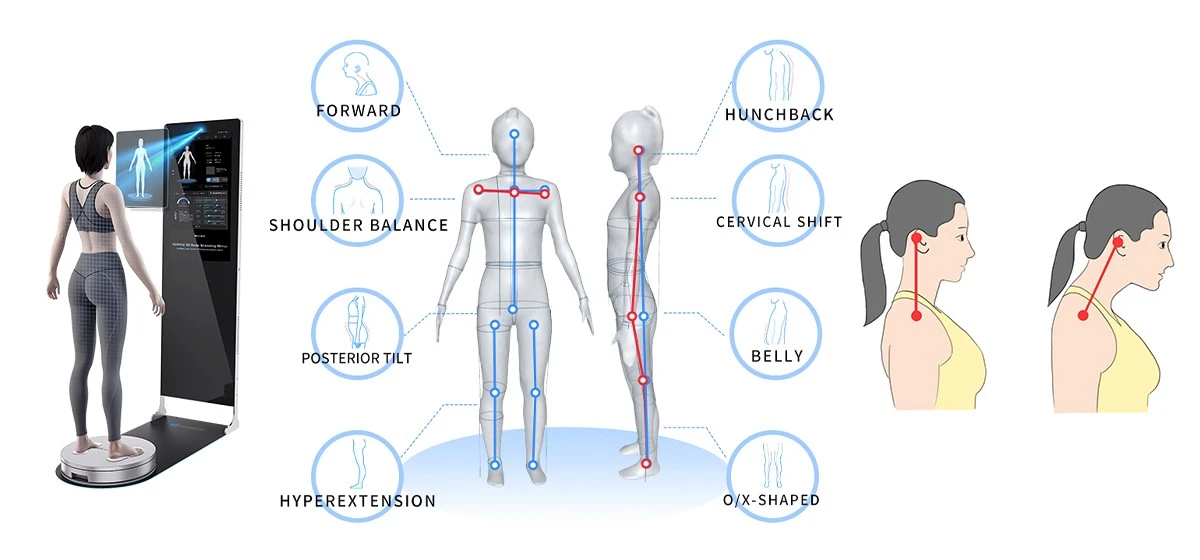
Forward head posture is characterized by the anterior positioning of the head relative to the shoulders and thoracic spine. In optimal alignment, the ear canal should align vertically with the center of the shoulder joint. However, in FHP, this alignment is disrupted, with the head projecting forward by several inches or centimeters. The severity of FHP is typically measured by the craniovertebral angle (CVA), which normally ranges between 49-59 degrees when measured on lateral view photographs. A CVA of less than 49 degrees indicates forward head posture, with more acute angles representing greater severity.
Clinically, FHP rarely exists in isolation. It commonly presents with complementary postural deviations, including:
- Rounded shoulders: Anterior positioning and internal rotation of the shoulder girdle
- Thoracic kyphosis: Excessive curvature of the upper back
- Reduced cervical lordosis: Loss of the normal forward curve in the neck
These associated adaptations create what clinicians refer to as "upper crossed syndrome," a pattern of muscular imbalances where certain muscles become tight and overactive while others become weak and inhibited. The body scan technology provides objective measurement of these complex postural relationships, enabling more targeted interventions.
Table 1: Muscular Imbalances Associated with Forward Head Posture
| Overactive/Tight Muscles | Underactive/Weak Muscles | Consequences of Imbalance |
|---|---|---|
| Upper trapezius | Deep cervical flexors | Increased compressive forces on cervical spine |
| Levator scapulae | Lower trapezius | Reduced scapular stability and control |
| Sternocleidomastoid | Serratus anterior | Altered shoulder mechanics and breathing patterns |
| Suboccipitals | Rhomboids | Headache and restricted cervical rotation |
| Pectoralis major and minor | Middle trapezius | Forward shoulder positioning and reduced thoracic extension |
3. Etiology: The Multifactorial Causes of Forward Head Posture
The development of forward head posture typically results from a combination of lifestyle factors, occupational demands, and underlying physiological processes. Understanding these causative factors is essential for effective prevention and treatment.
3.1 Technological Influences and Modern Lifestyle Factors
The proliferation of digital devices represents one of the most significant contributors to the rising prevalence of FHP. The average adult spends approximately 3-4 hours daily looking down at smartphones or tablets, creating sustained gravitational stress on the cervical structures. Research has demonstrated that the effective weight of the head increases dramatically with forward flexion:
15 degrees of flexion: 27 pounds (12.2 kg) of compressive force
30 degrees of flexion: 40 pounds (18.1 kg) of compressive force
45 degrees of flexion: 49 pounds (22.2 kg) of compressive force
60 degrees of flexion: 60 pounds (27.2 kg) of compressive force
This represents a 300-500% increase in cervical loading compared to the neutral position, where the head exerts approximately 10-12 pounds (4.5-5.4 kg) of force. Occupational demands, particularly desk-based work with improper workstation ergonomics, further exacerbate these stresses by maintaining sustained postural strain over 6-8 hour periods.
3.2 Musculoskeletal and Biomechanical Factors
Chronic FHP often develops through a self-perpetuating cycle of muscular adaptation. Initially, prolonged positioning leads to adaptive shortening of the posterior cervical tissues and pectoral muscles. This creates reciprocal inhibition of their antagonist muscles, particularly the deep cervical flexors and mid-back stabilizers. Over time, these patterns become neurologically encoded, making the postural deviation feel "normal" to the individual even as it creates progressive structural strain.
Additional biomechanical factors include:
- Previous whiplash injuries: Leading to protective muscular splinting and altered movement patterns
- Degenerative disc disease: Changing spinal biomechanics and weight distribution
- Visual deficits: Causing compensatory head positioning to improve visual field
- Breathing pattern disorders: Creating overactivity of accessory respiratory muscles
A comprehensive body scan assessment can identify these underlying contributors, enabling more targeted and effective intervention strategies.
3.3 Psychological and Behavioral Contributors
Emerging research suggests that psychological states can influence postural presentation. Chronic stress, anxiety, and depression have been correlated with increased forward head positioning, potentially through neurophysiological pathways affecting muscle tone and proprioceptive awareness. Additionally, learned postural habits developed during formative years may become entrenched without conscious correction.
4. Health Implications and Progressive Consequences of Untreated FHP
Left unaddressed, forward head posture initiates a cascade of structural, functional, and neurological changes that can significantly impact health and quality of life.
4.1 Musculoskeletal Pain and Dysfunction
The most immediate consequence of FHP is increased mechanical stress on cervical structures. Research indicates that for every inch (2.54 cm) of forward head positioning, the effective weight on the cervical spine increases by approximately 10 pounds (4.5 kg). This additional loading accelerates degenerative processes and contributes to:
- Cervical facet joint irritation: Resulting in localized neck pain and stiffness
- Disc degeneration: Altered pressure distribution accelerates disc breakdown
- Myofascial pain syndrome: Development of trigger points in overworked muscles
- Cervicogenic headaches: Referred pain patterns originating from cervical structures
Studies have demonstrated that individuals with FHP are 3.2 times more likely to experience chronic neck pain compared to those with normal alignment. The body scan technology enables early identification of these biomechanical stressors before they progress to chronic pain conditions.
4.2 Neurological and Vascular Implications
The forward positioning of the head can compromise the neurovascular structures passing through the cervical region. The reduced space in the intervertebral foramina may create mechanical compression of:
- Spinal nerve roots: Leading to radicular symptoms in the upper extremities
- Vertebral arteries: Potentially affecting cerebral blood flow and contributing to dizziness
- Sympathetic chain ganglia: Creating autonomic nervous system dysregulation
Chronic FHP has been associated with reduced cognitive performance, potentially through its impact on cerebral circulation and oxygenation. A comprehensive body scan evaluation includes assessment of these potential neurological implications through postural analysis and movement assessment.
4.3 Functional Limitations and Quality of Life Impact
The progressive nature of FHP leads to measurable functional decline across multiple domains:
- Reduced cervical range of motion: Particularly in rotation and extension
- Altered balance and proprioception: Increasing fall risk, particularly in older adults
- Compromised respiratory function: Reducing vital capacity by up to 30%
- Decreased athletic performance: Through impaired movement efficiency and power transfer
These functional limitations collectively diminish quality of life and participation in daily activities. Research using the Neck Disability Index has demonstrated moderate to severe disability scores in individuals with chronic, uncorrected FHP.
Table 2: Progressive Stages of Forward Head Posture and Associated Findings
| Stage | Clinical Presentation | Radiographic Findings | Functional Limitations |
|---|---|---|---|
| Stage 1 (Mild) | Intermittent symptoms; minimal postural deviation | Normal disc height; minimal degenerative changes | Occasional stiffness; fatigue with prolonged positioning |
| Stage 2 (Moderate) | Consistent postural deviation; muscle hypertonicity | Early disc space narrowing; facet joint changes | Reduced cervical ROM; early strength deficits |
| Stage 3 (Advanced) | Fixed postural deviation; chronic pain presentation | Moderate degenerative changes; possible neural compromise | Significant ROM restrictions; neurological symptoms |
| Stage 4 (Severe) | Structural adaptation; compensatory changes throughout spine | Advanced degeneration; possible spinal stenosis | Severe functional limitations; possible myelopathic signs |
5. Traditional Assessment and Treatment Approaches
Conventional management of forward head posture typically involves a combination of assessment techniques and corrective strategies.
5.1 Assessment Methodologies
Traditional postural assessment has relied on:
- Visual observation: Subjective evaluation of standing or seated posture
- Plumb line analysis: Using a weighted line to assess vertical alignment
- Photographic analysis: Taking lateral view photographs for CVA measurement
- Radiographic evaluation: Assessing bony alignment and degenerative changes
- Palpation: Identifying areas of muscle hypertonicity and tenderness
While these methods provide valuable information, they often lack the precision, objectivity, and comprehensive nature needed for optimal treatment planning. This limitation has driven the development of advanced technologies like the Xianku3d body scanner that offer more detailed and quantifiable data.
5.2 Conventional Treatment Modalities
Standard interventions for FHP typically include:
- Therapeutic exercise: Strengthening weak muscles and stretching tight tissues
- Manual therapy: Joint mobilization and soft tissue techniques
- Ergonomic modifications: Adjusting workstations and daily habits
- Postural re-education: Developing awareness of optimal alignment
- Pain management: Medications or modalities for symptomatic relief
While these approaches can be effective, they often suffer from limited objectivity in progress measurement and insufficient personalization to individual biomechanical patterns. The integration of body scan technology addresses these limitations by providing precise, quantifiable data to guide and monitor interventions.
6. The Xianku3d Body Scanner: A Technological Paradigm Shift in Postural Assessment
The Xianku3d body scanner represents a significant advancement in postural evaluation, leveraging cutting-edge technology to provide comprehensive, data-driven insights into forward head posture and its associated compensations.
6.1 Technical Specifications and Capabilities
The scanner utilizes high-resolution 3D structured light technology to capture over 1,000,000 data points in under 10 seconds, creating a precise digital avatar of the individual's posture. Key technical features include:
- Sub-millimeter accuracy: Capturing subtle postural deviations often missed by visual assessment
- Real-time data processing: Generating immediate reports and visualizations
- Multi-plane analysis: Assessing posture in sagittal, coronal, and transverse planes
- Integrated AI analytics: Comparing individual results against normative databases
- Longitudinal tracking: Monitoring changes across multiple assessment sessions
This advanced body scan technology provides objective data that enhances clinical decision-making and patient education.
6.2 Comprehensive Postural Assessment
The scanning process evaluates multiple parameters relevant to forward head posture, including:
- Craniovertebral angle: Quantifying the degree of forward head positioning
- Shoulder alignment: Assessing associated forward shoulder posture
- Spinal curvature: Measuring cervical, thoracic, and lumbar curves
- Center of gravity: Determining weight distribution and balance
- Pelvic positioning: Identifying compensatory patterns throughout the kinetic chain
This comprehensive assessment reveals the interconnected nature of postural deviations, enabling more effective and holistic treatment approaches.
6.3 Clinical Applications and Advantages
The Xianku3d body scanner offers numerous advantages in the management of forward head posture:
- Early detection: Identifying postural deviations before symptom development
- Objective baseline: Establishing quantifiable metrics for treatment planning
- Progress monitoring: Tracking changes with unprecedented precision
- Patient engagement: Visual representations enhance understanding and compliance
- Personalized interventions: Tailoring treatment to individual biomechanical patterns
Clinical implementations have demonstrated that incorporating body scan technology into practice improves patient outcomes while streamlining clinical workflows.
Table 3: Xianku3d Body Scanner Metrics for Forward Head Posture Assessment
| Assessment Parameter | Measurement Method | Clinical Significance | Normative Values |
|---|---|---|---|
| Craniovertebral Angle | Angle between horizontal line through C7 and line to tragus | Primary indicator of FHP severity | 49-59 degrees |
| Forward Head Translation | Horizontal distance from tragus to C7 vertebral body | Quantifies anterior head carriage | <2.5 cm |
| Cervical Lordosis | Angle between C2 and C7 vertebral bodies | Assesses cervical curve integrity | 31-43 degrees |
| Shoulder Protraction | Distance from acromion to wall in standing position | Identifies associated upper crossed syndrome | <2.5 cm |
| Scapular Position | Vertical and rotational alignment relative to thoracic spine | Evaluates scapulothoracic relationship | Symmetrical, neutral rotation |
7. Integrating 3D Body Scanning into Comprehensive FHP Management
The Xianku3d body scanner serves as the foundation for a more effective, evidence-based approach to forward head posture management through multiple applications.
7.1 Enhanced Diagnostic Precision
The detailed quantitative data provided by the body scan enables clinicians to move beyond subjective assessment and develop targeted treatment plans based on specific biomechanical findings. This precision is particularly valuable for complex cases with multiple contributing factors and compensatory patterns.
7.2 Personalized Exercise Prescription
The scanning technology facilitates exercise recommendations tailored to individual patterns of muscle imbalance and joint restriction. Rather than applying generic exercise protocols, clinicians can design programs that address each patient's unique presentation, optimizing outcomes and efficiency.
7.3 Objective Progress Monitoring
The ability to quantitatively track changes in postural alignment provides objective evidence of treatment effectiveness, enhancing patient motivation and enabling timely program modifications. This data-driven approach represents a significant advancement over traditional subjective progress assessments.
7.4 Preventive Applications
Beyond rehabilitation, the body scan technology offers powerful preventive applications by identifying postural deviations in their earliest stages, often before symptoms develop. This enables proactive intervention to prevent the progression to chronic pain and functional limitation.
8. Future Directions in Postural Assessment and Correction
The field of postural evaluation continues to evolve, with several emerging trends shaping its future development:
- Wearable sensor integration: Combining static scanning with dynamic movement assessment
- Telehealth applications: Remote monitoring of postural alignment and exercise compliance
- Predictive analytics: Using artificial intelligence to identify individuals at high risk for postural deterioration
- Gamified rehabilitation: Incorporating real-time biofeedback to enhance exercise engagement
The Xianku3d body scanner platform is positioned to incorporate these advancements, further enhancing its utility in both clinical and wellness settings.
9. Conclusion
Forward head posture represents a significant and growing health concern with far-reaching implications for musculoskeletal health, neurological function, and overall quality of life. Traditional assessment and treatment approaches, while valuable, have been limited by their subjective nature and insufficient personalization.
The Xianku3d body scanner addresses these limitations through precise, comprehensive postural evaluation that enables targeted, evidence-based interventions. By leveraging advanced scanning technology, healthcare providers can detect postural deviations earlier, implement more effective treatments, and objectively monitor progress-ultimately achieving superior outcomes for individuals affected by forward head posture. As technology continues to evolve, the integration of sophisticated assessment tools like the body scan will play an increasingly vital role in promoting spinal health and preventing the progressive consequences of postural imbalances.
(86)-181-2464-3821
alexliu@xianku.com
