

1. Introduction
The global athletic footwear market is experiencing robust growth, projected to reach $230 billion by 2025 , driven by rising health consciousness and evolving consumer preferences. However, beneath this expansion lie systemic challenges-homogenized products, superficial functional claims, and declining consumer engagement-that hinder sustainable innovation. Brands increasingly compete on price and marketing rather than substantive value, leaving a gap for solutions that prioritize individualized needs.
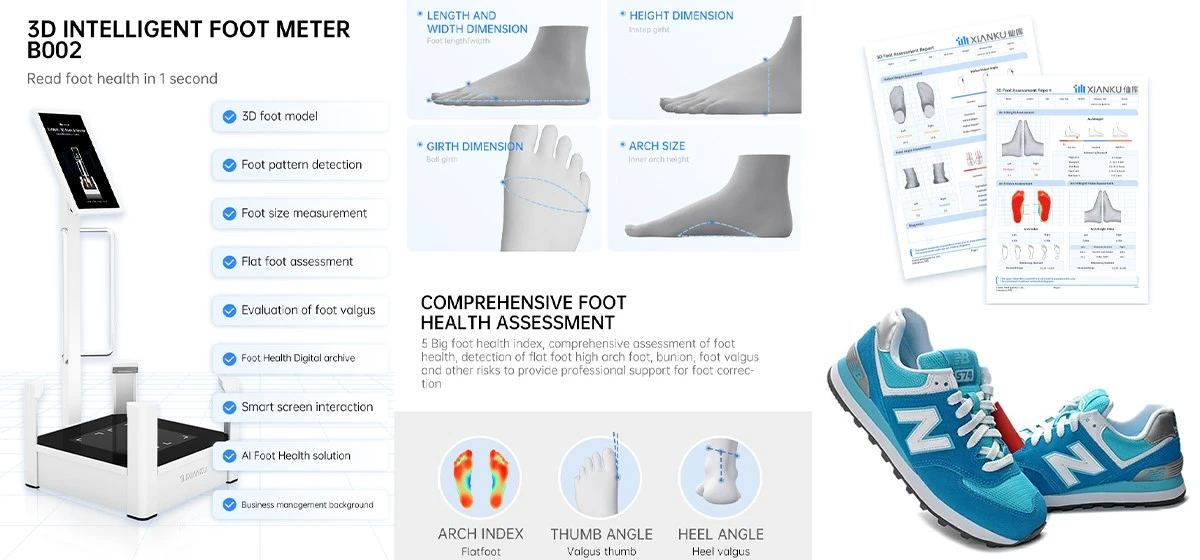
The Xianku3D foot scanner emerges as a transformative tool, leveraging precision scanning technology to redefine customization, enhance retail experiences, and empower data-driven decision-making. This article explores the athletic footwear industry's pressing issues and how integrating advanced foot scan technology can pave the way for a more responsive and health-focused future.
2. Market Overview: Growth, Segments, and Key Drivers
The athletic footwear sector remains a powerhouse within the global sportswear industry, with North America and Europe accounting for over 60% of market share . Growth is fueled by:
- Rising Participation in Fitness Activities: Post-pandemic emphasis on wellness has amplified demand for performance-oriented footwear.
- Technological Innovations: Brands like Nike and Adidas dominate through continuous research in materials and design.
- Segmentation Trends: Performance running shoes lead revenue generation, while lifestyle sneakers blur the lines between athletic and casual wear .
Despite this momentum, the market faces saturation, with the top five brands-including Nike (18% market share), Adidas, and Skechers -competing fiercely for consumer attention. Emerging labels like On Running and HOKA have carved niches through hyper-specialization (e.g., marathon running shoes) but struggle to scale without compromising uniqueness .
3. Critical Challenges in the Athletic Footwear Industry
3.1 Low Differentiation and Brand Saturation
The market is overcrowded with brands relying on logo recognition, aesthetic updates, and price reductions to drive sales. For instance, product launches often emphasize celebrity endorsements or color variations over technical improvements. This has led to consumer fatigue, with 62% of buyers reporting difficulty distinguishing between brands beyond superficial traits . Even innovative companies like Nike face pressure to continuously reinvent their offerings.
3.2 Superficial Functional Claims
While terms like "arch support" and "energy return" are ubiquitous, many products lack scientifically validated designs. For example, claims about cushioning frequently rely on material properties rather than biomechanical research, failing to address individual gait patterns or foot morphology. This gap is evident in the high return rates for ill-fitting shoes, particularly in e-commerce channels .
3.3 Inadequate Consumer Experience
Traditional retail environments depend on sales associates to communicate value, often without tools to demonstrate health benefits. A mere 15% of stores offer gait analysis or foot assessments, leaving customers uninformed about their specific needs . The absence of interactive experiences undermines engagement and reduces perceived value, especially among younger demographics who prioritize personalized interactions.
3.4 Fast-Fashion Mentality and Price Competition
The industry's emphasis on rapid production cycles and cost leadership has eroded loyalty and profitability. Brands like Adidas and Puma report margin pressures due to discounting, while consumers increasingly view sneakers as disposable commodities . This cycle discourages investment in long-term innovation, such as sustainable materials or custom-fit technologies.
3.5 Outdated Sales SOPs and Scalability Issues
Legacy retail models prioritize store location and advertising spend over experiential retail. Emerging brands face high barriers to entry, as scaling requires massive capital for brick-and-mortar expansion. For instance, On Running initially struggled to penetrate mainstream markets until partnering with established retailers .
3.6 Insufficient Data Utilization
Many brands operate with fragmented inventory systems and limited consumer insights, leading to overstocking or missed demand trends. Less than 30% of companies use data analytics to inform product development, resulting in mismatched sizes and narrow width options .
Table 1: Key Industry Challenges and Business Impacts
| Challenge Category | Specific Manifestations | Business Impact |
|---|---|---|
| Low Differentiation | Reliance on branding/aesthetics; replicated features | Declining brand loyalty; price sensitivity; commoditization |
| Superficial Functionality | Material-centric claims; lack of biomechanical validation | High return rates; inability to justify premium pricing |
| Poor Consumer Experience | Limited in-store engagement; dependency on sales staff | Low conversion rates; weak emotional connection |
| Fast-Fashion Model | Price wars; frequent product refreshes | Eroded margins; high waste; unsustainable practices |
| Inefficient Sales SOPs | High capital expenditure; rigid scaling models | Slow expansion; inconsistent service quality |
| Inadequate Data Use | Reactive inventory management; minimal R&D insights | Supply-demand mismatches; stagnant innovation |
4. Competitive Landscape: Traditional Giants vs. Emerging Innovators
The athletic footwear market is stratified into three tiers:
- Headline Players: Nike (18% market share) and Adidas leverage global supply chains and marketing prowess to maintain dominance. Nike's recent launches focus on neuroscience to enhance mental focus , while Adidas emphasizes circular design and retro revivals.
- Established Contenders: Brands like Skechers and New Balance compete on comfort and niche segments (e.g., walking shoes). Skechers' growth is fueled by "functional comfort" appealing to broad demographics .
- Disruptive Newcomers: On Running (Switzerland) and HOKA (France) target specialized domains like trail running and maximalist cushioning.However, their reliance on wholesale partnerships limits control over consumer touchpoints .
Despite these dynamics, the industry lacks widespread adoption of fit-focused customization, creating an opening for technologically augmented solutions.
5. Xianku3d Foot Scanner: A Paradigm Shift in Athletic Footwear
The Xianku3d foot scanner employs high-resolution 3D structured light technology to capture over 100 foot dimensions in 1 second, generating a precise digital avatar and comprehensive health report . This technology addresses core industry challenges through the following applications:
5.1 Enhancing Differentiation via Personalized Experiences
The scanner transforms retail spaces into interactive hubs by offering customized foot assessments. For example, customers receive visualizations of their arch type, pressure points, and gait alignment, enabling associates to recommend shoes based on data-not guesswork. This shifts the competitive focus from branding to individualized solutions, allowing smaller brands to compete on expertise rather than marketing budgets.
5.2 Embedding Scientific Functional Benefits
By analyzing metrics like heel inclination, toe morphology, and plantar pressure distribution, the scanner enables designs tailored to biomechanical needs. Brands can integrate features such as dynamic arch support or pronation control directly into shoe designs, moving beyond generic cushioning claims .
5.3 Elevating Consumer Engagement
The scanning process creates an immersive educational journey. Customers view their foot morphology in 3D, understanding how specific designs alleviate issues like plantar fasciitis or bunions. This transparency builds trust and justifies premium pricing-critical in an era where 62% of consumers prioritize experiences over products .
5.4 Enabling Data-Driven Operations
The system's cloud-based platform aggregates anonymized foot data, revealing regional sizing trends and common anatomical issues. Brands can optimize inventory by producing shoes in proportion to local demand, reducing waste and markdowns. Additionally, these insights inform R&D, leading to designs that resonate with demographic needs .
5.5 Streamlining Retail SOPs
The scanner standardizes fitting processes, reducing dependency on staff expertise. With minimal training, associates can interpret scans and make evidence-based recommendations, ensuring consistency across locations. This scalability supports rapid franchise expansion while maintaining service quality.
Table 2: Xianku3D Foot Scanner Capabilities and Applications
| Feature | Technical Specification | Industry Application |
|---|---|---|
| 3D Structured Light Scanning | 1-second capture; millimeter accuracy | Precise foot modeling; custom shoe last creation |
| AI-Powered Analytics | Assessment of arch height, pressure points, alignment | Personalized product matching; functional design input |
| Digital Reporting | Interactive 3D avatar; health risk evaluation | Consumer education; transparent value communication |
| Cloud Integration | Secure data storage; trend analysis | Inventory optimization; demographic-driven R&D |
| Mobile Connectivity | QR code activation; app synchronization | Omnichannel retail strategies; home scanning options |
6. Case Studies: Pioneering Brands Leveraging Technology
- Nike: The brand's Mind 001/002 footwear uses underfoot nodes to stimulate sensory feedback, highlighting the shift toward neuroscience-driven design . While not a scanning tool, it underscores the value of personalizing physiological responses.
- On Running: Its focus on cloud cushioning and lightweight construction appeals to marathoners, but limited customization options leave gaps in addressing individual biomechanics.
- HOKA: Known for maximalist cushioning, the brand relies on specialized retail partners for fittings. Integrating scanning technology could enhance its authority in the performance segment.
- These examples illustrate the industry's trajectory toward personalization, though most solutions remain product-centric rather than consumer-centric.
7. Implementation Roadmap for Brands
To adopt the Xianku3D foot scanner, brands should:
- Pilot in Flagship Stores: Deploy scanners in high-traffic locations to gauge consumer response and refine workflows.
- Train Multidisciplinary Teams: Educate staff on interpreting scan data and recommending products based on health metrics.
- Integrate with Supply Chains: Use aggregate data to inform production plans and reduce size-related returns.
- Develop Tiered Offerings: Combine free basic scans with premium services (e.g., custom orthotics or made-to-order shoes).
- Leverage Marketing Insights: Promote scan-driven personalization in campaigns to attract health-conscious consumers.
8. Future Outlook: The Next Frontier in Athletic Footwear
The industry is evolving toward biometric integration and AI-driven customization. Trends include:
- Predictive Fit Algorithms: Using historical scan data to recommend sizes and models for e-commerce.
- Sustainable Personalization: 3D printing of shoes from scan data to minimize waste.
- Holistic Health Ecosystems: Connecting foot health to overall wellness via smart apparel and wearables.
The Xianku3d foot scanner positions brands at the forefront of these shifts, transforming footwear from a commodity into a tailored health solution.
9. Conclusion
The global athletic footwear market stands at a crossroads, where differentiation through traditional means is no longer sustainable. The Xianku3D foot scanner offers a comprehensive solution to systemic challenges-from homogenized products and superficial functionality to inefficient retail operations. By embracing this technology, brands can foster deeper consumer relationships, justify premium pricing, and build agile, data-driven business models. The future of athletic footwear lies not in louder marketing but in smarter personalization-and the tools to achieve this are already within reach.
(86)-181-2464-3821
alexliu@xianku.com
