
1. Introduction
The global women's footwear market is experiencing steady growth, with projections indicating a rise from $757.8 billion in 2024 to $973.8 billion by 2031, reflecting a compound annual growth rate (CAGR) of 3.7% . Despite this expansion, the industry faces significant challenges, including intense competition, low differentiation, and a lack of focus on functional health benefits. Traditional strategies centered on pricing, aesthetics, and brand influence are no longer sufficient to meet evolving consumer demands for personalized, health-conscious products.
This article examines the current landscape of the women's footwear sector, its pressing issues, and the transformative potential of innovative solutions like the Xianku3d foot scanner. By leveraging advanced technology to deliver customized experiences and data-driven insights, this approach offers a pathway for brands to differentiate themselves and foster sustainable growth.
2. Market Overview: Growth, Segments, and Regional Dynamics
The women's footwear market encompasses diverse product categories, including casual sandals, formal shoes, athletic footwear, and specialized designs for various occasions . Geographically, China dominates as the largest market, accounting for approximately 20% of global sales, followed by the United States and Europe, which collectively hold around 25% of the market share . The rising influence of e-commerce, coupled with growing health awareness among consumers, has reshaped purchasing behaviors, creating opportunities for brands to integrate technology into their offerings.
For instance, the women's athletic footwear segment has seen notable growth, driven by trends in fitness activities like running and yoga, as well as the demand for versatile designs that combine style with functionality .
3. Key Challenges in the Women's Footwear Industry
3.1 Low Differentiation and Homogenized Competition
Many brands continue to compete primarily on superficial factors such as branding,appearance, and pricing, rather than investing in innovative product features or services . The market is highly fragmented, with the top four global players accounting for just over 2% of total market share . This saturation has led to a "copycat" culture, where designs and marketing strategies are replicated, making it difficult for emerging brands to stand out. Even successful companies like Dream Pairs have had to rely on aggressive pricing and data-driven product development to carve out a niche in crowded markets like North America .
3.2 Superficial Focus on Functional Health Benefits
While terms like "comfort" and "health" are frequently used in marketing, few brands deliver scientifically validated functional benefits. For example, claims about arch support or foot pain relief are often based on materials rather than biomechanical research . This gap is particularly evident in the athletic footwear segment, where product homogeneity prevails despite consumers' need for shoes that address specific issues like overpronation or plantar fasciitis .
3.3 Inadequate Consumer Experience and Engagement
Traditional retail environments rely heavily on sales associates to communicate product value, often without tools to demonstrate health benefits tangibly . The absence of interactive experiences leaves customers uninformed about their foot health and unable to connect product features to their personal needs. For instance, a study on digital foot measurement technologies revealed that incorrect sizing is a leading cause of online returns, highlighting the disconnect between consumer expectations and actual product performance .
3.4 Fast-Fashion Mentality and Price Wars
The industry's focus on low-cost production and rapid turnover has eroded profit margins and customer loyalty . Brands like Caleres have reported declining sales due to inflationary pressures and tariffs, forcing them to implement cost-saving measures to maintain competitiveness . This environment discourages investment in sustainable practices or long-term innovation, perpetuating a cycle of price-based competition.
3.5 Outdated Sales SOPs and Scalability Issues
Conventional retail models emphasize store location, advertising expenditure, and brand recognition, creating high barriers to entry for newcomers . Scaling operations requires significant capital, and without differentiated selling propositions, even established brands struggle to replicate success across regions. The lack of standardized, technology-enabled processes also leads to inconsistencies in customer service and operational efficiency.
3.6 Insufficient Data Utilization
Many brands operate without data-driven inventory management or product optimization systems . This results in overstocking, understocking, or misaligned product designs that fail to resonate with consumer preferences. The absence of centralized data on foot morphology and purchasing patterns further limits brands' ability to anticipate trends and tailor offerings.
Table 1: Key Challenges and Business Impacts in the Women's Footwear Industry
| Challenge Category | Specific Manifestations | Business Impact |
|---|---|---|
| Low Differentiation | Reliance on branding and price; replicated designs | Reduced customer loyalty; price sensitivity; limited market share for new entrants |
| Superficial Health Claims | Material-centric comfort features; lack of scientific validation | Inability to justify premium pricing; low repeat purchases; missed niche markets |
| Poor Consumer Experience | Dependency on sales staff; lack of interactive tools | Low conversion rates; high return rates; weakened brand trust |
| Fast-Fashion Model | Price competition; rapid production cycles | Eroded profit margins; high inventory waste; unsustainable practices |
| Inefficient Sales SOPs | High dependency on location and advertising | Slow expansion; difficulty in scaling; inconsistent service quality |
| Inadequate Data Use | Limited inventory optimization; minimal consumer insights | Poor product alignment; inefficient supply chains; missed innovation opportunities |
4. Competitive Landscape: Traditional Players and Emerging Innovators
The global women's footwear market includes legacy brands like Belle, Daphne, and Skechers, which leverage extensive distribution networks and broad product portfolios . However, emerging players are gaining traction by addressing unmet needs. For example:
- Dream Pairs: This brand achieved success on Amazon by prioritizing practical aesthetics and data-driven development . By analyzing customer reviews and social media trends, it identified pain points like arch support deficiencies and introduced targeted solutions, resulting in a 60% success rate for new product launches .
- Nike and Adidas: These giants dominate the athletic segment through continuous innovation in materials and design, though they still face challenges in delivering personalized fittings at scale .
Despite these successes, the industry lacks widespread adoption of health-focused customization, creating an opportunity for technologically advanced solutions.
5. Xianku 3D Foot Scanner: A Technological Paradigm Shift
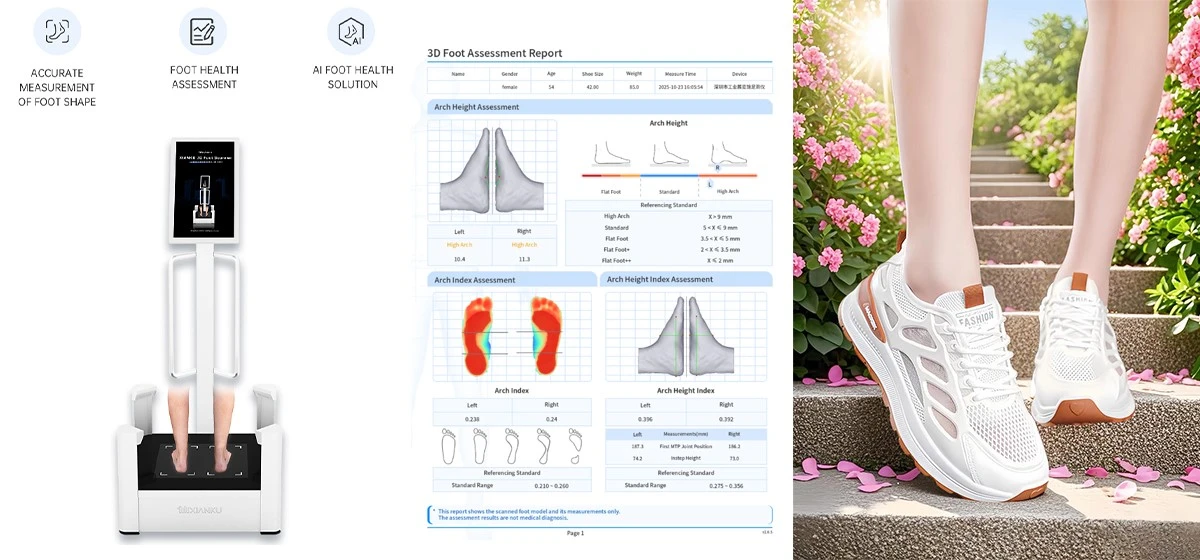
The Xianku3d foot scanner employs advanced 3D structured light technology to capture precise foot morphology data within seconds, generating detailed reports on parameters like arch height, heel inclination, and toe alignment . This technology addresses core industry challenges by enabling data-driven personalization and enhancing consumer engagement.
5.1 Enhancing Differentiation Through Personalized Experiences
The scanner transforms retail environments into interactive hubs by offering customized foot health assessments. For instance, customers receive a digital twin of their feet, allowing them to visualize issues like flat feet or bunions and understand how specific shoe features can address these concerns . This process shifts the focus from generic marketing to individualized solutions, helping brands differentiate themselves in a crowded market.
5.2 Integrating Functional Health Benefits
By providing millimeter-accurate measurements, the scanner enables the design of shoes with functional elements such as arch support, heel stabilization, and metatarsal pads . These features are tailored to individual biomechanical needs, moving beyond superficial comfort claims to scientifically grounded benefits. For example, the technology can recommend insoles for conditions like plantar fasciitis or suggest shoe modifications for gait abnormalities.
5.3 Elevating the Consumer Experience
The scanning process itself becomes an educational journey, engaging customers through real-time data visualization and AI-powered recommendations . Sales associates use these insights to transition from pitch-driven selling to consultative guidance, fostering trust and increasing conversion rates. This interactive approach has been shown to reduce return rates by ensuring better-fitting products .
5.4 Enabling Data-Driven Operations
The scanner integrates with cloud-based platforms to aggregate foot morphology data, providing brands with actionable insights for inventory management and product development . For example, retailers can analyze regional trends to optimize stock levels or identify common foot issues to inform new designs. This data-centric approach reduces waste and improves alignment with consumer preferences.
5.5 Streamlining Sales SOPs and Scalability
The technology standardizes the fitting process, reducing dependency on individual expertise. With minimal training, staff can operate the scanner and interpret results, ensuring consistent service quality across locations . This scalability supports rapid expansion while maintaining a high standard of customer care.
Table 2: Xianku3d Foot Scanner Features and Applications
| Feature | Technical Specification | Application in Footwear |
|---|---|---|
| 3D Structured Light Scanning | Captures 1-2 million data points in 1 second | Generates precise foot dimensions for custom sizing |
| AI-Powered Analytics | Assesses arch type, pressure points, and alignment | Recommends shoe types and supportive features |
| Digital Reporting | Produces comprehensive health reports in 5 seconds | Educates consumers and justifies premium pricing |
| Cloud Integration | Stores and compares historical foot data | Informs inventory planning and product innovation |
| Mobile Compatibility | Syncs with apps for remote access | Enables omnichannel retail strategies |
6. Case Studies: Success Stories in Health-Focused Footwear
6.1 Dream Pairs: Data-Driven Product Development
By analyzing customer feedback and leveraging scalable production, Dream Pairs addressed specific pain points like arch support and durability . The brand's focus on "practical aesthetics" allowed it to dominate Amazon's women's footwear category, demonstrating the value of aligning product features with consumer needs .
6.2 Dr. Scholl's: Legacy Meets Innovation
As a subsidiary of Decker, Dr. Scholl's has built its reputation on foot health solutions, such as comfort-focused insoles and shoes . By integrating technologies like 3D scanning, the brand could further personalize its offerings and strengthen its competitive edge.
6.3 Nike and Adidas: Technological Leadership
These brands have incorporated digital tools for gait analysis and custom fittings in select stores . While not yet widespread, these initiatives highlight the growing importance of personalized experiences in the athletic footwear segment.
7. Implementation Roadmap for Brands
To successfully adopt the Xianku3d foot scanner, brands should consider the following steps:
- Pilot Programs: Introduce the technology in flagship stores to gauge consumer response and refine workflows.
- Staff Training: Equip sales associates with the knowledge to interpret scan results and recommend products confidently.
- Data Analytics: Use aggregated foot data to identify regional trends and optimize inventory.
- Marketing Integration: Highlight the personalized fitting experience in campaigns to attract health-conscious consumers.
- Partnerships: Collaborate with orthopedic specialists or wellness brands to enhance credibility.
8. Future Outlook: Trends Shaping the Women's Footwear Market
The industry is evolving toward greater personalization and sustainability. Key trends include:
- AI-Driven Customization: Brands will increasingly use scan data to create made-to-order shoes.
- Sustainable Practices: Consumer demand for eco-friendly materials will drive innovation in production.
- Direct-to-Consumer Models: Digital platforms will enable brands to offer virtual fittings and reduce returns.
The Xianku3d foot scanner aligns with these trends by providing the tools needed to deliver personalized, health-focused products at scale.
9. Conclusion
The women's footwear industry stands at a crossroads, where traditional strategies are no longer sufficient to address modern consumer demands. The Xianku3d foot scanner offers a comprehensive solution to longstanding challenges, from differentiation and functionality to customer engagement and data utilization. By embracing this technology, brands can not only enhance their competitive positioning but also build lasting relationships with consumers through meaningful, health-centric experiences. The future of footwear lies in the seamless integration of data, design, and personalization-and the time to act is now.
(86)-181-2464-3821
alexliu@xianku.com