
1. Introduction
The global hotel industry stands at a pivotal juncture. Despite projected growth, the sector faces intense pressure to differentiate in an increasingly saturated market. Modern travelers, particularly frequent business guests and health-conscious tourists, are no longer satisfied with standardized amenities. They seek personalized well-being experiences that address their individual physiological needs, especially regarding sleep quality.
This article explores how the Xianku3d body scanner introduces a transformative approach to hospitality by bridging the gap between traditional accommodation and evidence-based sleep health, offering hotels a powerful tool to overcome systemic industry challenges.
2. Global Hotel Market Overview: Growth Amidst Structural Challenges
The hotel industry demonstrates resilient growth, with the U.S. hotels and motels market alone expected to reach $286.5 billion in 2025 . This expansion, however, masks underlying vulnerabilities. The industry faces unprecedented competitive pressures, with global hotel brand numbers exceeding 1,000 and new brand survival rates falling below 35% . This saturation has triggered widespread price competition and eroded profit margins, forcing hoteliers to seek innovative differentiation strategies.
The market is simultaneously experiencing significant polarization. Luxury wellness resorts like Canyon Ranch in Arizona and Joali Being in the Maldives have demonstrated the commercial viability of integrated well-being programs, commanding premium rates through personalized health interventions . Conversely, mainstream hotels struggle to translate wellness concepts into tangible guest experiences, creating a critical market gap for scalable, data-driven solutions.
3. Critical Challenges Facing the Hotel Industry
3.1 The Sleep Health Deficiency in Traditional Hospitality
Most hotels compete on superficial differentiators-room size, smart technology, or aesthetic design-while neglecting the scientific principles of sleep health. Standardized bedding solutions fail to address individual anatomical variations, leading to poor spinal alignment and compromised sleep quality for guests. This oversight represents a significant missed opportunity, particularly considering that sleep quality consistently ranks among travelers' top concerns.
The industry's approach to wellness has largely been confined to spa services or fitness centers, with few properties integrating scientific sleep optimization into their core hospitality proposition. Even prominent brands like Waldorf Astoria, while offering advanced wellness facilities through partnerships with established names like Guerlain , have yet to fully bridge the gap between luxury and personalized sleep health at scale.
3.2 The Personalization Paradox: Standardization Versus Individual Needs
The hotel industry remains bifurcated between large chains relying on brand power and pricing strategies and independent properties competing primarily on decorative uniqueness. This dynamic leaves little room for genuine personalization, despite growing consumer demand for tailored experiences.
The problem is particularly acute in the sleep domain. Hotels typically offer limited pillow menus based on generic firmness categories rather than individual anatomical needs. This one-size-fits-all approach ignores crucial variations in guest physiology, including spinal curvature, shoulder width, and preferred sleep positions-factors that significantly impact sleep quality and recovery.
3.3 Eroding Customer Loyalty and Brand Differentiation
In an era of proliferating brands and booking options, customer loyalty has become increasingly elusive. The CBRE 2025 Hotel Brand Performance Report reveals that brand premium has narrowed to just 12.7% , indicating diminishing returns from traditional branding alone.
Affluent travelers, who represent the most lucrative segment, seek health-oriented experiences but often find hotels offering only tiered pricing without substantive value differentiation. The result is diminished emotional connection and reduced repeat bookings, forcing properties to compete primarily on location and price-a unsustainable strategy in a crowded marketplace.
3.4 Inadequate Guest Experience and Health Integration
Traditional check-in processes lack health-centric onboarding, such as sleep assessments or personalized bedding configurations. The conventional "test rest" approach provides limited diagnostic value and fails to justify premium pricing for wellness-oriented offerings.
The success of dedicated wellness resorts demonstrates the growing demand for integrated well-being services. Properties like Bürgenstock Resort in Switzerland with its 10,000-square-meter Alpine spa have built their entire value proposition around holistic guest health. Mainstream hotels, however, have struggled to translate this concept into scalable, technologically-enabled experiences that address fundamental needs like sleep optimization.
3.5 Operational Inefficiencies and Scalability Limitations
Legacy sales and operational procedures in hospitality prioritize scale over customization, creating systemic barriers to personalization. The industry's reliance on subjective staff expertise for service delivery creates inconsistencies across locations and increases training costs.
This operational model particularly challenges emerging brands seeking to compete through superior guest experiences. Without standardized assessment protocols and scalable technology platforms, even successful personalized service concepts prove difficult to replicate across multiple properties, limiting growth potential and competitive impact.
3.6 Underutilized Revenue Streams
Hotel monetization strategies remain dominated by room bookings, food, beverages, and toiletries, overlooking high-margin wellness products. The industry has largely failed to capitalize on the growing consumer willingness to invest in sleep quality, despite the global cervical pillow market projected to reach $5.41 billion by 2029 .
This oversight is particularly striking given the demonstrated success of retail initiatives in hospitality. The challenge lies in transitioning from generic retail to curated, personalized wellness products that directly address individual guest needs-a transition that requires sophisticated assessment capabilities currently absent from most hotel operations.
Table 1: Hotel Industry Core Challenges and Business Impacts
| Challenge Category | Specific Manifestations | Business Impact |
|---|---|---|
| Sleep Health Deficiency | Standardized bedding ignoring anatomical variations; lack of scientific sleep optimization | Poor guest recovery; negative reviews; reduced repeat bookings |
| Limited Personalization | Generic pillow menus; one-size-fits-all approach to sleep experience | Inability to command premium pricing; high return rates for wellness packages |
| Eroding Loyalty | Diminishing brand differentiation; over-reliance on location and price competition | Decreased direct bookings; higher customer acquisition costs; price sensitivity |
| Inadequate Experience Integration | Superficial wellness positioning without tangible sleep benefits | Failure to justify premium pricing; missed wellness travel market segment |
| Operational Inefficiencies | Subjective service delivery; high training costs; inconsistent experiences | Limited scalability; difficulty replicating successful concepts across properties |
| Underutilized Revenue | Limited focus on high-margin wellness retail; generic amenity offerings | Missed ancillary revenue opportunities; failure to capitalize on sleep health trend |
4. The Xianku3d Body Scanner: A Technological Paradigm Shift
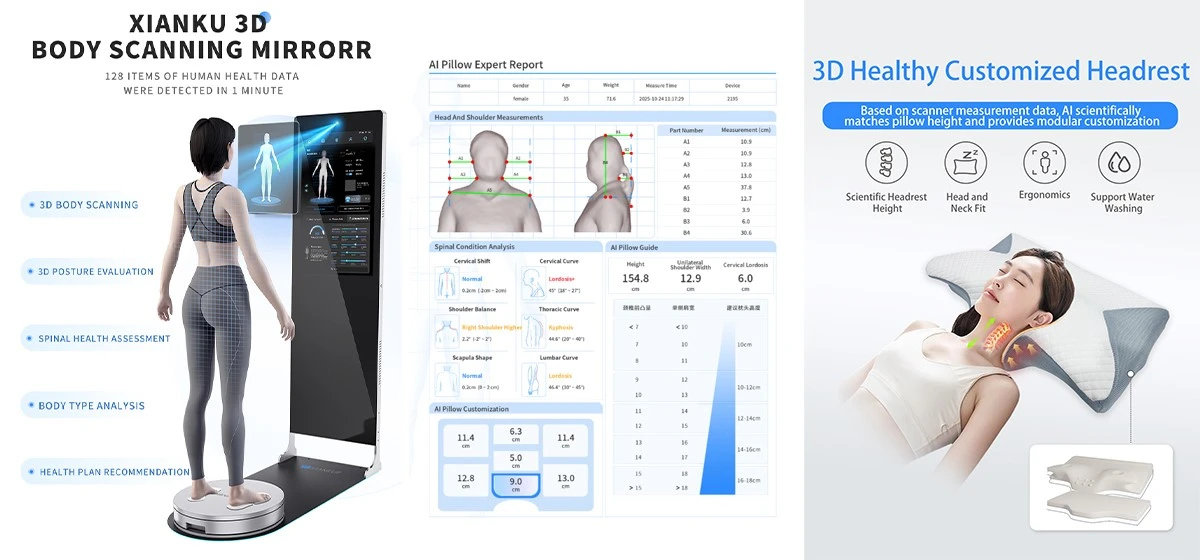
The Xianku3d body scanner represents a fundamental reimagining of hospitality personalization, leveraging advanced 3D structured light technology to create precise digital avatars of guests' anatomy. This technology enables hotels to address sleep health systematically while creating unprecedented operational and competitive advantages.
4.1 Scientific Sleep Assessment and Personalization
The scanner captures 138+ body measurements in seconds, including critical spinal alignment metrics, neck curvature, and shoulder width . This data generates a comprehensive sleep health report that identifies optimal pillow height, firmness, and support zones for each guest-transforming abstract comfort claims into evidence-based recommendations.
The assessment process itself becomes an engaging educational experience. Guests receive visualizations of their spinal alignment and detailed explanations of how personalized support can address their specific sleep issues. This transparency builds trust and demonstrates tangible value, justifying premium pricing for customized sleep solutions.
4.2 Enhanced Guest Engagement and Loyalty Building
The end-to-end workflow-"scan → analysis → AI-generated pillow report → trial → purchase"-creates a memorable journey that fosters emotional connections. A business traveler receiving a custom pillow based on their spinal data is more likely to book the same hotel chain repeatedly, increasing lifetime value and reducing price sensitivity.
This systematic approach addresses the industry's personalization paradox by combining technological precision with hospitality warmth. The scanning process takes minutes but delivers lasting impact, creating a powerful brand differentiator in a market saturated with superficial wellness claims.
4.3 Operational Scalability and Consistency
By standardizing the assessment process, the scanner reduces dependency on individual staff expertise. A single trained employee can operate the system, enabling consistent service quality across locations and supporting rapid franchise expansion-a critical advantage in an industry struggling with service replication.
The technology integrates seamlessly with existing hotel operations, requiring minimal space while delivering maximum impact. The scanning station can be positioned in dedicated wellness areas, executive lounges, or even lobby environments, creating both a functional service touchpoint and a visible brand statement.
4.4 Data-Driven Revenue Diversification
The system enables direct monetization through personalized pillow sales and sleep accessories, tapping into the lucrative sleep health market. Unlike generic retail, these products are validated by individual scan data, justifying premium pricing and increasing conversion rates.
The commercial impact extends beyond direct retail. Hotels can leverage the technology to support tiered pricing strategies, with personalized sleep optimization included in premium room categories or wellness packages. This approach transforms sleep from a standard amenity into a revenue-generating experience.
4.5 Strategic Competitive Differentiation
In a market where new brands struggle to achieve traction, the scanner provides immediate differentiation through demonstrable health benefits. Rather than competing on price or location, hotels can position themselves as sleep science leaders, attracting health-conscious travelers and commanding rate premiums.
The technology creates a sustainable competitive advantage that is difficult to replicate without similar technological capabilities. As consumer awareness of sleep health grows, properties offering evidence-based optimization will increasingly dominate the premium segment.
Table 2: Xianku3d Body Scanner Applications and Benefits
| Application Area | Technical Capabilities | Business Benefits |
|---|---|---|
| Sleep Health Assessment | 138+ body measurements; spinal alignment analysis; pressure point mapping | Evidence-based personalization; justified premium pricing; reduced returns |
| Guest Engagement | Interactive 3D avatar visualization; personalized health reports; AI recommendations | Increased emotional connection; higher satisfaction scores; improved loyalty |
| Operational Efficiency | Standardized assessment protocol; automated reporting; minimal staff training | Consistent service quality; scalable personalization; reduced expertise dependency |
| Revenue Diversification | Custom pillow production; sleep accessory retail; premium package creation | New profit centers; increased ancillary revenue; enhanced lifetime value |
| Competitive Positioning | Technological differentiation; health leadership; unique value proposition | Brand distinction; rate premium justification; market segment leadership |
5. Implementation Framework: Integrating Scanning Technology into Hotel Operations
Successful implementation requires strategic integration across multiple hotel functions:
5.1 Operational Integration Models
Hotels can deploy the technology through various approaches:
- Wellness Concierge Service: Positioning scanners in dedicated wellness areas with trained specialists
- Executive Lounge Enhancement: Offering personalized sleep optimization as a premium benefit
- Check-in Integration: Incorporating basic sleep assessment into streamlined arrival experiences
- Pop-Up Activation: Deploying mobile scanning stations during promotional events or in high-traffic areas
5.2 Staff Training and Role Evolution
The technology enables role elevation from transactional service to health advisory. Frontline staff receive training in basic sleep science and scanner operation, transforming them from room assigners to sleep consultants. This development increases employee engagement while delivering superior guest experiences.
5.3 Data Management and Privacy Compliance
The system incorporates robust data protection protocols, storing guest information securely and complying with global privacy regulations. Hotels can leverage anonymized aggregate data to inform procurement decisions, room configurations, and market-specific offerings without compromising individual privacy.
5.4 Marketing and Positioning Strategy
Successful implementation requires communicating the technological advantage through targeted campaigns that emphasize measurable health benefits over generic comfort claims. Marketing assets can include:
- Case studies demonstrating improved sleep metrics
- Visualizations of the scanning and personalization process
- Testimonials from satisfied guests
- Educational content on sleep science and spinal health
6. Case Studies: Pioneering Wellness Integration in Hospitality
6.1 Canyon Ranch: Comprehensive Wellness Leadership
This Arizona-based pioneer has built its brand around customized wellness programs, offering advanced diagnostic technologies including full-body scanning . While operating in the dedicated wellness segment, its success demonstrates consumer willingness to invest in personalized health optimization-a precedent for mainstream hotels adopting similar technologies.
6.2 Joali Being: Innovative Sensory Integration
The Maldives-based resort has developed unique sensory experiences including sound healing trails and specialized water therapies . Its approach highlights the importance of multi-sensory engagement in wellness hospitality-a principle that extends to sleep optimization through the Xianku3d scanner's immersive assessment process.
6.3 Bürgenstock Resort: Historical Legacy Meets Modern Wellness
The Swiss property combines 150 years of hospitality heritage with a 10,000-square-meter Alpine spa , demonstrating how established hotels can integrate comprehensive wellness offerings. Its scale and scope provide a reference for large-scale implementation of advanced health technologies.
6.4 Waldorf Astoria New York: Luxury Partnership Model
The property's collaboration with Guerlain illustrates how hotels can leverage established wellness brands to enhance their value proposition. The Xianku3d scanner offers a similar partnership opportunity for properties seeking to strengthen their sleep health positioning through recognized technological innovation.
Table 3: Implementation Considerations for Scanning Technology
| Implementation Aspect | Key Considerations | Best Practices |
|---|---|---|
| Technology Integration | Space requirements; system interoperability; data security | Dedicated wellness areas; API integration with property management systems; encryption protocols |
| Staff Training | Technical operation; guest communication; basic sleep science | Certification programs; role-playing scenarios; ongoing skill development |
| Guest Experience Design | Process transparency; educational components; trial opportunities | Visual demonstrations; personalized reports; risk-free testing periods |
| Revenue Management | Pricing strategy; package development; retail integration | Tiered offerings; membership programs; bundled wellness packages |
| Performance Measurement | Guest satisfaction; revenue impact; operational efficiency | Pre/post-implementation metrics; ancillary revenue tracking; operational cost analysis |
7. Future Outlook: The Evolution of Sleep-Optimized Hospitality
The integration of 3D body scanning technology represents the beginning of a broader transformation in hospitality personalization. Several key trends will shape its future development:
7.1 Predictive Sleep Optimization
As hotels accumulate anonymized guest data, they will develop predictive modeling capabilities that anticipate sleep needs before arrival. Returning guests might find rooms pre-configured with their preferred pillow configurations, creating seamless personalization across stays.
7.2 Integrated Sleep Ecosystems
The scanning technology will increasingly connect with in-room environmental controls, adjusting temperature, lighting, and acoustics based on individual sleep patterns and preferences. This integration creates comprehensive sleep environments rather than isolated comfort elements.
7.3 Expanded Health Applications
Beyond sleep optimization, the anatomical data captured by scanners will inform other wellness offerings, including ergonomic workspace configuration, stretch routines, and personalized fitness recommendations-creating holistic health ecosystems within hotel environments.
7.4 Subscription-Based Personalization
Hotels may develop subscription models offering regular pillow refreshes, at-home sleep optimization kits, and continuous sleep monitoring-extending the guest relationship beyond individual stays and creating recurring revenue streams.
8. Conclusion
The global hotel industry's future lies not in more luxurious amenities or aggressive pricing, but in intelligently personalized experiences that address fundamental human needs. Sleep-which consumes nearly one-third of every guest's stay-represents the most significant yet most neglected opportunity for meaningful differentiation.
The Xianku3d body scanner provides a technologically sophisticated yet operationally practical path toward this personalization future. By offering scientific sleep assessment, customized solutions, and enhanced guest engagement, it enables hotels to transcend price competition while building lasting consumer relationships.
As the hospitality market continues to fragment and evolve, properties that embrace evidence-based personalization will increasingly define the premium segment. The revolution in hotel sleep experiences is just beginning-and the early adopters stand to gain the most in this new era of personalized wellness hospitality.
(86)-181-2464-3821
alexliu@xianku.com