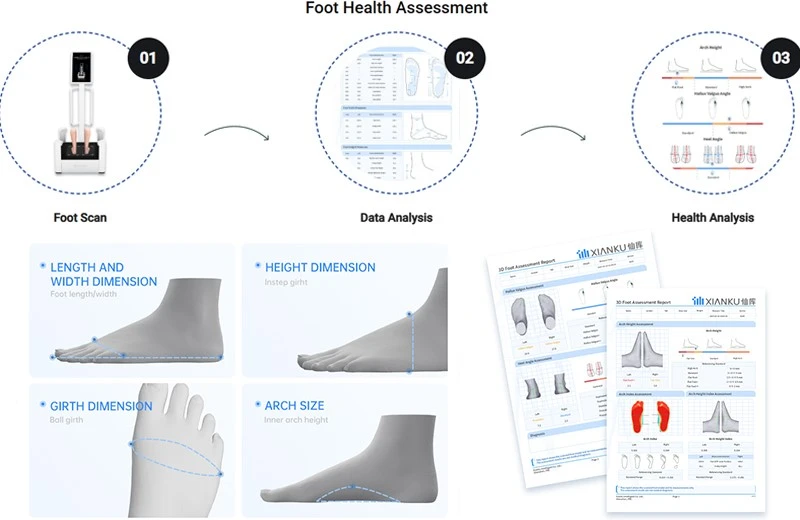
European podiatry stands at a pivotal moment. With an aging population, rising diabetes rates, and increasing demand for preventive care, podiatry clinics across the continent are seeking technologies that enhance diagnostic precision while improving patient engagement. The Xianku 3D Foot Scanner represents a fundamental shift in how foot health is assessed, documented, and treated.
The State of Podiatry in Europe
Europe's podiatry landscape is diverse but shares common challenges. The European Federation of Podiatrists represents over 40,000 practitioners across 25 countries, serving a population increasingly aware of foot health's impact on overall wellbeing.
Key demographic trends affecting European podiatry:
| Trend | Impact on Podiatry Practice |
|---|---|
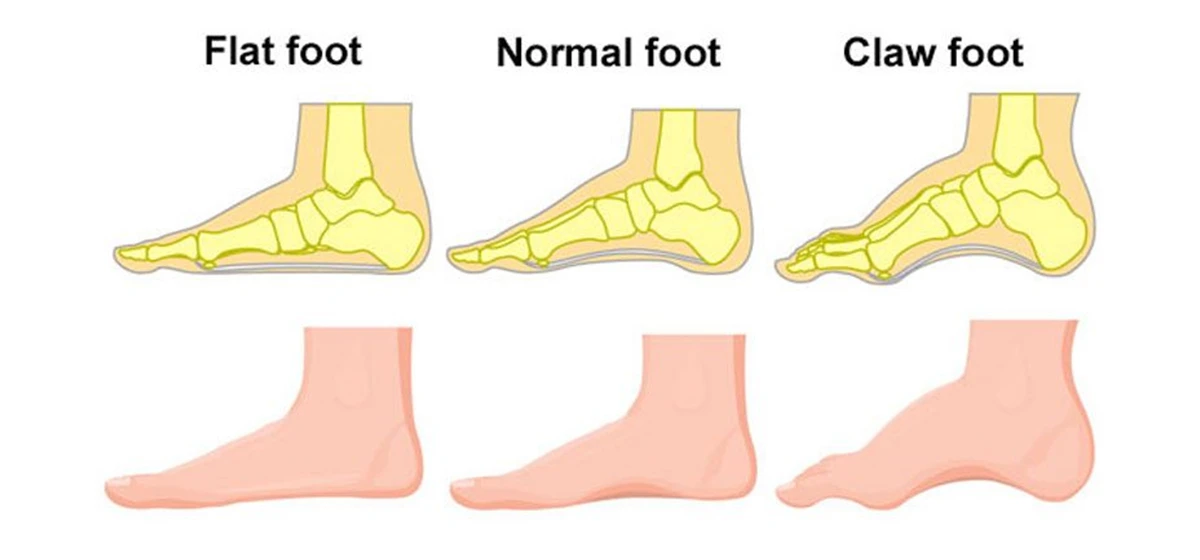
| Aging population | 20-25% of adults affected by flat feet; arch collapse accelerates with age |
| Rising diabetes rates | 60+ million European adults diabetic; 34% develop foot ulcers without intervention |
| Preventive health focus | Patients seek early intervention rather than reactive treatment |
| Digital health adoption | Expectation of technology-enhanced consultations |
Traditional Assessment Limitations
Despite growing demand, most European podiatry practices still rely on assessment methods with significant limitations:
Visual observation remains the primary tool for postural assessment, yet studies show manual assessments can vary by 15-40% between practitioners. A patient's flat foot classification might change depending on which clinician they see.
Manual measurements with tape and goniometers are time-consuming, typically capturing only 5-10 data points in 15-20 minutes. They miss critical parameters like arch volume, heel inclination angles, and dynamic pressure distribution.
Plaster casting for orthotics introduces distortion and requires 30-45 minutes per patient, with remake rates of 20-30% due to material shrinkage and positioning errors.
Patient communication suffers when practitioners rely on verbal explanations. Abstract concepts like "overpronation" or "forefoot varus" are difficult for patients to visualize, reducing treatment compliance.
The Xianku Solution: Precision Measurement at Scale
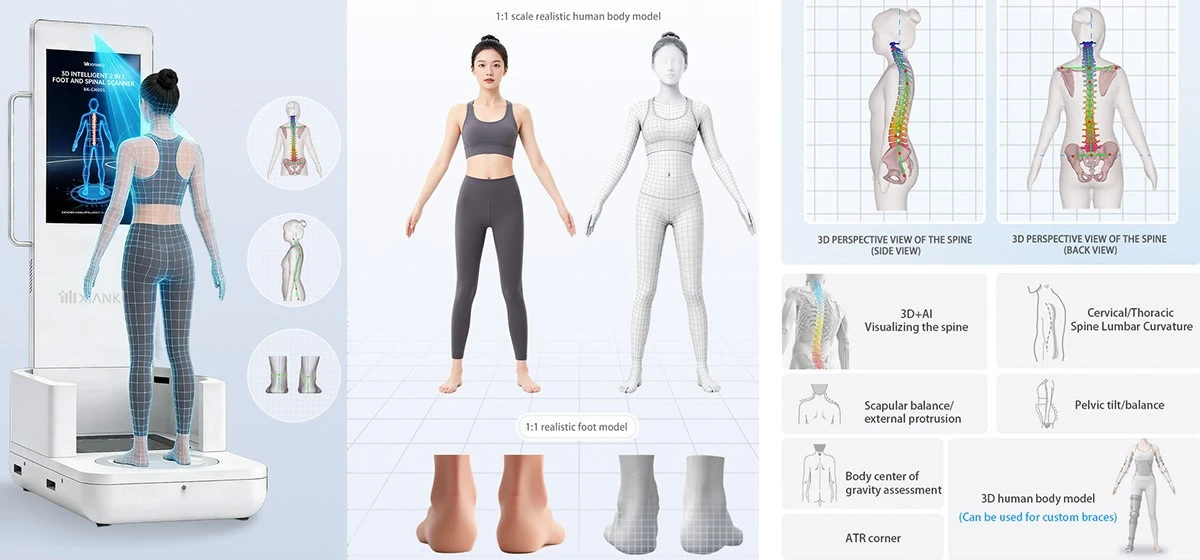
The Xianku 3D Foot Scanner addresses these limitations through advanced technology designed for clinical environments:
Infrared structured light scanning captures 2 million data points in just 1 second, creating a precise 1:1 digital twin of the patient's foot with ±0.5mm accuracy. Unlike laser scanners requiring 20+ seconds, Xianku's multi-camera array eliminates motion artifacts and ensures stability.
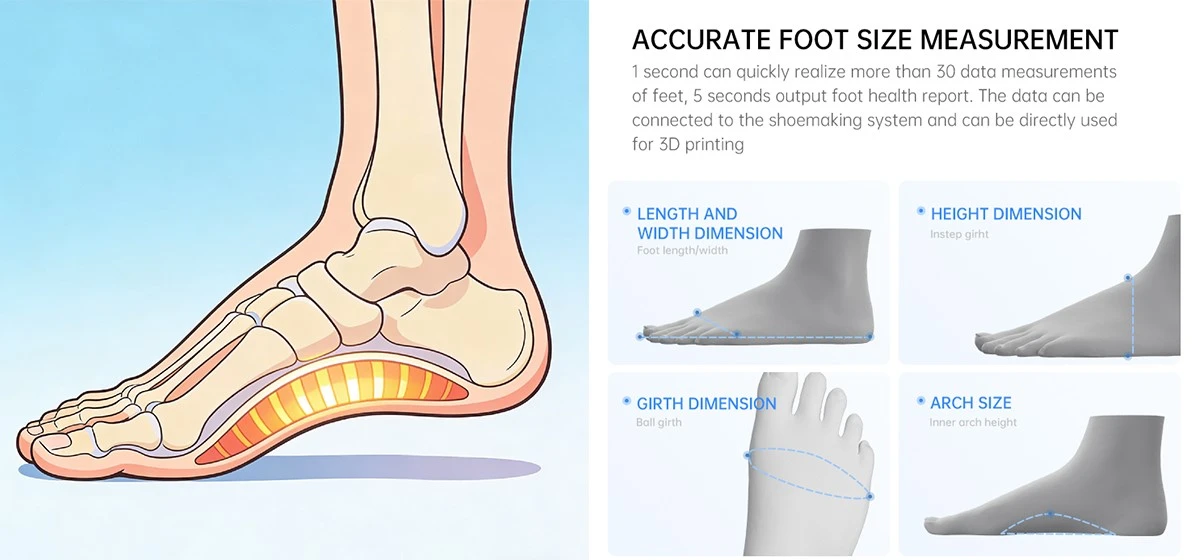
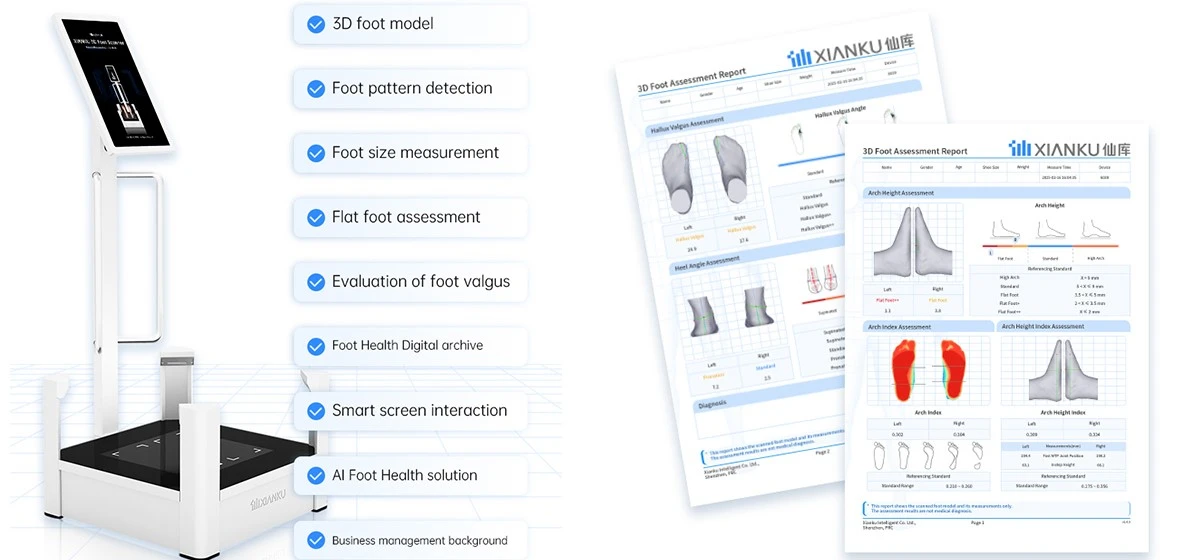
Comprehensive parameter capture includes 30+ anatomical measurements essential for clinical diagnosis:
| Parameter Category | Specific Measurements | Clinical Significance |
|---|---|---|
| Static Morphology | Foot length/width, arch height, metatarsal girth | Basic sizing, structural assessment |
| Pathology Indicators | Hallux valgus angle, heel inclination (varus/valgus), arch index | Diagnoses bunion severity, pronation/supination |
| Pressure Distribution | Plantar heatmaps identifying high-pressure zones | Diabetic ulcer risk, metatarsalgia |
| Biomechanical Axes | Leg alignment angles | X/O-leg assessment, gait implications |
Arch Index (AI) classification is particularly valuable: Pes Planus (AI>0.26), Neutral (0.21–0.26), Pes Cavus (AI<0.21). This objective classification replaces subjective "flat foot" judgments.
Hallux Valgus Angle (HVA) measurement enables precise bunion staging: Mild (15°–20°), Moderate (21°–39°), Severe (>40°).
Clinical Workflow Integration
The Xianku system integrates seamlessly into existing podiatry workflows:
Initial consultation (15 minutes total):
- Patient completes intake forms (5 min)
- 1-second foot scan captures complete data
- Automated report generation (5 seconds)
- Practitioner reviews findings with patient using 3D visualization
Follow-up visits (10 minutes):
- Quick rescan documents changes
- Automated comparison with baseline
- Objective tracking of treatment effectiveness
European Regulatory Compliance
For European podiatry practices, regulatory compliance is essential. The Xianku 3D Foot Scanner meets stringent EU requirements:
- CE marking as a medical device
- GDPR compliance with data encryption and European residency options
- Biocompatibility certification for all patient-contact materials
Case Example: German Podiatry Practice Transformation
A multi-location podiatry practice in Bavaria implemented Xianku scanning across three clinics in early 2025. After six months:
- New patient consultations increased 35% (technology as differentiator)
- Orthotic prescription compliance improved 58% (patients understood their needs)
- Follow-up appointment adherence increased 40% (visual progress motivated continued care)
- Insurance documentation acceptance improved (objective measurements supported claims)
The practice director noted: "Before Xianku, I spent 20 minutes per patient on manual measurements and still wondered if I'd missed something. Now I have complete data in one second, and my patients actually understand their conditions. It's transformed both my clinical confidence and my patients' outcomes."
The Business Case for European Podiatry
| Revenue Stream | Traditional Model | With Xianku |
|---|---|---|
| Initial consultation | €80-120 | €120-180 (including scan) |
| Orthotic prescription | €300-600 | €300-600 (higher acceptance) |
| Progress scans | Not offered | €30-50 add-on |
| Monitoring packages | Limited | €150-300/year |
Practices report payback periods of 3-6 months on their Xianku investment.
Conclusion
For European podiatry practices, 3D foot scanning is no longer optional-it's the new standard of care. The Xianku 3D Foot Scanner provides the precision, efficiency, and patient engagement tools that modern podiatry demands, while meeting Europe's rigorous regulatory requirements.
Call to Action: Ready to transform your podiatry practice? Contact Xianku today for a personalized demonstration and ROI analysis tailored to your European clinic.
Sources:
Xianku clinical applications data
European foot health statistics
Xianku practice implementation case studies